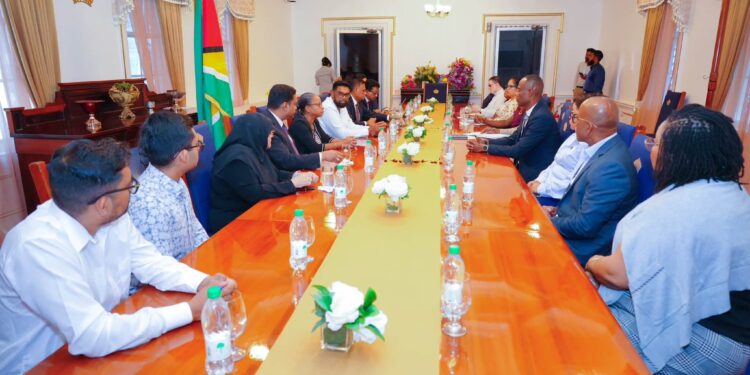
President Dr Mohamed Irfaan Ali is urging public transportation providers and other stakeholders to act responsibly and avoid excessive fare increases as global fuel prices continue to rise due to ongoing instability in the Middle East and disruptions in international transport systems.
In a statement on Tuesday, the president said Guyana, despite being a major crude oil producer, still relies heavily on imported refined fuel products and is therefore affected by rising international energy prices.
He noted, however, that the government has spent hundreds of billions of dollars over the years to shield consumers from the full impact of inflationary pressures stemming from global fuel market fluctuations.
“You would recall that the Government of Guyana removed the excise tax on imported refined products to zero,” President Ali stated.
According to the head of state, the removal of the excise tax has resulted in savings of more than $100 billion annually for consumers, helping to keep fuel prices significantly below increases being experienced globally.
He explained that the policy translated into approximately $500 in savings on every gallon of diesel or gasoline purchased by consumers.
The president said minibus operators, taxi services, speedboat operators, truckers, farmers and businesses all benefited substantially from the zero-rated excise tax.
“For minibuses operating in Georgetown and consuming an average of more than 12 gallons of fuel per day, the policy delivered savings of about $6,000 per day directly,” he explained.
Despite those interventions, President Ali pointed out that there had been no corresponding reduction in transportation fares when fuel prices previously declined as a result of government measures.
As a result, he said the government now expects transport operators and suppliers of public services to demonstrate social responsibility during the current period of global volatility.
“We expect that all of the operators will reduce their profit lines so as to mitigate that impact,” the president stated.
He added that since March 2026, the government has also been subsidising diesel and gasoline through measures aimed at reducing profit margins within the fuel supply chain to help stabilise the local market.
The president noted that state-owned fuel supplier GUYOIL has already reduced its profitability significantly in an effort to maintain balance in fuel prices locally.
President Ali further explained that the current global crisis is not due to a shortage of fuel supply, but rather challenges associated with the movement and transportation of fuel products internationally.
He called on importers of refined products and transportation providers to work alongside the Government in protecting consumers from additional economic pressure.
The head of state also outlined several long-term measures being pursued to strengthen Guyana’s energy security and reduce freight costs.
Among those initiatives are plans to improve port infrastructure and dredge the Demerara River to accommodate larger vessels, which would reduce shipping costs and improve economies of scale.
Additionally, the government is actively engaging potential investors interested in establishing an oil refinery in Guyana to provide greater supply security and price stability in the future.
President Ali said the administration remains committed to using every available policy tool to cushion citizens from international economic shocks while pursuing long-term solutions to strengthen the country’s energy and transport systems.
Department of Public Information