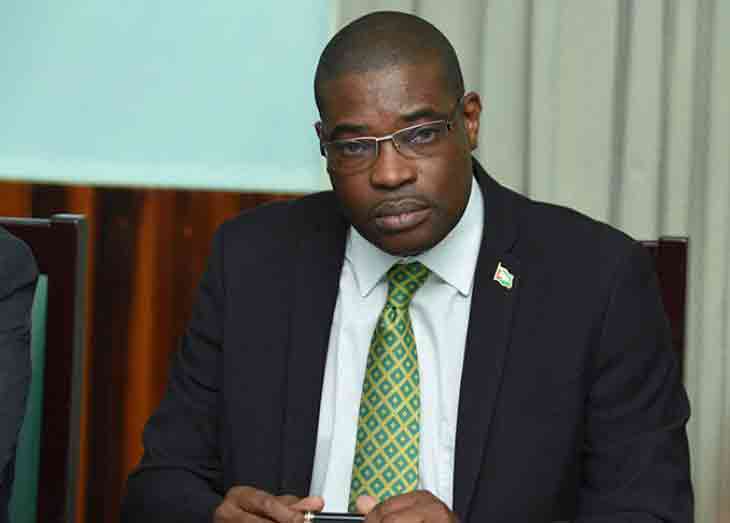
Former People’s Progressive Party (PPP) minister, political scientist Dr. Henry Jeffrey has argued that Guyana remains trapped in the same political dysfunction that marked the country’s Independence era nearly six decades ago, warning that the nation’s recurring crises will persist until a system of “ethnically inclusive democratic governance” is established.
Writing in his Future Notes column published May 10 under the title “Climate change, AI, co-operatives and freedom,” Jeffrey contended that Guyana’s longstanding complaints about “growing autocracy, inequalities in the presence of substantial wealth, unaccountable governance, incompetence, corruption etc.” are symptoms of a deeper unresolved political problem rooted in ethnic exclusion and winner-take-all governance.
“The rate of these types of complaints might have increased but have been there all this time and will continue until a way is found to establish ethnically inclusive democratic governance in Guyana,” Jeffrey wrote.
His intervention comes amidst Guyana preparing to commemorate its 60th Independence Anniversary on May 26 and renewed national debate over governance, accountability, corruption, political polarization, and constitutional reform.
Central to Jeffrey’s argument is the concept of “inclusionary democracy,” which was incorporated into Article 13 of Guyana’s Constitution following major constitutional reforms in 2001, though many governance advocates contend that limited legislative and structural measures have since been implemented to fully operationalise the principle.
Article 13 states that the principal objective of the political system is to establish “an inclusionary democracy” by providing increasing opportunities for citizen participation in the management and decision-making processes of the state.
Those constitutional reforms emerged after years of political unrest, nationwide agitation, street protests, ethnic tensions, and intervention by the Caribbean Community (CARICOM), which facilitated dialogue between political stakeholders following the disputed 1997 General and Regional Elections.
Despite the constitutional changes, constitutional reform advocates, trade unionists, and activists have long argued that successive governments failed to enact the legislative and structural reforms necessary to give practical meaning to inclusionary democracy.
For more than two decades, veteran trade unionist Lincoln Lewis, the Guyana Trades Union Congress (GTUC), and other civic voices have consistently advocated for meaningful shared governance and inclusive constitutional arrangements to reduce ethnic political conflict and strengthen democracy.
Jeffrey’s article situates Guyana’s governance dilemma within wider global concerns about autocracy, inequality, climate change, and the rise of artificial intelligence.
He argued that liberal democracy has failed to fully realize human freedom and warned that growing global instability is creating conditions conducive to authoritarianism.
“I have argued before that the intrinsic humanist possibilities of ‘democracy’ have not been allowed to fully develop globally and that until such time as it does the threat of autocratic revival will remain,” Jeffrey wrote.
He linked those concerns to climate change and artificial intelligence, describing both as existential challenges requiring societies to rethink economic systems, labour, and democracy itself.
Referencing a 2025 Global Footprint Network Report, Jeffrey noted that humanity is consuming natural resources at unsustainable rates.
“Humanity is using the earth’s resources 1.7 times faster than its biocapacity can regenerate,” he wrote, adding that if global populations consumed at the level of average Americans, “5 earths” would be required.
Jeffrey also explored the implications of artificial intelligence replacing human labour, referencing warnings from renowned physicist Stephen Hawking that advanced AI “could spell the end of the human race.”
However, Jeffrey suggested that AI, if embedded within democratic and cooperative economic systems, could instead reduce compulsory labour, improve equality, and expand human freedom.
Drawing heavily on the writings of Karl Marx, Jeffrey argued that cooperative economic systems and democratic control of production may become increasingly relevant in a future shaped by automation and ecological pressures.
He also invoked the legacy of Hubert Nathaniel Critchlow, the Father of Trade Unionism in Guyana and the British Empire and honoured as Guyana’s second National Hero, to illustrate the historical resistance faced by labour and emancipatory movements.
Jeffrey recalled that after Critchlow reportedly expressed supportive views about the Soviet Union following a 1932 visit, sections of the colonial establishment reacted harshly.
“The Guyanese bourgeoisie heard that on his way home via the West Indies from a visit to the Soviet Union in 1932… Critchlow was making supportive noises of the situation in the Soviet Union, and the local press commented: ‘We believe all he has said of his experiences and wish to assure him that if and when it suits him we will accommodate him in a cell!’”
Against the backdrop of Guyana’s approaching Independence anniversary, Jeffrey’s analysis revives longstanding questions about whether the country can achieve genuine national cohesion, democratic stability, and equitable development without fundamentally restructuring its political system to accommodate ethnic inclusion, shared governance, and broader citizen participation.