GUANGZHOU, April 30 (Xinhua) — At first glance, it appeared to be a routine cleaning job. Then a wheeled robot rolled in beside 43-year-old cleaner Lei Xiaoli, extending a mechanical arm to collect scattered rubbish.
For Lei, it was not a case of replacement, but the start of a new working partnership. She is learning to share her duties with a machine designed to navigate the clutter and unpredictability of a real home.
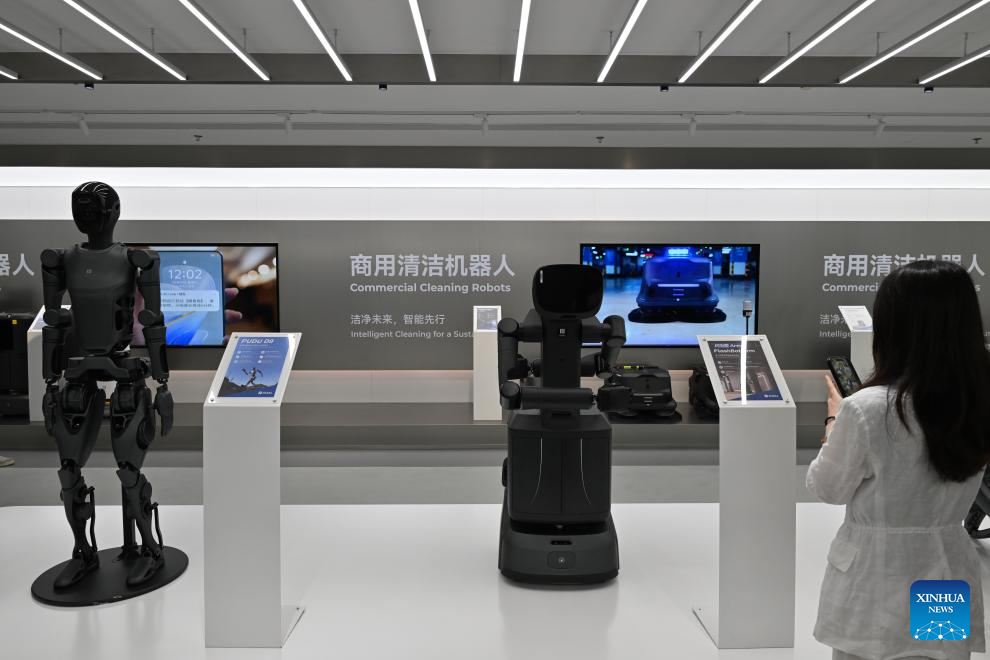
The robot, mounted on a wheeled base and equipped with two mechanical arms, is part of a home-cleaning service launched in March by Shenzhen-based startup X Square Robot in partnership with home services platform 58.com.
Priced at 149 yuan (about 22 U.S. dollars) for a three-hour session, the service divides tasks between human and machine. The robot handles basic chores such as picking up trash, organizing shoes and toys, and replacing garbage bags, while the cleaner focuses on more detailed work in kitchens, bathrooms and bedrooms, as well as interacting with clients.
“The first time I saw it, I was very curious and kept watching it work,” Lei said. After more than 20 sessions together, Lei said she has grown used to the collaboration, and the robot is becoming more capable.
“It can identify areas that need cleaning on its own, which reduces my workload,” she said.
Some early customers in Shenzhen have been quick to give the service a try.
One customer, Ge Landong (pseudonym), deliberately scattered household waste across his living room to test the robot’s abilities.
“Whether it was a banana peel or small chicken bones, it could accurately recognize, pick them up and throw them into the trash,” he said. “Its perception and precision exceeded my expectations.”
Still, there are some limitations. Ge noted that the robot is relatively bulky, so it cannot access tight spaces, and it can only handle simple tasks, meaning a human cleaner still needs to follow up. An engineer is also present during service visits to make sure everything runs smoothly.
X Square Robot acknowledged the constraints in a social media post on April 15, saying the robot currently moves more slowly than humans and still needs improvement in adapting to complex home environments.
The company said it also launched the service in Beijing on April 21 and plans to expand it to more cities, with a goal of deploying 1,000 units by 2026.
The trial points to a silent evolution under way: in the era of embodied AI, robots are not just demonstrating what they can do, but learning to work in everyday life scenarios.
“Home environments are far more complex and dynamic than factories. They are, in a sense, the ultimate testing ground for robots,” said Liu Shaoshan, an embodied AI expert at the Shenzhen Institute of Artificial Intelligence and Robotics for Society.
Liu said China holds advantages in hardware supply chains, rapid product iteration and the diversity of real-world application scenarios — factors that allow companies to improve systems more quickly through real-world feedback.
Beyond household cleaning, he said, robots could play a role in elder care, providing companionship and daily support in a sector long constrained by labor shortages.
Positioned as a future industry in China’s latest five-year plan, embodied AI is set for a new growth drive. According to a Morgan Stanley report, China’s robotics market is projected to grow from 47 billion U.S. dollars in 2024 to 108 billion U.S. dollars by 2028, with service robots achieving a compound annual growth rate of 25 percent.
Across China, provincial-level regions are stepping up efforts to develop the sector. In Guangdong Province, output of service robots rose 11.2 percent in 2025, accounting for about 80 percent of the national total. In Beijing, production surged 47.6 percent year on year, reflecting strong momentum in the sector.
Industry insiders say as robots take on more routine tasks, what remains for humans — judgment, adaptability and interaction — may become more central to the nature of work. How that balance evolves could shape not only the future of cleaning jobs, but how people and machines coexist in everyday life.
For Lei, the change is already having a tangible impact in the real world.
“I hope it can learn to clean windows or carry heavy items,” she said. “That would reduce physical strain and safety risks for us.”
She is not worried about being replaced. “There will always be things I can do better, at least for now.”