

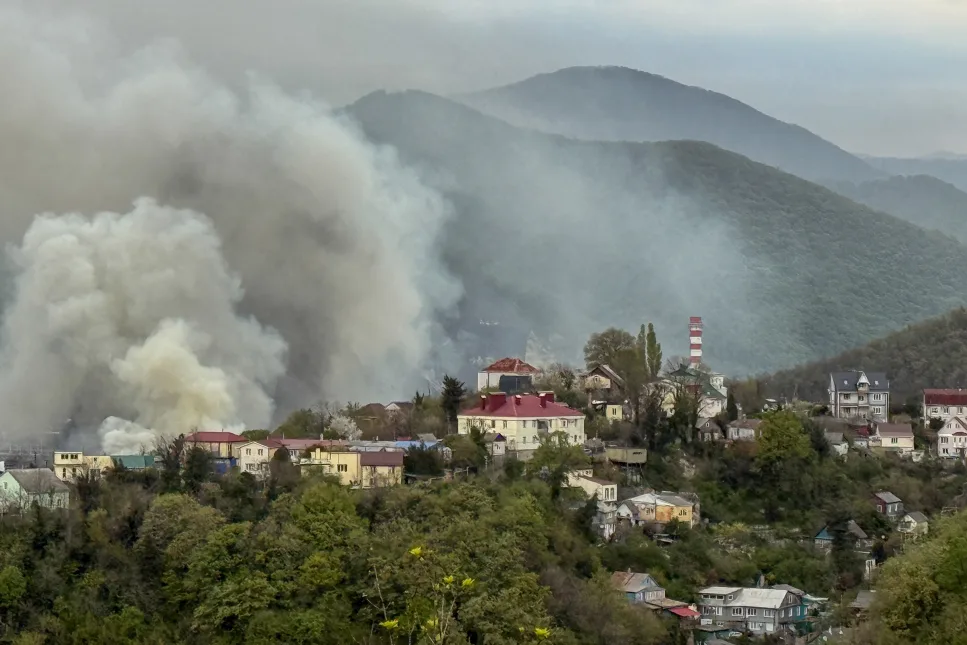
CNN News – For the third time in 12 days, the Russian Black Sea town of Tuapse woke up Tuesday to apocalyptic scenes.
Thick toxic fumes, and flames rising up from the latest Ukrainian drone attack on the Rosneft-owned Tuapse oil refinery, almost reached the heights of the surrounding Caucasus mountains.
By Thursday morning, authorities said the fire had been extinguished. Fires from the two previous attacks, on April 16 and 20, also took days to put out, with toxic substances pouring down in black rain and blanketing cars and streets in oily grime, leading to what experts are dubbing the worst environmental disaster in the region in years.
“The city is choking on smoke,” one resident said on social media.
Located around 70 miles northwest of Sochi, which hosted the 2014 Winter Olympics, Tuapse is part of the subtropical resort area along the Black Sea coast, once known as the “Russian Riviera” thanks to its popularity among Russians as a summer holiday destination. The town’s refinery, attached to a marine terminal, is a key oil-processing and export hub for Russia, and has been repeatedly targeted by Ukraine in recent months.
“Oil is literally falling from the sky. We can’t breathe. The entire city reeks of fuel oil, dripping onto cars,” Elmira Ayrapetyan, an entrepreneur who runs a branding agency in nearby Krasnodar and came to Tuapse to help with the clean-up, told CNN.
Volunteers have come together here partly because it took almost two weeks – and three attacks in quick succession – for regional and federal authorities to react.
On Tuesday, the Kremlin acknowledged the situation for the first time, and President Vladimir Putin dispatched his emergencies minister Aleksandr Kurenkov to the scene to coordinate the fire response. “The situation is not easy, but it’s controllable,” the minister said.
The governor of the Krasnodar region had used the same wording earlier that day as he surveyed the damage, flames and smoke still billowing into the streets.
‘Real environmental catastrophe’
Putin used the disaster as an opportunity to repeat well-worn accusations against Ukraine of carrying out “terrorist attacks” against Russian civilians and energy infrastructure.
In a late-night security meeting Tuesday, he said that strikes on Tuapse “could potentially cause serious environmental consequences” but added that “it seems there are no serious threats; people are dealing with the challenges they face on the spot.”
Environmental experts take a somewhat different view.
“It’s a real environmental catastrophe, regional in scale at a minimum. There hasn’t been anything like this for several years,” ecologist and opposition political activist Yevgeny Vitishko told CNN in an interview conducted before Tuesday’s attack.
Satellite images and social media video verified by CNN show the oil has spilled into the Tuapse river and the sea, with parts of Russia’s southern Black Sea coast still blackened by fuel oil, though part of the main beach in Tuapse appeared to have been cleaned by Tuesday.
CNN analysis of satellite imagery from Sunday, before the latest attack, shows traces of oil have spread at least 50 kilometers (31 miles) from the shore. Russia’s emergencies minister announced Tuesday that barriers would be placed “soon” to prevent “potential leaks into the sea.”
“What’s important here is that the situation unfolding in Tuapse involves contamination across multiple environments at once: the air, the soil over a large area, the river that runs through the city, and the Black Sea,” Russian ecologist Dmitry Lisitsyn told CNN. “This is a highly complex environmental disaster, the true scale of which is still difficult to assess at this stage.”
He also compared the rare sight of oil-saturated rain to the events in Iran last month, when airstrikes hit an oil depot in its capital Tehran, causing burning fuel to evaporate into toxic smoke, and later oil-filled rain. “For petroleum residues to fall from the sky in clumps – what you might call ‘oil rain’ – is extremely rare,” he said.
“We will definitely see a surge in respiratory diseases and, most likely, oncological ones in the future,” said Vitishko, a Tuapse resident who also heads a working group on ecology under the governor’s office. He further speculated that carcinogens could accumulate in the body, especially through water. The Kremlin deflected a question from CNN on Wednesday about the longer-term health implications of the oil contamination.
Vitishko said faster action should have been taken “at a minimum to isolate children, kindergartens, schools.” Local authorities did evacuate residents in the areas close to the refinery Tuesday, but health officials only issued advice on staying indoors and wearing masks two days after the second attack. City-wide school closures were announced for Tuesday and Wednesday this week, though some kindergartens stayed open.
Kremlin spokesman Dmitry Peskov told CNN on Wednesday it was “too early to assess” whether the authorities should have acted quicker to prevent environmental and health risks.
Ukraine escalating energy attacks
Ukraine acknowledged carrying out all three attacks on the refinery “as part of efforts to reduce the military and economic potential of the Russian aggressor,” in a statement issued by the General Staff after Tuesday’s strike.
Kyiv has for months been escalating long-range drone attacks against critical Russian energy infrastructure, to try to reduce Moscow’s war budget, and complicate military logistics. It has continued, and even ramped up further as Moscow has profited from the disruption to global energy supplies caused by the US-Israeli war with Iran, even amid “signals” from some of its allies that it should scale back, Ukraine’s President Volodymyr Zelensky told journalists in late March.
“If Russia is ready to stop targeting Ukraine’s energy sector, we will not retaliate against its energy sector,” he said. Russia’s repeated attacks on Ukraine’s power infrastructure have caused widespread outages, worsening over four winters at war.
On Thursday, columns of smoke rose over another Russian city, as energy infrastructure in Perm, some 900 miles from the Ukrainian border, came under attack for a second day. Kyiv confirmed on Wednesday it had hit an oil pumping station there. The Perm governor confirmed a drone attack on “one of the industrial sites.”
The Tuapse refinery was already “effectively offline” after previous Ukrainian drone attacks last fall, said Sumit Ritolia, a senior manager at commodities intelligence firm Kpler in written comments to CNN. These latest attacks will “delay restart timelines and constrain product handling and exports even once operations resume.”
For local entrepreneur Ayrapetyan, who helped coordinate volunteers during a previous Black Sea disaster, when two tankers leaked their cargo into the sea near Anapa in late 2024, this is all too familiar.
“We in Anapa had to wait two weeks for the Emergencies Ministry to arrive,” she told CNN, adding she believes the situation in Tuapse is much worse and would require a significantly larger response effort.
“It’s a sea of fuel oil,” she said. “The city has not received the amount of help it needs.”
For ecologist Lisitsyn, the lack of information is equally concerning. “Forty years after the Chernobyl disaster, nothing has changed… There was little to no information about the level of pollution and its spread to the population then, and it’s very similar now.”
CNN’s Farida Elsebai contributed to this report.