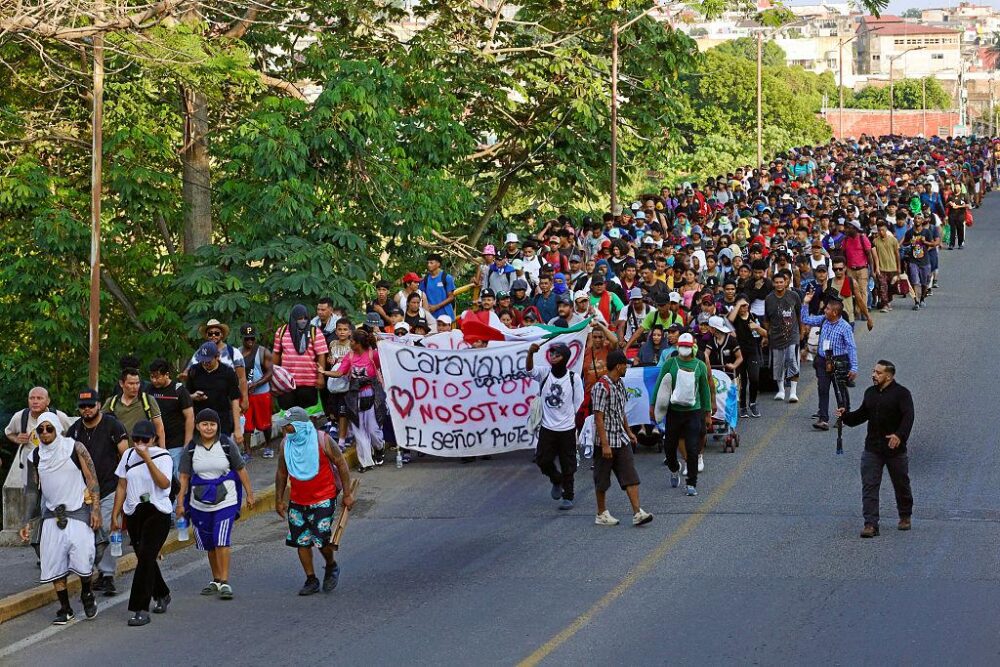
A caravan of approximately 1,500 migrants, including families with young children from Central America and other parts of the region, is travelling north through southern Mexico in the hope of reaching the United States, amid renewed uncertainty over Washington’s immigration policies.
The group, which departed Tapachula, in Mexico’s southern Chiapas state, near the Guatemalan border on Tuesday, November 10, is encouraged by the recent Democratic victory in the US midterm elections, which has raised hopes among migrants that the political shift could eventually create more welcoming immigration policies.
According to Reuters, the migrants have named their movement Dios con Nosotros (God With Us). Many are carrying their belongings in backpacks, while parents transport young children in strollers or carry them in their arms and on their shoulders.
The caravan is initially seeking to reach Mexico City, more than 1,000 kilometres away, where participants hope to obtain assistance and protection from detention as they continue their journey north.
Tapachula has long served as a major transit point for migrants attempting to reach the United States. However, tighter US immigration restrictions and deportations have left thousands stranded in the Mexican city, with limited access to employment, healthcare and education.
Migrants see political opportunity after US elections
The Democratic gains in Congress have given some migrants renewed optimism that immigration policy could change, despite President Donald Trump’s continued hard-line approach to border enforcement.
Reuters quoted Cesar Sandoval, a 47-year-old Nicaraguan national who was deported from the United States several months ago, expressing hope that the political changes could offer migrants another opportunity.
“There might be a light at the end of the tunnel, a way for us to get in,” Sandoval said.
He added that migrants believed Democrats could help them.
The group includes people fleeing poverty, unemployment, insecurity and violence in their home countries. Some have also reported experiencing kidnapping and other forms of violence during their journeys.
However, analysts have cautioned that the Democratic victory does not mean an immediate change in immigration policy, particularly while Trump remains president.
Trump threatens to double tariffs on Mexico
The developing caravan has prompted a strong reaction from Trump, who on Thursday threatened to immediately double existing US tariffs on Mexican goods unless Mexico stops the migrants from reaching the American border.
Trump declared that the migrants would not be allowed into the United States and warned that Mexico would face economic consequences if it failed to prevent their passage.
The threat adds another layer of tension to relations between Washington and Mexico City, which are already navigating trade negotiations and disagreements over immigration enforcement.
Mexican President Claudia Sheinbaum confirmed that migrants were moving north through her country but rejected Trump’s characterisation of the situation.
She said no migrant caravan had reached the US border since Trump returned to office in January 2025.
Sheinbaum also said Mexican authorities were working to discourage migrants from continuing the journey, while ruling out the use of force to break up the groups.
Reaching the US remains uncertain
Despite the migrants’ optimism, their journey faces considerable obstacles.
The caravan must cross a substantial portion of Mexico before reaching the US border, and there is no guarantee that its members will be granted permission to enter the United States or obtain asylum.
The political shift in Congress also does not automatically translate into an immediate reversal of existing immigration restrictions.
For the migrants travelling north, however, the Democratic victory has provided renewed hope that opportunities for legal entry, employment and protection could eventually emerge.
For now, their journey continues against the backdrop of heightened immigration enforcement, growing US-Mexico tensions and uncertainty over the future direction of American immigration policy.