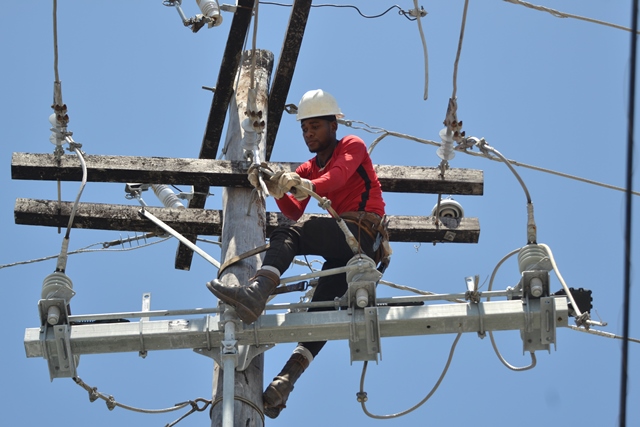
More than three hours. That is how long large sections of Demerara were plunged into darkness today — businesses stalled, homes overheated, internet connections collapsed, and work interrupted — all in a country now swimming in billions from oil.
And once again, the official explanation from Guyana Power and Light was not institutional failure, not weak grid resilience, not poor systems planning, but an external event: roadworks equipment making contact with a transmission line. Earlier, the country was told wildlife — including the now infamous raccoon explanation — was behind disruptions. Today it is machinery. Tomorrow, who knows? At what point does the nation stop accepting excuses and start demanding competence?
To our readers at Village Voice News, we extend an apology for delays in publishing today. Like thousands of Guyanese, our operations were disrupted by the now all-too-familiar collapse of electricity service. In 2026, in one of the fastest-growing oil economies in the world, this should not be normal. But it has become normal.
What makes this crisis more infuriating is that Guyana is not poor. The country’s oil revenues have transformed state finances. Billions of US dollars have flowed from the ExxonMobil-led offshore operations into the Natural Resource Fund, while citizens are told to celebrate “development” and “prosperity.” Yet basic infrastructure — the backbone of any modern society — remains frighteningly fragile.
Modern power systems around the world do not rely on luck. They invest in grid redundancy, underground transmission in high-risk corridors, automated fault isolation systems, vegetation and hazard management, predictive maintenance, and real-time infrastructure monitoring. These are standard protections against precisely the kind of disruptions Guyanese now endure as routine.
Today’s blackout was triggered after roadworks equipment hit a high-voltage line, according to GPL, causing major service interruptions across Demerara. But the deeper issue is not the trigger — it is the vulnerability. A single point of contact should not cripple the capital. That is the mark of a weak system.
This falls squarely at the feet of President Irfaan Ali and Prime Minister Mark Phillips, whose administration has repeatedly boasted about transforming Guyana into a modern powerhouse. Yet for ordinary citizens, the lived reality remains flickering lights, damaged appliances, interrupted businesses, and daily uncertainty.
Heads must roll. Not just at GPL, but at the policy level where this culture of excuses is tolerated, defended, and normalised. Accountability cannot stop at the technician or the line worker. It must reach the boardroom, the ministry, and the Cabinet. If there is no accountability, there will be no improvement. Guyana’s oil wealth was supposed to lift standards, not finance mediocrity.
It is not enough to point fingers at a contractor, an animal, or a technical glitch. Governance means building systems that can withstand accidents, human error, and external shocks.
What Guyanese are being conditioned to accept is mediocrity wrapped in public relations. And that is dangerous. A nation cannot build world-class hospitals, schools, industries, or digital services on a third-rate electricity system. Investors notice. Citizens suffer. Productivity dies in the dark.
The time has come for society — business leaders, labour, civil society, and ordinary citizens — to stop normalising failure. Oil wealth must translate into modern infrastructure, not endless apologies and explanations. Guyana is too rich to be this powerless. And Guyanese deserve far better than darkness as a way of life.