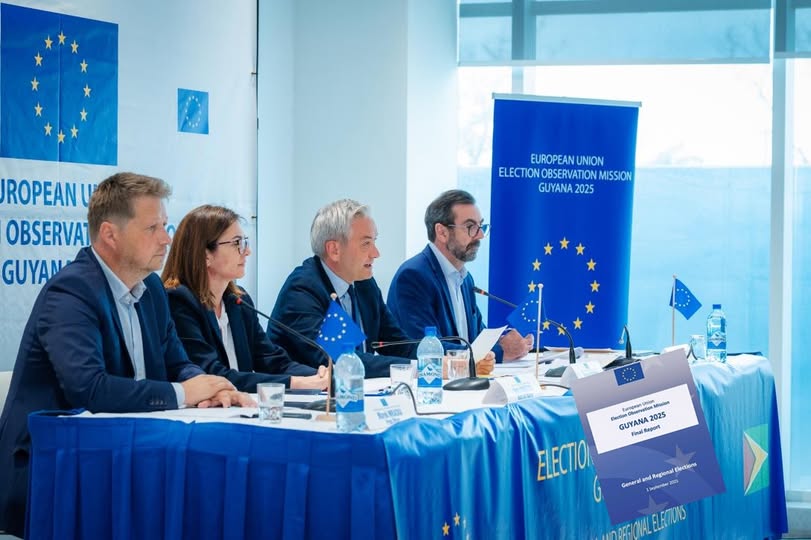
By Mark DaCosta-The A Partnership for National Unity (APNU) has emphasised the urgent need for the government to act on the troubling recommendations outlined in the European Union (EU) Election Observer Mission report for the 2025 General and Regional Elections. The findings highlight critical inadequacies within our nation’s electoral framework that, if unaddressed, could further jeopardise the integrity of democracy in our country.
The EU has recommended reforms to strengthen the credibility of the electoral system, including improving the accuracy and transparency of the voters’ list, introducing clearer rules on campaign financing and the use of state resources, and ensuring more balanced media coverage. The report also called for legal and institutional updates, stronger oversight of digital campaigning, and measures to enhance inclusion and reduce political tension.
 The APNU has strongly articulated that the issues identified are not mere political grievances but concrete challenges that undermine public trust in our democratic institutions. Citing the report, the party states, “the electoral environment is affected by serious structural weaknesses that, if left unaddressed, will continue to erode public trust and weaken democracy.” This assertion underscores a profound concern regarding the persistent complicity of the current government in exacerbating these weaknesses.
One significant concern raised is the misuse of state resources, which highlights a troubling trend where the government appears to mix state operations with political activities. The line between governmental duty and political campaigning has become increasingly blurred. APNU has brought attention to the fact that “public resources belong to the people of Guyana, not to any political organisation,” calling for immediate measures to prevent the incumbent party from using state assets for electoral advantage. If this conduct is not curtailed, the legitimacy of the electoral process will continue to be compromised, reducing the principle of fairness to a mere slogan.
Another critical area highlighted in the EU report is campaign financing, where the existing framework is described as both antiquated and ineffective. APNU insists that “spending limits are unrealistic, oversight is weak, and transparency is virtually nonexistent.” Such a system creates opportunities for corruption, allowing those with deep pockets to manipulate the democratic process. Addressing campaign finance is paramount, and the APNU has urged the establishment of an independent body to oversee such matters. Transparent legislation needs to be implemented to ensure that the Guyanese populace is aware of the financial underpinnings of political power and influence.
Moreover, the media landscape is another pressing matter demanding immediate reform. The APNU has criticised the government for its failure to ensure impartial coverage across media platforms. They contend that state media, funded by taxpayers, is not fulfilling its role to inform all citizens equally, instead favouring the ruling party. As delineated by the APNU, “democracy depends on informed citizens,” and thus, it is vital for all political entities to gain fair access to media resources.
Data protection is another area of concern for the APNU, who chastises the government for its handling of citizens’ personal information. The misuse of data for political gain is cited as a “direct violation of trust,” necessitating the immediate implementation of robust data protection laws and the formation of an independent authority to oversee compliance. It is crucial for our citizens to feel secure about their personal information, which is a fundamental responsibility of any government.
Questions regarding the integrity of the voters list also persist, with the APNU demanding a comprehensive overhaul to foster confidence in the electoral process. They assert that “confidence in elections begins with confidence in the list,” and without an accurate and transparent electoral roll, the entire electoral process remains vulnerable to doubt.
Finally, the APNU has strongly advocated for meaningful constitutional and electoral reform. Acknowledging the sluggish progress of the existing reform process, they stress that time is of the essence. As stated in their communication, the country cannot afford delays in advancing reforms that are critical for strengthening democratic systems. They call for immediate action with expert involvement and genuine public engagement to ensure that reforms are enacted, not just discussed.
The views of the APNU present a loud call for accountability, transparency, and equitable governance. They urge the current government to heed the recommendations of the European Union and take immediate steps to rectify the systemic shortcomings highlighted in the report. If there is no action taken, the government must accept its role in the continuous deterioration of trust and fairness within our democratic framework.