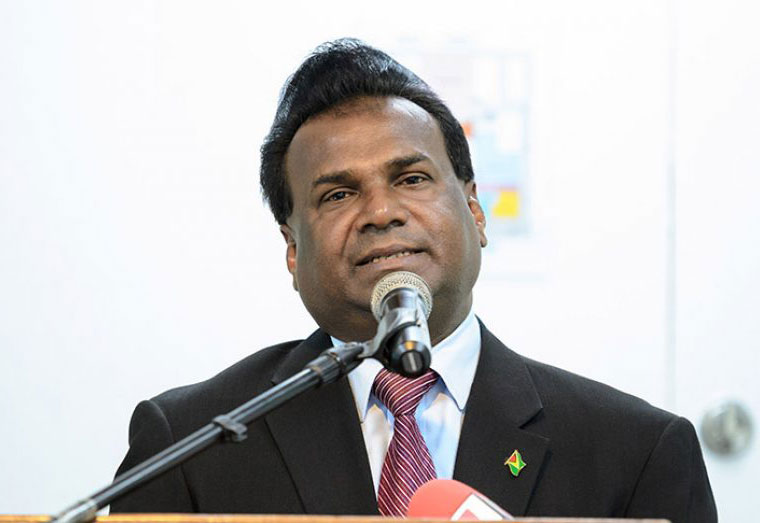
People’s National Congress Reform (PNCR) member Annette Ferguson, who also served as a parliamentarian and minister in the A Partnership for National Unity and Alliance for Change (APNU+AFC) government, has pushed back against recent claims about religious freedom in Guyana, warning against what she described as historical misrepresentation and the growing politicisation of religious spaces.
In a letter published April 10, 2026, Ferguson responded to remarks made by Seventh-day Adventist (SDA) President Pastor Exton Clarke during a regional camporee where President Irfaan Ali was featured. While acknowledging that discussion on religious freedom is important, she stressed that such discourse must be grounded in historical accuracy.
“Let it be unequivocally stated that the right to freedom of religion in Guyana was not established under the current administration led by President Irfaan Ali, nor is it a creation of the People’s Progressive Party/Civic (PPP/C),” Ferguson wrote. “This fundamental right predates the present political dispensation and is deeply rooted in the visionary leadership and nation-building efforts of Linden Forbes Sampson Burnham.”
Burnham-Era Reforms Underscored
Ferguson highlighted the role of the Forbes Burnham-led government in shaping Guyana’s modern religious framework, noting that key reforms dismantled colonial restrictions and broadened recognition of diverse faiths.
These included the repeal of the British Obeah Ordinance, which decriminalised Afro-Guyanese spiritual practices, as well as elevating Hindu and Muslim religions that were not accepted as mainstream under colonial rule. The Burnham administration also entrenched the separation of church and state and facilitated religious accommodation, including allowing Seventh-day Adventists to observe Saturday as their Sabbath at a time when Guyana operated under a six-day work week.
“Under Burnham’s stewardship, Guyana developed and institutionalised a framework that upheld freedom of conscience and religious expression as central pillars of its democratic identity,” Ferguson stated.
Adventist Community Unease
Ferguson’s comments come amid growing unease within the Seventh-day Adventist community following remarks by Pastor Clarke at the April 1 opening of the Caribbean Union Conference Pathfinder Camporee at Loo Creek along the Soesdyke–Linden Highway.
At that event, Clarke publicly praised President Ali, describing him as “a statesman, a visionary leader…with a heart for God.” The situation has been further heightened by the President addressing the gathering from the pulpit—an appearance some Adventists say blurs the Church’s long-standing boundary between spiritual mission and partisan politics.
Several members of the denomination, speaking on condition of anonymity, expressed concern that such actions risk politicising a church historically grounded in neutrality.
Warning Against ‘Misleading’ Narratives
Ferguson cautioned against attributing the origin of religious freedoms to current political leadership, drawing a clear distinction between preservation and creation.
“While any sitting government bears the responsibility to preserve and protect these freedoms, it is both misleading and historically inaccurate to attribute their origin to current political actors,” she said. “The distinction between maintaining a right and creating it must not be blurred for the sake of political convenience or narrative.”
Pulpit Should Not Be Political Platform
She also raised concerns about the increasing use of religious platforms for political messaging.
“It is time for some religious leaders to cease providing opportunities for political figures to occupy the altar for partisan expression,” Ferguson wrote. “The pulpit must not become a platform for political speeches, nor should it be used to advance political agendas under the guise of religious engagement.”
She emphasised that preserving the neutrality of religious institutions is critical.
“The separation between religious observance and political advocacy is not merely desirable; it is essential to preserving both democratic integrity and the sanctity of worship,” she added.
Call for Truth and Accountability
Ferguson concluded by urging a national conversation rooted in historical truth and respect for institutional boundaries.
“In conclusion, as we engage in national conversations on religious freedom, let us do so with fidelity to historical truth, respect for institutional boundaries, and a shared commitment to protecting the principles that unite us as a people.”
Her intervention adds to a widening national debate over history, governance, and the appropriate boundaries between religion and politics in Guyana.