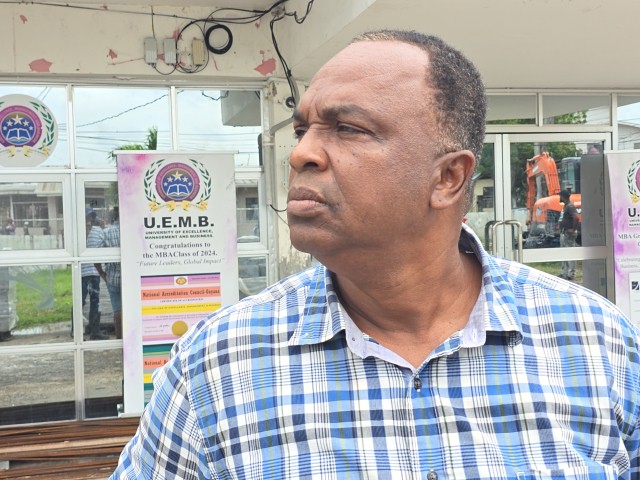
By Mark DaCosta- A dramatic turn takes place in the ongoing battle for Critchlow Labour College’s premises as the principal of the University of Excellence, Management and Business Inc (UEMBI) has recently surrendered the keys of the college to the Alberttown Police Station. This complex legal dispute has raised significant questions about authority, governance, and the future of an institution that has played a vital role in the empowerment of the working class in our nation.
At the heart of the matter is the legal contention between UEMBI, led by Principal Stanley Paul, and the college’s leadership, represented by Board Secretary Lincoln Lewis of the Guyana Trades Union Congress (GTUC), and owner of the College The case, which finds its origins in disputes over a controversial lease agreement that Paul signed with the Principal of the college, Dr. Ivor English, has escalated to scrutiny from the High Court. The lease has been called into question, primarily because the college’s operational status was reportedly inactive at the time of the agreement, thus rendering it invalid.
The recent developments come in the wake of a High Court hearing presided over by Justice Fidela Corbin-Lincoln, who expressed her commitment to ensuring justice would prevail in this dispute. It is clear from the judge’s statements that UEMBI’s objections and the principal’s requests for additional affidavits would not impede the court’s progress on this case. Lewis has affirmed that their legal arguments stem from the belief that the agreements Paul entered into lacked proper validity, accentuated by the college’s later reintegration into the Companies Register in 2025.
However, the situation has been further entangled by allegations of financial and legal mismanagement surrounding UEMBI. Principal Paul has publicly admitted to incurring exorbitant legal fees — approximately GY$2.5 million — while engaging multiple lawyers who ultimately withdrew from representing him. These admissions raise significant concerns regarding Paul’s governance of the institution and the motivations underlying UEMBI’s claims to the college’s valuable premises. “How has Paul managed to assert rights over an institution deeply entrenched in the ethos of our nation?” the question lingers over this unfolding story.
The Critchlow Labour College, which has stood as a symbol of pride within our country since 1967, now finds its legacy jeopardised by corporate interests. This educational institution’s mission to uplift the working class has not been without its challenges, including recurring fires, some suspected, and confirmed, to be acts of arson, that have left it vulnerable to threats from opportunistic entities seeking to capitalise on its fragility.
As the college grapples with corporate encroachment in the form of UEMBI, the alleged complicity of the current government, helmed by the People’s Progressive Party (PPP), becomes paramount in discussions surrounding institutional autonomy and support. With dwindling state backing exacerbating the college’s plight, many observers have begun to question whether the PPP genuinely prioritises the protection of educational heritage and public institutions in our nation.
As the court prepares to hear the case on May 11, the stakes mount dramatically. Lincoln Lewis and his team are fighting to reclaim rightful ownership of the college while mitigating the threats posed by UEMBI’s claims. The urgency has intensified, driven by a commitment to both the physical legacy of Critchlow Labour College and its cultural significance within our community — a legacy that countless generations of workers have relied upon for their education and empowerment.
In a surprising twist post-hearing, Principal Paul disclosed that he had relinquished the keys of the college to the local police station after burning certain documents he deemed sensitive. This revelation has caught many off-guard, raising eyebrows not only about his motives but also concerning the substantial equipment and resources he claims to have left on the premises.
When approached by local news outlets, Lewis expressed his cautious approach, indicating that any decisions regarding the keys would require legal consultation. Senior Counsel Roysdale Forde, representing the college’s interests, commented on the sudden nature of Paul’s decision, suggesting that should Paul acknowledge the nullity of the lease agreement, his clients might be willing to negotiate terms favourably.
Paul’s reluctance to take legal action against the college for unpaid dues related to expenditures on the building further complicates an already convoluted saga. His suspiciously sudden lack of faith in the court system has prompted him to take seemingly drastic actions, including parting with the building under contentious circumstances.
Both parties now find themselves at a crucial juncture, with the future of Critchlow Labour College hanging in the balance and community members anxiously awaiting the court’s ruling. It must be noted that Mr. Stanley Paul was just a tenant of an office within the compound of the Critchlow Labour College prior to two fires that consumed the buildings in the compound. Mr. Paul then asserted control of the whole property.
As this legal drama unfolds, it signals a broader imperative for accountability and equity in our nations’ education sector.