President Irfaan Ali’s recent remarks on Cuba have ignited debate about whether Guyana is departing from decades of foreign-policy principles rooted in non-interference, non-alignment and the peaceful resolution of international disputes.
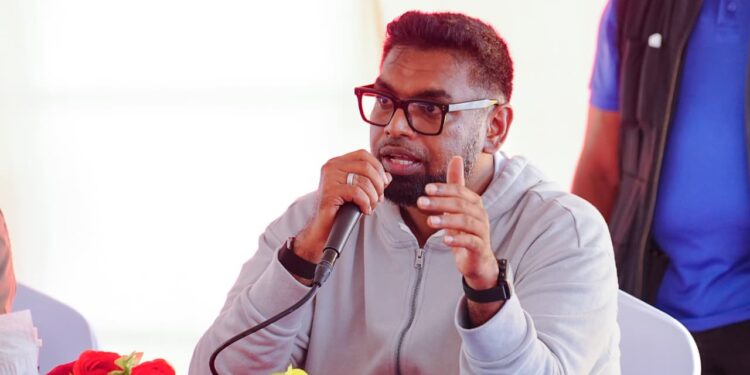
Speaking on Fox News Live last week during an interview with journalist Aishah Hasnie, on the sidelines of the inaugural “Shield of the Americas” summit in South Florida, Ali appeared to support the need for political change in Cuba.
“In the case of Cuba, we have had many discussions at the CARICOM level… we had discussions recently with [U.S.] Secretary [of State Marco] Rubio… and we all agree that the status quo cannot remain,” the President said.
“We agree that there must be an attempt to have this status quo changed and we all are aware that it will take time. It has to be incremental… there must be dialogue,” he added.
Ali said that any transition should ultimately improve the lives of Cuban citizens.
“…those changes must lead to the improvement of the people of Cuba, must lead to better conditions for the people of Cuba, must lead to a society in which the rule of law, in which democracy, in which freedom is celebrated,” the President said.
He further stated: “I think that is what the President [Donald Trump] is referring to — a type of transition that allows the people of Cuba to benefit from prosperity and democracy.”
Yet critics say the remarks represent a striking departure from Guyana’s traditional diplomatic posture — one that historically avoided involvement in the internal political affairs of other sovereign nations.
A foreign policy built on non-alignment
Since independence, Guyana has played an influential role among developing and non-aligned nations, seeking to position itself as a voice for smaller states in global affairs. The country pursued an active role in the Non-Aligned Movement (NAM) and even hosted the 1972 Conference of Foreign Ministers of Non-Aligned Countries in Georgetown, an event that brought together delegations from dozens of developing states.
The philosophy behind non-alignment was simple: small states should avoid becoming instruments of great-power rivalry while promoting dialogue, sovereignty and peaceful conflict resolution.
Guyana also embraced South-South cooperation, advocating solidarity among developing nations and supporting diplomatic engagement rather than intervention in internal political systems.
For decades, this approach shaped the country’s positions in international forums such as the United Nations, where small states often rely on collective diplomacy and adherence to international law to protect their sovereignty.
A historic relationship with Cuba
Ali’s remarks have also drawn scrutiny because Cuba has been one of Guyana’s closest diplomatic partners for more than half a century.
In 1972, Guyana joined Jamaica, Barbados and Trinidad and Tobago in establishing diplomatic relations with Cuba, a move widely seen as a bold act of regional independence at a time when many countries in the hemisphere had severed ties with Havana.
That decision helped break Cuba’s diplomatic isolation in the Americas and marked a defining moment in Caribbean foreign policy.
Since then, the two countries have developed deep cooperation in healthcare, education and technical training.
Hundreds of Guyanese — including many members and supporters of the People’s Progressive Party (PPP) — have benefited from Cuban scholarships, particularly in medicine, engineering and other technical disciplines.
Cuban doctors have also served in Guyana for decades, providing critical healthcare services, particularly in rural and hinterland communities.
Yet last month the Guyanese government quietly ended its participation in the Cuban medical programme, a move widely interpreted by critics as occurring under pressure from the United States.
A contradiction at home?
Analysts say the President’s comments also invite comparison between the government’s rhetoric abroad and its approach to governance at home.
Independent media houses have complained about the withdrawal of state advertising — a financial lifeline for many outlets.
One prominent example is Stabroek News, which reportedly is owed more than $80 million in government advertising revenue and has announced plans to close its doors on March 15, citing financial pressures linked to the withdrawal of state advertisements.
Opposition parties and segments of civil society have also complained about exclusion from national consultations and policy-making, raising broader concerns about the state of democratic engagement in the country.
The Venezuela factor
Foreign-policy analysts say Ali’s remarks are particularly sensitive given Guyana’s ongoing territorial controversy with Venezuela.
Caracas claims the Essequibo region, a vast and mineral-rich area that constitutes more than two-thirds of Guyana’s territory. The dispute has been referred to the International Court of Justice (ICJ) for legal determination.
Guyana has consistently argued that the matter must be resolved through international law and judicial settlement, rather than unilateral action or geopolitical pressure.
Observers say this principle mirrors the same philosophy that guided Guyana’s traditional foreign policy — respect for sovereignty and peaceful dispute resolution.
Critics therefore ask: How would Guyana react if other countries publicly supported regime change or political transition within Guyana, or sided with Venezuela’s claim over the Essequibo instead of respecting the legal process before the ICJ?
For small states, they argue, consistency in defending international law is often their strongest diplomatic protection.
A risky diplomatic posture
For some analysts, the President’s remarks suggest a risky shift in diplomatic posture.
By appearing to endorse political transition in another sovereign nation — particularly one that has been a long-time ally — critics say Guyana risks undermining the very principles it has historically relied upon to defend its own sovereignty.
The controversy has led some observers to describe the situation as a dangerous diplomatic dance.
They argue it raises uncomfortable questions: whether the President is a neophyte navigating complex geopolitical currents, or whether Guyana’s foreign policy is increasingly being shaped by the interests of larger powers rather than its own long-standing principles.
For a country that has long relied on international law, multilateral diplomacy and solidarity among developing nations, critics say the stakes could hardly be higher.
Watch the interview below: