Introduction
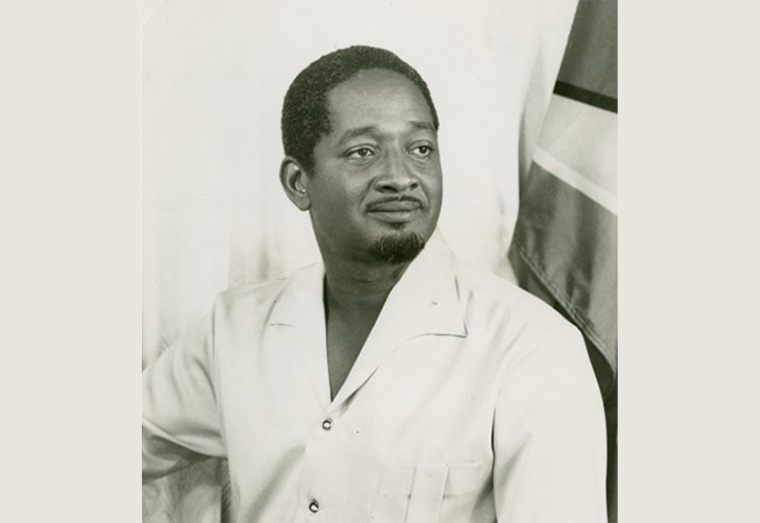
Forbes Burnham (Prime Minister 1964–1980; Executive President 1980–1985)
Mr. Linden Forbes Sampson Burnham O.E, S.C stands as a central architect of modern Guyana. As Prime Minister at Independence in 1966 and later the country’s first Executive President, he guided the transformation of British Guiana into a sovereign Cooperative Republic. His administration prioritised nation-building through free education, major infrastructure works, enduring social institutions such as the National Insurance Scheme, and a determined push for economic self-reliance.
Burnham’s leadership helped shape Guyana’s political identity, national symbols, and regional influence. He frequently reminded citizens that nation-building demanded collective effort and shared responsibility, declaring, “A nation is not built by the wealth of a few, but by the discipline, sacrifice and commitment of all.” The sentiment captured the ethos that underpinned his policies of self-reliance, social mobilisation, and national pride.
Political & Constitutional Achievements
-
Led Guyana to Independence from Britain (1966).
-
Declared Guyana a Cooperative Republic (1970), ending constitutional ties to the British monarchy.
-
Oversaw the adoption and establishment of national symbols, including:
-
Golden Arrowhead (national flag)
-
Coat of Arms
-
National Anthem
-
National Motto
-
National Flower and Bird
-
-
Instituted and formalised Mashramani (Republic Day) celebrations.
-
Recognised Pagwah (Phagwah) and Diwali as national holidays, strengthening multicultural recognition.
-
Signed the Port of Spain Protocol (1970) concerning the Venezuela border controversy.
Education Reform & Expansion
-
Implemented free education from nursery to university level.
-
Expanded primary and secondary education, including multilateral and community high schools.
-
Supported and expanded the University of Guyana (established 1963).
-
Built residential hinterland schools for Indigenous students (e.g., St. Ignatius, Mabaruma).
-
Expanded technical and vocational education, including the New Amsterdam Technical Institute.
- Scholarship Programme- provided overseas scholarships for education and professional development.
Infrastructure & National Development
-
Constructed the Demerara Harbour Bridge (opened 1978).
-
Built the Soesdyke–Linden Highway, linking coastal and interior regions.
-
Developed and expanded Timehri International Airport (now Cheddi Jagan International Airport).
-
Expanded rural infrastructure — roads, bridges, stellings, and aerodromes.
-
Extended electricity, water, and telephone services nationwide.
-
Housing- spearheaded the country’s largest housing expansion programmes, developing new communities with turnkey homes supported by essential infrastructure such as roads, bridges, electricity, potable water, health centres, playgrounds, schools, and shopping facilities — a strategy aimed at improving living standards and fostering organised community life.
Agriculture & Economic Development
-
Established and expanded the Mahaica–Mahaicony–Abary (MMA/ADA) Scheme.
-
Strengthened irrigation projects, including Tapakuma, Boeraserie, and Black Bush Polder.
-
Nationalised major industries (bauxite and sugar) to promote economic self-reliance.
-
Promoted cooperative socialism, village economies, and local manufacturing.
-
Encouraged agro-processing and community production enterprises.
-
Increased minimum wages and strengthened labour protections.
Social Development & Institutions
-
Established the National Insurance Scheme (1969) — a national social security system.
-
Expanded public healthcare facilities and health centres.
-
Promoted cooperative banks and community credit unions.
-
Established institutions such as the Cooperative Bank, Agricultural Bank, and Kuru Kuru Cooperative College.
-
Introduced the Guyana National Service youth development programme.
Social & Cultural Initiatives
-
Introduced family planning programmes.
-
Improved women’s legal status and expanded their participation in employment and national defence.
-
Advanced Amerindian land titling through legislative reform.
Regional & International Leadership
-
Played a leading role in founding the Caribbean Community (CARICOM) and earlier CARIFTA.
-
Participated actively in the Non-Aligned Movement.
-
Supported African liberation movements and anti-apartheid efforts.
-
Hosted and promoted CARIFESTA (1972), a landmark regional arts and culture festival.
-
Expanded diplomatic ties with China, Cuba, the USSR, and other developing nations.
State-Led Industrialisation Under Forbes Burnham: Key Factories and Enterprises
During the 1970s and early 1980s, Burnham’s government pursued cooperative socialism and import-substitution industrialisation, leading to the establishment, nationalisation, or expansion of several state enterprises aimed at reducing import dependence and building domestic manufacturing capacity.
Notable factories and industrial enterprises
-
Guyana Refrigerator and Electrical Company (GRECO) — produced refrigerators, stoves, and small electrical appliances.
-
Tapir Soap and Detergent Factory — manufactured soaps and cleaning products using local inputs.
-
Caloi Bicycle Assembly Plant — a joint venture with Brazil assembling bicycles locally.
-
Guyana National Printers Limited — expanded as a state printing facility.
-
Enmore and Other State Rice Mills — consolidated rice milling to stabilise prices and increase value-added exports.
-
Guyana Pharmaceutical Corporation (GPC) — produced basic pharmaceuticals and medical supplies.
-
Guyana National Engineering Corporation (GNEC) — provided fabrication and engineering support for industry and agriculture.
-
Sanata Textile Complex — a major textile and garment manufacturing initiative.
-
Glass Factory — established to manufacture glass products locally and support the construction and consumer sectors.
-
Clay Brick Factory — developed to supply locally produced building materials, reinforcing the national housing and construction drive.
Note: This listing is not exhaustive. Burnham’s industrialisation and nation-building initiatives extended well beyond the enterprises highlighted here, and scholars and citizens alike may readily add to this record.
Conclusion
Forbes Burnham’s ambitious industrial and social transformation unfolded without the benefit of oil wealth, as Guyana grappled with foreign exchange constraints and the shocks of rising global oil prices. Navigating the tensions of a bipolar Cold War world and internal conflicts, his government nonetheless pursued self-reliance and state-led development, leveraging diplomacy and South-South partnerships to advance nation-building under difficult economic circumstances.
His legacy remains inseparable from the foundation of independent Guyana. Through an unwavering commitment to sovereignty, an expansive vision for education, strategic infrastructure investment, and assertive regional leadership, Burnham helped forge a path of national self-definition and resilience. Remembered as a fierce nationalist and bold visionary, he did more than govern — he instilled pride, purpose, and possibility in a young nation finding its voice. Decades later, the institutions he built and the ideals he championed continue to resonate, affirming his decisive role in shaping Guyana’s journey as a self-governing, confident, and enduring Caribbean state.