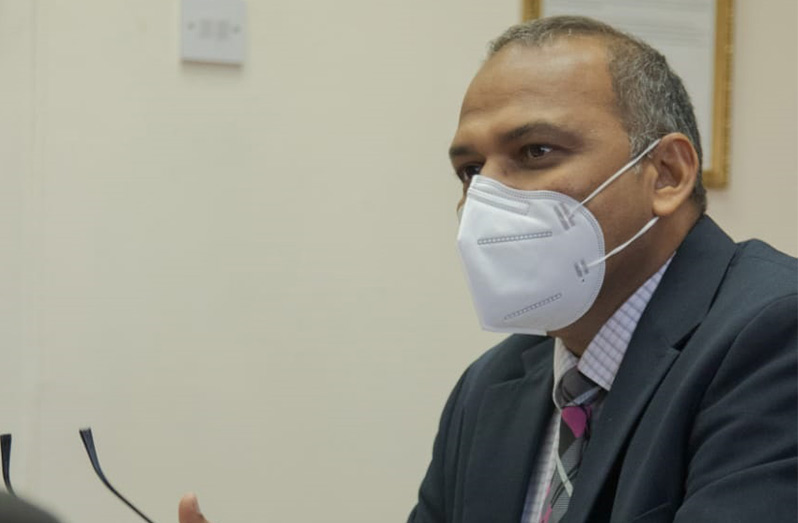
Invoking Dr. Walter Rodney to argue racial underdevelopment, Working People’s Alliance (WPA) co-leader, Dr. David Hinds said African Guyanese remain “the underdeveloped of the underdeveloped” in oil-rich Guyana.
Dr. Hinds’ remarks were channeled from his examination of Rodney’s 1972 landmark work “How Europe Underdeveloped Africa,” on Sunday, which formed part of an ongoing lecture series initiated by the International Decade of People of African Descent- Guyana ( IDPADA-G), in honour of Black History Month.
During the online discussion, Hinds argued that while Guyana celebrates unprecedented oil revenues and record GDP growth, the structural condition of African Guyanese begs urgent political attention.
“One would argue that African Guyanese, African Caribbean people are the underdeveloped of the underdeveloped.”
He contended that underdevelopment in Guyana must be understood at two levels — first at the level of a multi-ethnic, multi-racial society, and the level of the African Guyanese experience.
“We had 400 years of enslavement,” the political analyst said, arguing that slavery and racial dehumanisation carved out structural disadvantages that continue to shape poverty and social vulnerability today.
“To understand Rodney, one has to understand the synthesis of race,” he continued, pushing back against portrayals of Rodney as only concerned with class. Rodney, he noted, deliberately confronted race.
Rodney had argued that if race was historically used to dehumanise Africans, it must also be used analytically to understand contemporary inequality.
“If race is used to dehumanise the African, then Africans must use the racial prism to humanise themselves.”
Oil Wealth and the Development Debate
Dr. Hinds’ remarks come as Guyana continues to record one of the fastest growing economies globally, fueled by oil production and a $1.558 trillion national budget for this year.
He however warned that GDP growth and the expansion of infrastructure cannot be twinned with genuine development.
“There are two conversations,” he said. “One is about how developed Guyana is — the GDP, the highest per capita — and then there’s the conversation about underdevelopment.”
That underdevelopment, he argued, is visible in lived realities — including the black woman who leaves her home at 6 PM to work as a watchman, leaving her daughters vulnerable to the dangers of the night.
“That is the conversation we have to have — the dialectics of underdevelopment in the era of oil and gas.”
The Global Layer
The political leader situated Guyana’s oil economy within the broader framework outlined by Rodney during the decolonisation era of the 1960s and 1970s, when African and Caribbean nations transitioned from “plantation to nation.”
At the end of the Second World War, he argued that global economic systems were shaped by powerful nations, leaving newly independent states to operate within structures that were not designed with them in mind.
“They came up with this term ‘underdeveloped, developing and developed countries,’” Hinds said. He explained how African and Caribbean countries were placed at the bottom of that system.
Rodney rejected the notion that underdevelopment was natural or inevitable.
“There was a time when Africa was developed and that the fact that it is so called underdeveloped today has to do with what happened between then and now.”
Dr. Hinds said the question confronting Guyana is whether oil wealth represents genuine transformation or a modernised continuation of extraction.
“We are now getting the kind of resources that the labour of our people was able to realise, but never came to us,” he said.
Yet he cautioned that physical infrastructure does not automatically translate into human development.
“Some roads and some bridges, but human development is not keeping up with infrastructural development.” (Release)
evelopment is not keeping up with infrastructural development.” (Release)