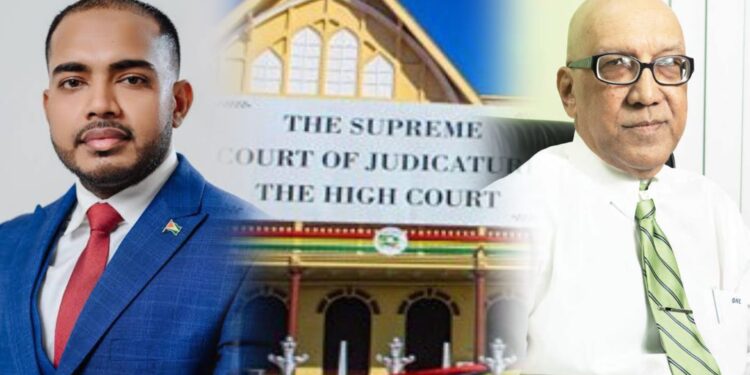
The world watches as Guyana, a small nation with colossal new wealth under the control of authoritarian leaders, takes a dangerous and deliberate step into the shadows of dictatorship. Guyana’s President Irfaan Ali and his People’s Progressive Party (PPP) government are executing a silent coup against their own constitution, paralyzing the legislature to avoid a single, inconvenient outcome; the legitimate election of their chief rival, Azruddin Mohammed of the WIN party, as Opposition Leader.
Not only is this political maneuvering, it is also constitutional vandalism.
At the heart of this crisis is a clear, non-negotiable requirement of Guyana’s Constitution. Article 186 (1) states unequivocally; “The Leader of the Opposition shall be appointed by the President from among those elected members of the National Assembly who are members of the opposition party whose numerical strength in the National Assembly is greater than that of any other opposition party.”
The key term is “shall be appointed.” This is a mandatory, procedural cornerstone of our democracy.The PPP’s delay in convening the National Assembly to facilitate this election which some call a scheduling dispute is clearly a willful refusal to execute a constitutional command. By preventing the Assembly from meeting to formally recognize the largest opposition bloc, President Ali is not delaying an appointment; he is blocking one, rendering the constitutional provision a dead letter.
The ramifications of this vacuum are profound and immediate. Guyana’s governance structure is meticulously designed with checks and balances that require the input or concurrence of the Opposition Leader. Key constitutional bodies—the Judicial Service Commission (responsible for judicial appointments), the Public Service Commission, the Police Service Commission, and the Integrity Commission cannot be constitutionally constituted without the meaningful input of the Opposition Leader. By creating this vacuum, the PPP government is sidelining an opponent and suspending the foundational oversight mechanisms of the state. Critical appointments, anti-corruption safeguards, and checks on executive power are now in limbo, allowing the government to operate in an unchecked space it has illegally created.
One must ask; Has the Constitution been silently suspended? The government’s actions suggest it believes so. It governs as if the requirements for bipartisan consensus on critical institutions are mere suggestions. This creates a perilous precedent; that the ruling party can, through inertia and obstruction, cherry-pick which parts of the supreme law to observe, effectively granting itself temporary absolute power.
The international community; notably the diplomats of the United States, United Kingdom, and Canada, has rightly raised the alarm. Their statements are a defense of the very democratic principles Guyana claims to uphold. To the world, Guyana is transforming from a democratic success story into a petro-state cautionary tale. The image is clear; a government, flush with oil revenues, so fearful of a constitutional opponent that it is willing to shatter democratic norms to avoid him. This perception catastrophically elevates political and economic risk. Investors see institutional collapse, not robust governance. Diplomats see a partner becoming unstable and arbitrary.
The political risk is now palpable. This act exposes the arbitrariness of the PPP government, revealing that its commitment to the rule of law is conditional upon its outcomes. It signals to citizens that power flows not from the law but from the whims of the incumbent. Furthermore, it places the judiciary under intense, unfair pressure and public scrutiny. If the courts are forced to intervene; as they must, their rulings will be attacked by the government’s supporters, further compromising their perceived independence and deepening societal division. An “unstable democracy” is too generous a term; this is the active manufacture of a constitutional crisis.
What is taking place in Guyana is the betrayal of a nation’s foundational compact. President Ali and the PPP are not just delaying a vote; they are dismantling, brick by brick, the democratic edifice they swore to protect. They are telling Guyanese citizens and the world that in the new era of oil wealth, the constitution is an obstacle to be bypassed, not a covenant to be honored.
The world is watching, and its judgment will be severe. Political stability, economic credibility, and Guyana’s honor are on the line. The ambassadors have spoken. The constitution has spoken. It is time for every citizen who believes in the Republic of Guyana to demand that their president simply listens, obeys, and convenes the Assembly. The future of Guyana’s democracy depends on it.