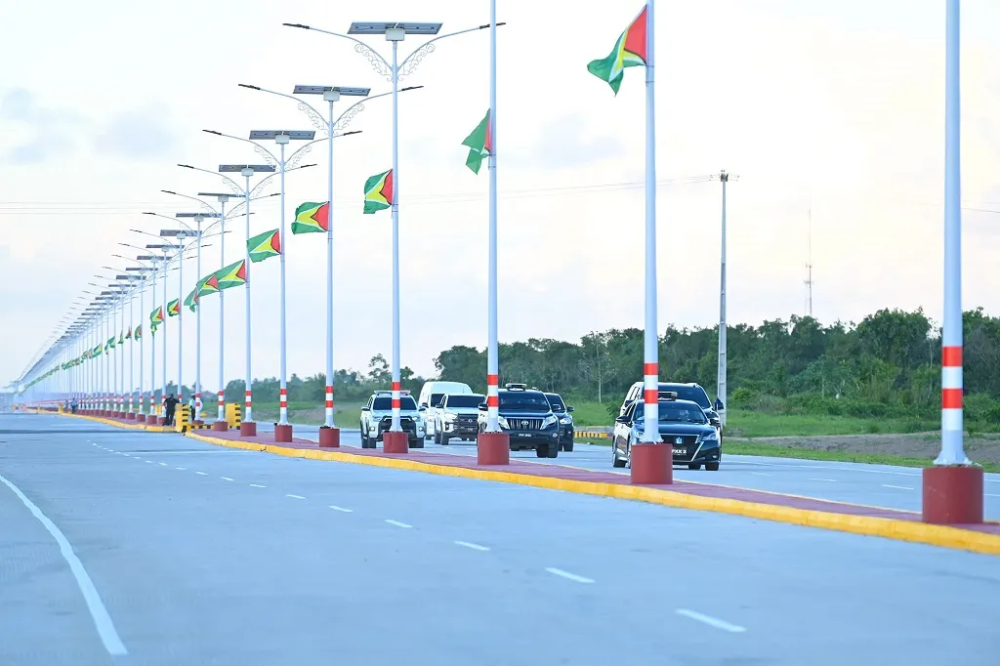
The People’s Progressive Party (PPP) government is under fire for the $4.2 billion expansion of the $13.3 billion Heroes Highway, a roadway infamously labeled “concussion road” by U.S. Secretary of State Marco Rubio due to its deteriorating condition. Commissioned in December 2023, the highway has already suffered potholes and early structural wear, highlighting the government’s lack of foresight and poor planning.
The Ministry of Housing, through the Central Housing and Planning Authority (CHPA), is managing the widening of the highway from four to six lanes between Haags Bosch and Massy Road, East Bank Demerara. Kaieteur News reports that the project has been split into five lots, with six contractors submitting bids to the National Procurement and Tender Administration Board (NPTAB) in October.
In March, Secretary Rubio delivered a sharp critique of the newly built highway, calling it “dangerous” and the result of a “terrible job” by contractors. He added, “If you did that job in America, someone would sue you for a lot of money,” and described the ride as so rough it nearly gave him a “concussion,” referencing the American definition of a violent impact causing impaired brain function.
The successful contractors and their contract amounts are as follows: Ivor Allen – Lot 1 for $650,499,465; Guyamerica Construction Inc. – Lot 2 for $639,695,805; AIKA General Construction – Lot 3 for $801,327,744; BK International Inc. – Lot 4 for $1,025,838,791; and S. Jagmohan Construction – Lot 5 for $1,170,452,850. Work is now underway on both the eastern and western carriageways.
Former Housing Minister and former parliamentarian under the A Partnership for National Unity and Alliance for Change (APNU+AFC) administration, Annette Ferguson, has sharply condemned the PPP, accusing the government of a complete absence of forward planning and accountability. In a letter to the press, Ferguson warned that the additional $4.2 billion “suggests that the original project lacked a proper feasibility study, one that should have accounted for increased vehicular activity following the completion of the Ogle Bypass. Such foundational planning would have anticipated the resulting congestion and mitigated the need for costly revisions.”
Ferguson raised pointed questions about the rationale, financing, and oversight of the project:
-
Why were the widening works not included in the initial design and construction of the 9.4 km Heroes Highway?
-
Where is the $4.2 billion being sourced to finance this project?
-
What data, studies, or traffic modelling informed the decision to widen the roadway in 2025?
-
Why was this project not deferred to 2026, given the absence of a 2025 budgetary allocation?
-
What is the expected duration of the widening works?
-
Upon completion, how will the project alleviate congestion at the Jaguar Roundabout, and will this eliminate the need for police officers to manually control traffic during peak hours?
Ferguson also questioned the role of the CHPA in constructing major roads, stressing that the agency’s mandate has historically been to provide affordable housing and related infrastructure for working-class Guyanese. “The persistent absence of transparency and accountability in public spending is deeply concerning. Guyanese citizens deserve accurate, timely information and the assurance that their resources are being utilized responsibly,” she said.
The former minister stressed that while she supports infrastructure development, the PPP’s handling of the Heroes Highway expansion exposes systemic mismanagement, poor planning, and reckless waste of public funds. With the highway deteriorating barely two years after commissioning, Ferguson’s critique underscores a disturbing pattern of corruption and inefficiency that threatens to erode public trust and burden Guyana’s taxpayers.
The $4.2 billion expenditure is not merely a budgetary oversight—it is a glaring symbol of a government that prioritises appearances over planning, favours cronies over accountability, and leaves citizens to bear the cost of its mismanagement. Guyana cannot afford such reckless governance; the time for transparency, rigorous oversight, and responsible stewardship of public resources is now.