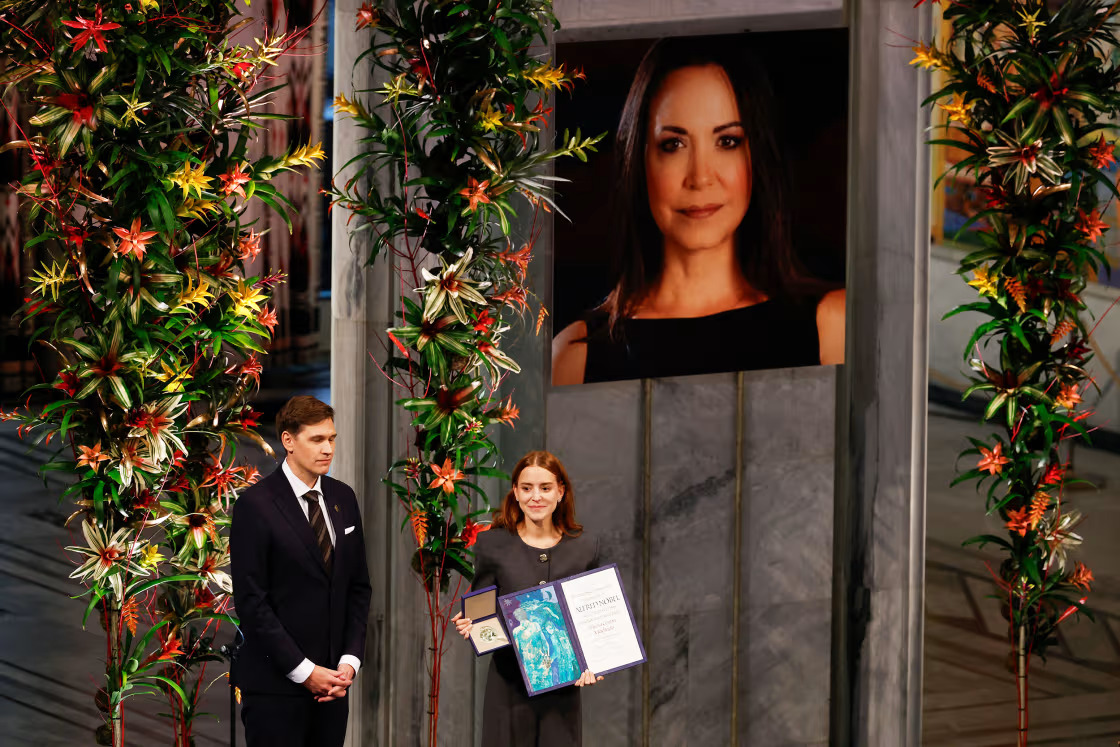
(NBC News )- Mystery surrounded the whereabouts of this year’s Nobel Peace Prize winner, Venezuelan opposition leader María Corina Machado, who didn’t accept the award in person in Oslo on Wednesday.
Instead, a giant portrait of Machado hung next to an empty seat on the stage in Oslo City Hall and her daughter read a speech on her behalf where she noted that the award, “reminds the world that democracy is essential to peace.”
Machado had “done everything in her power to come to the ceremony,” and her journey had been one “of extreme danger,” the Institute said in a statement.
But although the Institute was “profoundly happy to confirm that she is safe and that she will be with us in Oslo,” Machado was unable to receive the award in person at the ceremony attended by members of Norway’s royal family as well as Latin American leaders including Argentine President Javier Milei and Ecuadorean President Daniel Noboa.
To a standing ovation from the audience, as she accepted the award on behalf of her mother Ana Corina Sosa Machado said they would finally be able to embrace after “16 months of living hell.”
She went on to read a speech her mother had prepared.
“Freedom is not something we wait for, but something we become,” Machado wrote. “It is a deliberate, personal choice, and the sum of those choices forms the civic ethos that must be renewed every day.”
Machado, 58, is barred from leaving Venezuela and has spent more than a year in hiding since the authoritarian regime of President Nicolás Maduro declared him the winner in an election last year that was widely criticized as rigged. She had been the opposition’s original candidate against Maduro, but the government prevented her from running.
Authorities in Venezuela, where Machado has been under a decade-long travel ban, have said she will be considered a fugitive if she attempts to travel abroad. She was last seen in public on Jan. 9, when she was briefly detained after appearing with supporters at a protest in the Venezuelan capital, Caracas, the day before Maduro was sworn in for his third six-year term.
In her speech, Machado recounted the wave of support she received during the 2024 election and how “the dictatorship responded with terror.”
“And yet, the Venezuelan people did not surrender,” she wrote. “This prize carries profound meaning. It reminds the world that democracy is essential to peace.”
The Norwegian Nobel Committee, which hands out the annual prize, recognized Machado in October for keeping “the flame of democracy burning amidst a growing darkness” and for “her tireless work promoting democratic rights for the people of Venezuela.”
Machado said at the time that the honor was the “achievement of a whole society.”
But the committee’s decision has come under criticism amid Machado’s support for President Donald Trump’s military buildup in the Caribbean as well as the use of force to remove Maduro. Trump said Tuesday that Maduro’s “days are numbered,” although he declined to comment on whether the U.S. might send troops into the oil-rich South American nation.
After being awarded the prize in October, Machado dedicated it in part to Trump, who along with his supporters has openly campaigned for his own Nobel Peace Prize. She has been unwavering in her support for U.S. military actions against the Venezuelan regime, which have included strikes of questionable legality on alleged drug trafficking boats in the nearby Caribbean Sea.
According to the Pentagon, almost 90 people have been killed in 22 strikes in the Caribbean and off Latin America’s Pacific coast. The administration has produced no evidence to support its allegations about the boats or the people on board.
Machado has also supported forceful means to dislodge Maduro, saying the country’s elections are a sham. “You cannot have peace without freedom, and you cannot have freedom without strength,” she told NPR a day after winning the prize on Oct. 10.
Despite holding the world’s largest oil reserves, the collapse of Venezuela’s economy under Maduro has led to pervasive poverty and a mass exodus of Venezuelans that has become the largest displacement crisis in the world.
The Norwegian Peace Council, a group of 17 organizations promoting conflict resolution that is separate from the Nobel Committee, said in October that Machado does not “align with the core values” of the council, adding it was not going to hold its annual tradition of honoring the new laureate with a torchlight procession on Wednesday.
Nicknamed “the Lady of Steel” and “the Iron Lady,” Machado, an engineer and mother of three, revitalized Venezuela’s opposition, standing up against Maduro’s rule and his government’s crackdown against opposition figures, journalists and civil society at large.
She was barred from running for president against Maduro in July 2024, backing another opposition candidate, Edmundo González, instead. While González was recognized as the winner internationally, Maduro claimed victory, resulting in deadly mass protests.
González later sought asylum after a Venezuelan court issued a warrant for his arrest, while Machado was forced into exile inside her own country, fearing retaliation from the Maduro regime.
“Despite serious threats against her life she has remained in the country, a choice that has inspired millions of people,” the Nobel Committee said in its announcement