Guyana has fallen in the latest World Justice Project (WJP) Rule of Law Index 2025, slipping to 80th out of 143 countries as the global rule of law recession continues to deepen.
According to the report, 68 percent of countries experienced declines in their rule of law performance this year — up from 57 percent in 2024 — with Guyana among those showing a slight drop of less than one percent in its overall score.
Regionally, Guyana now ranks 18th out of 32 countries in Latin America and the Caribbean. The region’s strongest performers are Uruguay (23rd globally), Costa Rica, and Barbados, while Nicaragua, Haiti, and Venezuela remain at the bottom, with Venezuela ranked 143rd worldwide.
The WJP report highlights that 24 out of 32 countries in Latin America and the Caribbean recorded declines over the past year, with 19 of those countries showing consecutive declines for a second year. Among high-income nations, Guyana ranks 50th out of 51.
The report attributes the ongoing downturn to the expansion of authoritarian trends, which continue to undermine checks and balances and erode civil liberties. It notes that declines were particularly steep in areas measuring Constraints on Government Powers, Open Government, and Fundamental Rights.
“Freedoms crucial for public discourse and government oversight—measured under the Open Government and Fundamental Rights factors—saw widespread erosion,” the report stated, warning of a shrinking civic space worldwide.
Guyana is among more than 70 percent of countries experiencing a reduction in civic freedoms. The report found that freedom of opinion and expression declined in 73 percent of countries, freedom of assembly and association fell in 72 percent, and civic participation weakened in 71 percent—trends that also include Guyana.
The Index further reveals that judiciaries are losing ground to executive overreach, with political interference increasing in justice systems worldwide. Indicators assessing whether the judiciary limits executive power and whether civil and criminal justice systems operate independently declined in 61 percent, 67 percent, and 62 percent of countries, respectively — including Guyana.
When a society’s rule of law begins to slip, it signals a weakening of the very systems that ensure fairness, justice, and accountability. This decline can lead to reduced checks and balances, growing corruption, and a judiciary susceptible to political pressure.
Civil liberties, including freedoms of speech, assembly, and civic participation, are often curtailed, while economic confidence suffers as businesses and investors lose trust in the legal system. Inequality deepens as the powerful evades consequences and vulnerable groups struggle to access justice.
Over time, public trust in institutions erodes, social frustration increases, and democratic principles weaken. In essence, a decline in the rule of law threatens the stability and fairness of society.
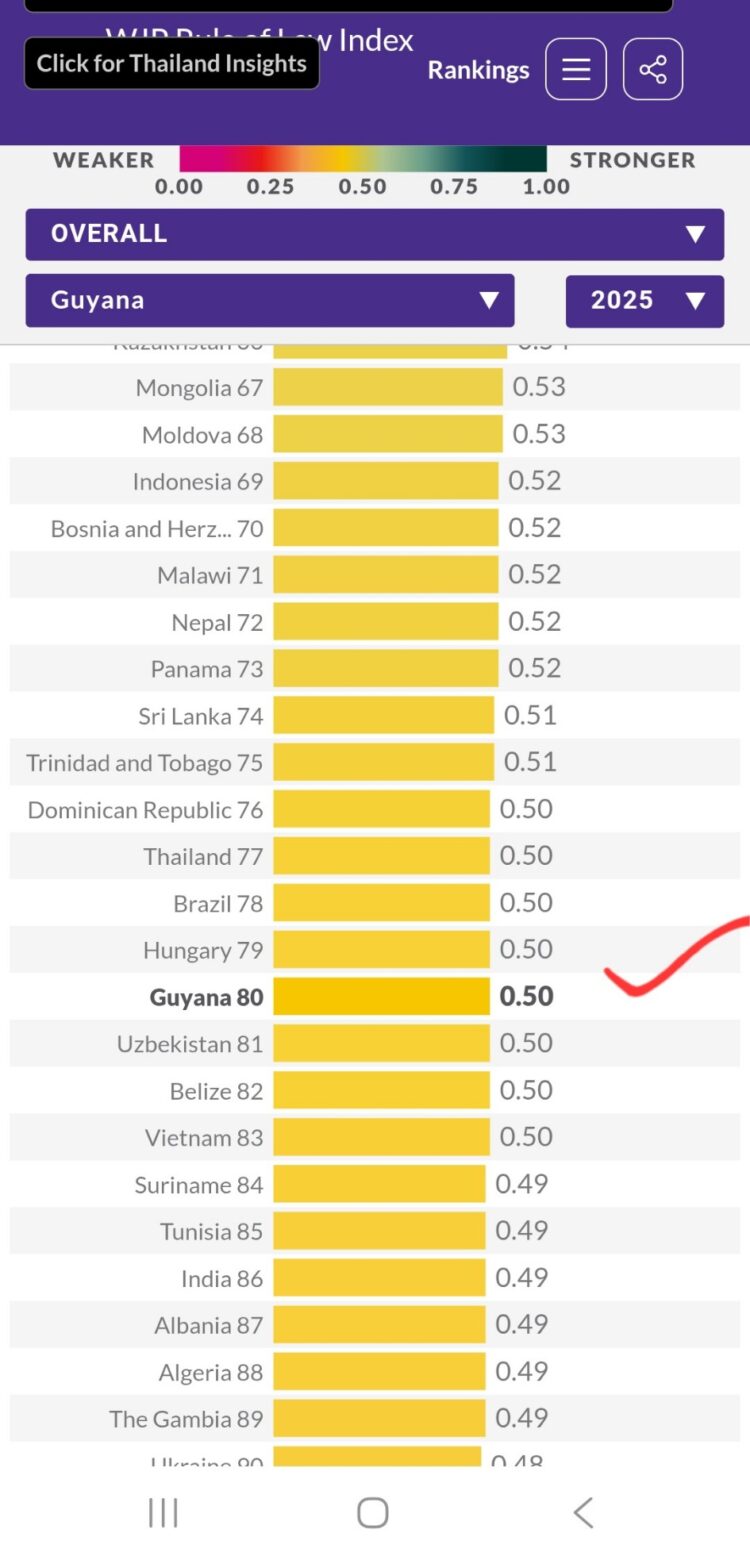
However, the report notes that civil justice did not weaken in Guyana, even though 68 percent of countries globally saw declines due to longer case delays, weaker alternatives to court proceedings, and increased government influence.
Globally, Denmark retained the top spot in the 2025 WJP Rule of Law Index, followed by Norway, Finland, Sweden, and New Zealand. Venezuela remains the lowest-ranked country, followed by Afghanistan, Cambodia, Haiti, and Nicaragua.
The World Justice Project Rule of Law Index is considered one of the most comprehensive assessments of adherence to the rule of law, measuring countries based on factors such as government accountability, justice systems, corruption, and fundamental rights.