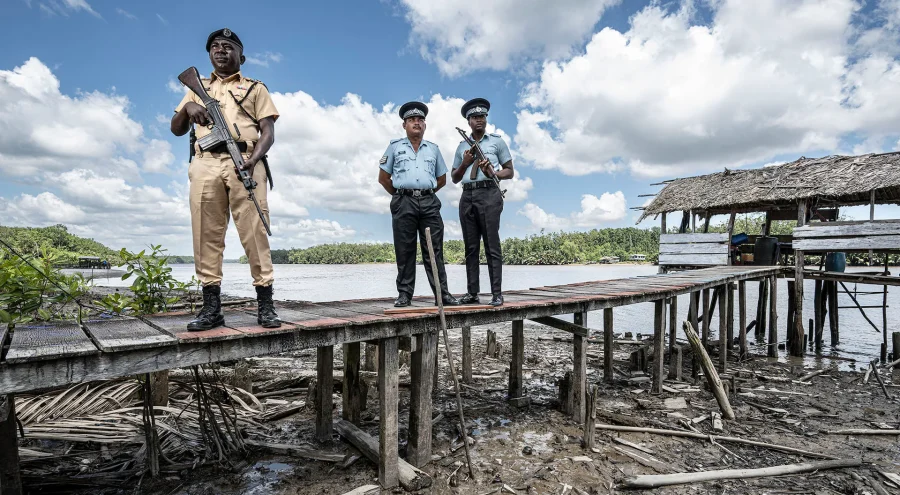
By (The Telegraph)- From a jetty on Guyana’s fragile frontier, Inspector Marcel Sandy gazes nonchalantly at the Venezuelan troops gathered just a hundred yards away across a low-lying waterway.
There are at least 15 soldiers in combat fatigues peering back at us across Imbotero Creek, the narrow dividing line separating these two South American nations locked in dispute over the territory on which we stand.
With tensions ratcheting up following Donald Trump’s threats to oust Venezuela’s despotic leader President Nicolas Maduro – bolstered by a huge US military build-up in the Caribbean – this sleepy outpost could easily be caught up in a brewing regional conflict.
It would be swiftly overcome. Only five people are posted here, two of whom are still asleep when we arrive by boat in the late morning. In normal times, the only disturbance is the splash of paddles from passing canoes.
Yet despite being outnumbered, 43-year-old Insp Sandy is relaxed about his perilous position in the long-running stand-off with Guyana’s much stronger neighbour, because he now has a powerful ally in the White House.
Resting an antique FAL automatic rifle in his lap as he languidly smokes a cigarette, the police officer declares unwavering support for the recent wave of controversial deadly US airstrikes on boats which Mr Trump claims harboured Venezuelan “narco-terrorists”. He is also pleased that the US has brought its guided missile destroyers, F-35 fighter jets, a nuclear submarine and around 6,500 troops closer to where we talk.
“I endorse what Trump is doing,” the 43-year-old officer breezily declares. “I sleep better at night knowing I have got a big stick – the military power of the Americans – just out there in the Atlantic. No one is going to do anything while they are there.”
While the lonely officers posted to isolated Imbotero welcome the deployment of US warships off the Venezuelan coastline, there are also fears that the Pentagon’s lethal enforcement action is already having unwanted repercussions. Last week it emerged that Mr Trump has approved covert CIA operations to tackle drug traffickers inside Venezuela.

According to a source within Guyana’s Customs Anti-Narcotics Unit (CANU), suspected drug flights across its territory have risen dramatically since the US military operations began.
Civilian sightings of illicit light aircraft thought to be transporting consignments of cocaine for the cartels on a flightpath from Venezuela across Guyana’s vast jungle hinterland have become much more frequent.
With at least 32 people killed in the airstrikes on vessels suspected of drug trafficking, gangs are apparently altering their traditional routes through the Caribbean.
Three people travelling in a boat linked to the Ejército de Liberación Nacional (ELN) guerrilla group, which is operational in Colombia and Venezuela, were killed on Friday in the latest precision drone attack. Two survivors will be repatriated for prosecution.
Mr Trump wrote: “It was my great honour to destroy a very large DRUG-CARRYING SUBMARINE that was navigating towards the United States on a well known narcotrafficking transit route.”
Even though the US has been accused of breaching international law and condemned by several South American nations for blowing up the unidentified boats, there has been less outcry in Guyana. ELN traffickers have been a persistent scourge of the border regions, and multiple sites where semi-submersible craft were being made have been raided.
For many here, the long-running intimidation of the Venezuelan state and the drug cartels is one and the same.

Mr Maduro, who has a $50 million US bounty on his head for information leading to his arrest and conviction on drug trafficking charges, is frequently cited as the ultimate controller of the gangs.
Cocaine trafficking across the porous, and disputed, 500-mile border has been a consistent problem for decades, running concurrently with Mr Maduro’s inflammatory bluster since the dictator came to power in 2013.
James Singh, in charge of CANU since 2020, admits Guyana cannot intercept all of the small planes which have been spotted.
“Traffickers always look for the path of least resistance, so the US operations offshore have certainly been a deterrent,” he says.
“We are determined to put up a defence, so the traffickers don’t see Guyana as an easy target. They view our country as somewhere they can pass their product through, in the same way as a legal logistics business. We don’t have a cartel here, or production, but cocaine does come through our territory.
“Our responsibility is to the people of Guyana to ensure it doesn’t become a narco-state, unlike Venezuela which is a narco-state from the top down.”
A map pinpointing suspected drug flights indicates that the pilots make clandestine drops at remote locations. Bales of cocaine are then transported to self-propelled semi-submersible craft waiting off the coast, bound for Europe, the US or West Africa.

In the last few years, Guyanese investigators have discovered airstrips buried deep in the rainforest used by traffickers. These were vital transit points for cartel smugglers moving their product from Colombia, through their Venezuelan stronghold and on through its smaller neighbour in order to dodge detection.
Locating these airstrips in a country dominated by dense jungle canopy and without an air force of its own is not easy, Mr Singh admits.
Aided by the US Drug Enforcement Agency and the Guyana Defence Force, his team has also uncovered hidden bunkers containing huge stashes of cocaine.
A record 4,400kg seizure with a street value of £131m was dug up from pits camouflaged with branches and leaves near an illegal airstrip in the same border region in August last year. A semi-submersible was found at the same site. Weapons and drones have also been confiscated by CANU.
In May, Guyanese soldiers came under attack three times in 24 hours from armed men in civilian clothing, believed to be Venezuelan paramilitaries. Six Guyanese troops were wounded after being fired at by unidentified gang militia in the same area earlier in the year.

The unprovoked attacks on the Guyana Defence Force conducting patrols on the Cuyuni River came after Venezuela held a referendum asserting its claim to the disputed Essequibo region, administered by Guyana for decades. Essequibo makes up two thirds of Guyana’s territory and is home to 125,000 of its 800,000 citizens.
Allegations of corruption and incursion by Venezuelan smugglers are abundant in the settlements inhabited by the indigenous Warao people that dot the sparsely populated border region.
Villagers confirm that ELN guerillas run the trade for the cartels, with the tacit support of the Maduro government in Caracas.
Blackwater Landing marks the end of the trail, several hours’ drive on dirt tracks from the regional hub Mabaruma, which itself can only be reached by a single-propeller 20-seater plane or speedboat.
At the end of a wooden boardwalk is a stagnant black lagoon, leading into a shallow creek. The next stop on the river is Venezuelan soil.
Many of the villagers cross over regularly to trade fruit and fish; others work in gold mines on the other side. But drugs also come through this clearing of wooden shelters covered with a thatch of dried leaves.
The cloying humidity is such that most residents are lying in hammocks to escape the worst of the debilitating afternoon heat during our visit, making only occasional movements to swat away flies.

It was here that a local man was lured to his execution by gang members after finding a single packet of cocaine which had been left behind in a canoe moored at the landing. Deciding that keeping the plastic-wrapped package would cause unnecessary trouble, he decided instead to cut it open and scatter the contents in the water. It would prove to be a fatal mistake.
Speaking for the first time about her husband’s brutal murder, Solomé Henry explains that cartel spies lurking in the village heard about what happened and reported it up the chain.
Her husband, whose identity Solomé wants to remain secret, was then lured over the border under the pretence of selling some fuel – his main source of income – and shot in the head at point-blank range.
“He was a good, honest man,” says Solomé, 40, “We had been together for more than 20 years and had three children. He represented our village council and always did his best for others.
“When he did this thing, it was for the right reason. We have lived with drugs coming through for a long time. He knew how keeping that cocaine for his own benefit would have been a mistake, so he got rid of it, but someone saw him. He just didn’t anticipate how dangerous these people were.

The wooden boardwalk leading to Blackwater Landing Credit: Simon Townsley/The Telegraph
“Afterwards we moved away, but they tracked him down. I can’t even go to his grave because he was buried where he was killed in Venezuela.”
It is a stark illustration of the brutality meted out by the Venezuelan cartels which Guyana is battling against.
With Guyana enjoying the fruits of an unprecedented oil boom – extracting over 700,000 barrels a day from its offshore platforms – the hope is that some of the proceeds will be used to boost the fight.
Venezuelan migrants living in Guyana are, however, wary of the potential impact of a US-led invasion, despite having to flee their own country because of the economic collapse precipitated by Mr Maduro.

Ernesto Viloria, 29, who has been living in Guyana on and off since Maduro came to power, says any attempted US invasion of his home country will meet fierce resistance.
“The war against the people they call narco-terrorists is just a way of putting pressure on Venezuela,” says Ernesto, who works for a gold trader in the Atlantic settlement of Charity.
“They are trying to make things worse for the ordinary people there. If they do start firing missiles from their ships it will be the civilians who feel the heat, not the politicians. My feeling is that Trump wants to invade Venezuela, but they know they can’t make it. There will be a lot of resistance; Venezuela has got weapons.”
Until then, the sabre-rattling against the Venezuelan gangs emanating from the White House leaves Insp Sandy and his ragtag outfit uniquely exposed. “I sleep with my rifle and sometimes a bulletproof vest,” he confesses.
Embedded in the fetid mangrove swamps and more than an hour’s speedboat ride from the nearest town, they are the implausible gatekeepers of the US’s main ally in this precarious yet pivotal region.