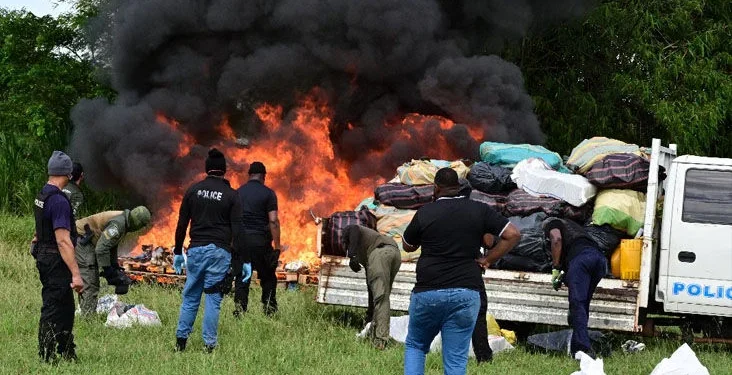
By Mark DaCosta- In a significant escalation of military action in the Caribbean, yesterday, the United States has executed its fourth air strike on a vessel it alleged was involved in drug trafficking, according to Secretary of War, Pete Hegseth. The latest operation occurred in international waters off the coast of Venezuela, further intensifying concerns regarding the legality and implications of U.S. military engagement in the region.
The air strike reportedly resulted in the deaths of four individuals, labelled by Hegseth as “narco-terrorists.” These assertions come without the provision of substantial evidence, raising eyebrows among legal experts and international observers alike. The U.S. government claims that these vessels are part of organised drug trafficking aimed at flooding the American market and imperilling public health. Yet, the lack of concrete evidence supporting these claims casts doubt on the justification for such military actions.
Tracing back to the initial air strike on September 2, the U.S. operations have unfolded rapidly and with increasing lethality. That first attack resulted in eleven fatalities, followed by subsequent strikes on September 15 and September 19, each claiming the lives of three more individuals. Hegseth’s announcement of this latest assault reiterated the Trump administration’s intention to sustain these operations until the flow of narcotics is halted. “These strikes will continue until the attacks on the American people are over!!!!” he emphatically stated.
The legality of these U.S. strikes has drawn significant attention and criticism. Experts argue that the current operations appear to contravene international law, which generally prohibits extrajudicial killings outside recognised combat situations. Furthermore, the United Nations Charter does not categorise drug trafficking as a legitimate cause for armed conflict. Despite this, the Trump administration has made the controversial assertion that the country is engaged in a “non-international armed conflict” with drug cartels, branding them as “unlawful combatants.” This has raised alarming questions about the precedents being set regarding U.S. military engagement in scenarios not traditionally classified as warfare.
Compounding these legal concerns is the revelation that the Trump administration has designated various Latin American drug cartels as “foreign terrorist organisations,” a categorisation that has historically been reserved for entities engaged in political violence or armed conflict, rather than merely illicit trade. Such characterisation extends to the Venezuelan group Tren de Aragua, which has been linked — without corroborating evidence — to President Nicolás Maduro, creating a further spectacle of blame in an already strained geopolitical landscape.
This fresh wave of military action not only has implications for international law but potentially endangers regional stability. Venezuela has expressed its outrage at these strikes, culminating in a military build-up along its coastline. The situation has sparked widespread fears about escalating tensions that could easily spiral into open confrontations. The U.S. military, meanwhile, has increased its presence in the Caribbean, deploying F-35 fighter jets and an array of naval vessels, including warships and submarines, igniting even greater fears of escalating hostilities.
Prominent critics have raised the alarm over the erosion of legal and ethical guidelines in military engagement under Trump’s leadership. Many former military lawyers argue that the administration’s reasoning for targeting suspected drug traffickers at sea undermines the established laws governing warfare. By sidestepping the requirement for due process and accountability, the Trump administration risks creating a precedent where extrajudicial actions become a commonplace strategy under the guise of upholding national security.
The implications of these actions extend beyond the battle against drug trafficking. The ramifications could include a destabilisation of the existing fragile peace in the Caribbean, with governments in the region, including our own, watching the unfolding events with anxiety. Cooperation in counter-narcotics efforts could be jeopardised, setting back progress in battling the very drug trade that the U.S. claims to combat.
Despite Trump’s bold declarations of intent, the underlying reality remains troubling. The administration has yet to provide clear and credible evidence to substantiate its claims regarding the drug trafficking activities of those they target, and as reports of countless individuals being killed or labelled without due process continue to emerge, the real motive behind these strikes is increasingly questioned by both international and domestic critics.
As the U.S. military engages in these high-stakes operations, it raises critical questions for our region: Will the pursuit of an aggressive anti-drug agenda lead to an era of confrontation rather than cooperation? Are the lives of innocent civilians — including our own — caught in the crossfire of a misguided war? With tensions mounting and legal boundaries being pushed, the unfolding situation merits scrutiny from not only those in power but every citizen of our nation, as we consider the broader consequences of America’s actions in our Caribbean waters.