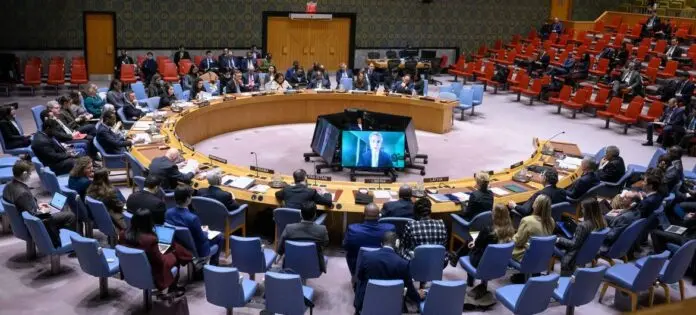
The United Nations Security Council has extended the mandate of the Gang Suppression Force in Haiti for another six months, as member states called for faster deployment of the multinational force and greater resources to address gang violence and help create conditions for elections.
The 15-member council adopted Resolution 2829 by a vote of 12-0, with China, Pakistan and Russia abstaining. The resolution extends the force’s mandate through March 31, 2027.
The council also requested that the UN secretary-general report every six months on progress against benchmarks established in a previous resolution.
The resolution noted a July 27 agreement between Haiti and the Gang Suppression Force that confirms the force’s legal personality. It also encouraged UN member states to recognize its legal status and provide the force and its personnel with the necessary privileges and immunities.
The council stressed that the force must operate in accordance with international law, including international human rights law. It also highlighted the need for reintegration, psychosocial support and education for children formerly associated with gangs.
Haiti urges faster deployment
Haiti’s representative welcomed the renewal but said the force must now receive the personnel, equipment and operational capabilities needed to become fully operational.
He called for the swift completion of legal, administrative and operational arrangements to facilitate deployment.
The Haitian government wants the force to help the state regain control of areas held by armed criminal groups, secure critical infrastructure, restore state authority and establish the security conditions needed for a return to constitutional order and elections.
“It is not enough to take territory from the gangs,” Haiti’s representative said, stressing that recovered areas must be held, public services restored and armed groups prevented from returning.
He also emphasized that the force should complement rather than replace Haitian institutions, including through coordination with the Haitian National Police and Haitian Armed Forces.
US points to early gains
The United States supported the renewal and pointed to what it described as early progress by the force.
The US representative said the force was “taking the fight to the gangs,” clearing roads and neighborhoods, reclaiming areas that had become inaccessible to police and shutting down illegal tolls.
He praised troops and police from Chad, El Salvador, Guatemala, Jamaica, Mongolia and Sri Lanka who are participating in the mission.
“They’ve left their homes and their families to take on some of the most violent gangs in our hemisphere — and that certainly takes courage,” he said.
The US representative said Haitians could “win back their streets, their lives and their futures for their families.”
China and Russia, however, questioned whether an external security force could address the deeper causes of Haiti’s crisis.
China’s representative said the crisis was “not a simple security question,” pointing instead to governance challenges, alleged collusion between police and gangs and economic conditions that contribute to some Haitians, including children, joining criminal groups.
China abstained from the vote.
Russia also abstained, with its representative saying Moscow had concerns about the force’s model and financing when it was established. He said delays in deployment had also affected preparations for general elections.
Russia’s representative called for international efforts to stop the flow of weapons and money to Haitian criminal groups.
Pakistan, which also abstained, said Haiti’s challenges require a comprehensive response that is nationally owned and implemented. Its representative expressed hope that the force would be fully deployed and supported through sustainable funding.
CARICOM calls for more resources
Jamaica’s representative, speaking on behalf of the Caribbean Community (CARICOM), welcomed the mandate extension while acknowledging that deployment has been slower than expected.
He called for the force to reach full operational capacity as soon as possible and urged international partners to provide additional financial, logistical and operational support to the force, the Haitian National Police and Haitian armed forces.
CARICOM also called for assistance including troop airlift, air and sea monitoring equipment, technical support, language training and translation services.
The Jamaican representative voiced concern about violence against women, girls and young people, including sexual and gender-based violence, exploitation and recruitment by criminal groups.
He said security improvements must ultimately create the conditions for elections and the restoration of democratic governance in Haiti under Haitian leadership.
“Armed gangs will not be allowed to determine Haiti’s future nor, indeed, that of the Caribbean region,” he said.
The Dominican Republic also supported the extension but cautioned that the renewal “is not an end in itself.”
Its representative said the additional six months should give the force time to complete its deployment and help establish conditions for elections.
“Security opens the way, but security alone is not enough to keep that path open,” he said.
caribbeannationalweekly.com