
The sudden barricading of sections of Stabroek Market on Thursday has thrown scores of vendors into turmoil, igniting public outrage and triggering a fierce debate over transparency, consultation and the human cost of urban development in the capital. Many stallholders—some of whom are the sole breadwinners for their households, others who recently took out loans to prepare for the lucrative Christmas season—say they received no prior notice, no involvement in decision-making and no clear information on how long they will be displaced or how their livelihoods will be protected.
For these vendors, the timing could not be worse. December is the most financially critical period of the year, when small traders depend heavily on increased sales to meet rent, repay debts, cover school expenses and provide for their families. Instead, many now face economic uncertainty, with some describing the abrupt barricading as “cruel” and “inhumane” given the already rising cost of living.
The Ministry of Local Government and Regional Development has rejected claims that the move was abrupt or inconsiderate. In response to nationwide criticism, Minister Priya Manickchand issued a lengthy public statement defending the government’s actions and insisting that the redevelopment effort had been communicated to relevant authorities.
Manickchand stated that at a meeting held in a packed boardroom at the Ministry of Housing—amid the Mayor of Georgetown, Alfred Mentore, and several city councillors—a video presentation was shown illustrating what the new Stabroek Square would look like. She said the response from the City Council was “lovely, lovely. This is what is needed.”
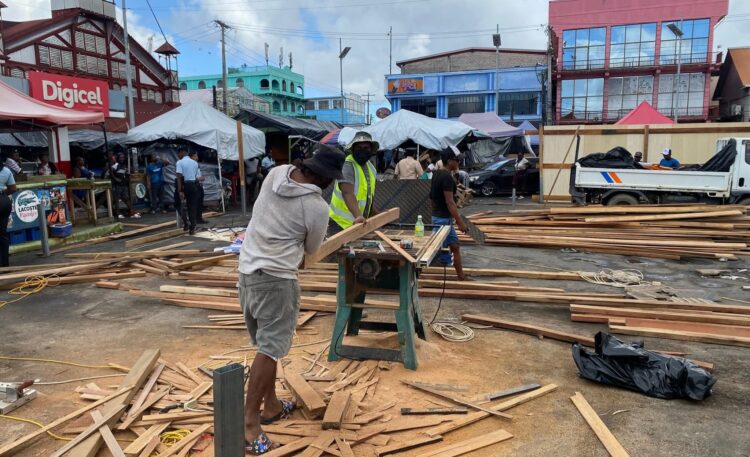
The Minister further claimed that the redevelopment concept was also presented during a wider stakeholder engagement and that the restoration of Stabroek Square has long been publicly discussed. She attributed the erection of plywood barriers to safety requirements and insisted that the project will be completed in under two weeks.
“We are further advised that two vendors could be displaced temporarily by this construction and instructions have been given that will minimize that effect,” Manickchand wrote. She added that the Ministry would engage the affected vendors directly and emphasized that “development must have a human face and that no vendors will be moved at this point.”
However, this account sharply contradicts the experiences reported by vendors on the ground, many of whom say they were blindsided by the barricades and left scrambling to salvage merchandise, negotiate space or simply determine whether they would be able to return the next day.
Long-standing PNCR supporter and former Parliamentarian Lurlene Nestor, responding on social media, accused the government of “hoodwinking” the vendors and operating in bad faith.
“The minister walked the streets, cozy up with the vendors then, in a clandestine fashion pulled the survival rug from under their feet. This is what hoodwink looks like, this is what disrespect looks like, this is what taking people for granted looks like, this is what believing that the people ‘stupid’ looks like,” Nestor argued.
She questioned why no “decent, respectful conversations” were held with vendors beforehand, particularly given the severe implications for their livelihoods. Nestor also raised concerns about the role of city authorities, asking whether Georgetown’s Mayor and City Council “surrendered” their legal authority under the Local Government Act and whether the national government sought lawful permission to construct the barricades.
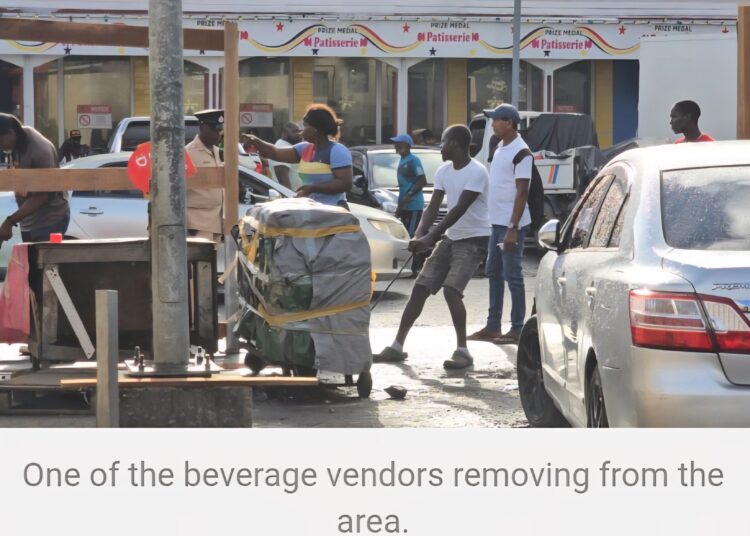
“It does not have to be like this,” she wrote, calling the timing—immediately before the Christmas shopping season—“significant.”
The competing narratives—one insisting that consultation occurred among senior officials, the other asserting that vendors were never informed—underscore a widening disconnect between policymakers and the informal sector that keeps much of Georgetown’s commercial life afloat. For the stallholders now facing displacement, the core issue is not only the absence of consultation but a deeper fear that redevelopment projects continue to marginalise low-income workers without providing realistic alternatives or economic protections.
With the Christmas season already underway, scores of families remain in limbo, unsure of how they will secure their earnings or meet financial obligations. Whether the promised “human face” of development will translate into concrete relief for those affected is now a critical test of whether urban renewal in Guyana can proceed without inflicting disproportionate hardship on the very people whose livelihoods depend on these public spaces.






![The skyline of Beijing. [Photo/VCG]](https://villagevoicenews.com/wp-content/uploads/2024/09/CHINA-5-350x250.jpeg)