By Mark DaCosta- Fire Chief Gregory Wickham has reportedly told the public that the media, that the inferno which gutted the Guyana Trades Union Congress (GTUC) headquarters and its Critchlow Labour College training centre on 31 July 2025 was intentionally set. The formal finding, reportedly handed to the Guyana Police Force for a criminal probe, comes amid growing unease that the July blaze may be linked to an earlier, unexplained fire at the same complex in March 22, 2025. Union leaders and members of the labour movement are demanding swift answers and heightened protection for institutions central to workers’ education and organisation.
The most recent fire erupted late on 31 July, consuming a multi-purpose building on Woolford Avenue that housed the GTUC administrative offices, the Critchlow Labour College and several training units. Firefighters reached the scene within minutes of the alarm but reported that one section was already fully ablaze and the flames were spreading rapidly, necessitating the deployment of additional appliances. Investigators now say the July blaze was maliciously ignited; the inquiry’s results have been passed to police, who have opened a criminal investigation. The earlier incident, in March 22, 2025, remains unresolved — the Fire Service has yet to release a conclusive finding on its cause, a delay that has fuelled suspicion and calls for accountability.
For decades the Critchlow Labour College served as a backbone of vocational and union education in our nation, providing pathways into teacher training and tertiary study for generations of Guyanese. Union officials point to the college’s long record of advancing workers’ skills and civic participation.
Lincoln Lewis, General Secretary of the GTUC, has been outspoken since the March fire, framing the destruction as more than property damage. “This attack is not merely against our buildings, but a direct assault on the independence of labour in our country,” he said, insisting the incidents represent an attempt to undermine the movement’s institutional capacity. He later added a broader civic warning: “The blow struck on GTUC is a blow against all Guyanese,” linking the loss to the nation’s social and educational fabric.
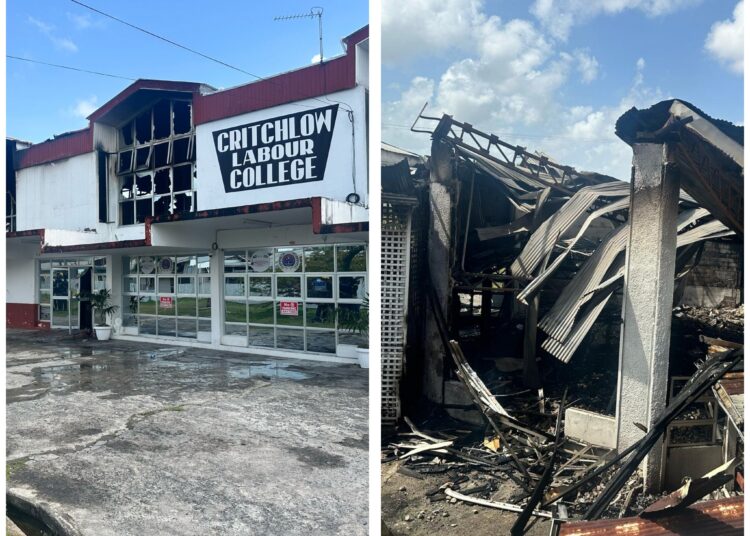
Those remarks echo the deep anger and anxiety within union ranks. In statements released after the July blaze, GTUC officials reminded the public that hundreds of thousands — from diverse communities across the country — have benefited from the college’s programmes over its half-century of existence. They also reiterated their frustration that, four months on from the March episode, a conclusive report had not been made public. That gap in official communication has left many questions unanswered: Why was the same complex affected twice within a matter of months? Were safety upgrades pledged after the March incident undertaken in full? And crucially, who stood to gain from disabling a hub of labour education and administration?
On the night of the July fire witnesses reported seeing the blaze grow quickly, with emergency crews fighting to prevent spread to adjacent properties. Sources close to the investigation told reporters that early evidence suggested deliberate ignition, which corroborated observers’ initial suspicions. Police have indicated that they are treating the recent findings seriously and are pursuing leads as part of a broader criminal inquiry. Investigators are also examining whether there is any connection between the two fires — a link that, if established, would elevate the matter from a tragic accident to a concerted campaign against organised labour.
President Irfaan Ali has pledged government support for reconstruction efforts, offering to assist in rebuilding the damaged facilities. Yet union leaders maintain that government rebuilding aid must be accompanied by transparency and a credible, expedited investigation. The GTUC has called publicly for the Fire Service to release its March report without further delay and for full cooperation between fire investigators and police so that those responsible, if criminality is confirmed, are brought to justice.
The destruction has practical consequences beyond the loss of buildings. Courses, records and meeting spaces vital to union activity have been disrupted. Students and trainees who rely on the college for advancement face uncertainty, and trade unionists say the damage threatens the continuity of training that feeds skilled professionals into the education sector and beyond.
As police carry the inquiry forward, labour leaders are urging citizens to treat the incident as a national concern — not only as an attack on a federation or a school, but on institutions that underpin workers’ rights and social mobility. The coming weeks will test the capacity of the investigative agencies to deliver clarity and the willingness of authorities to ensure the safety of institutions central to civil society. Until the full picture emerges, unionists and many in our nation will be left asking who would target these symbols of labour organisation and education, and why.