History of the Caribbean Community
The establishment of the Caribbean Community and Common Market (CARICOM) was the result of a 15-year effort to fulfil the hope of regional integration which was born with the establishment of the British West Indies Federation in 1958. The West Indies Federation came to an end in 1962 but its end, may be regarded as the real beginning of what is now the Caribbean Community.
With the end of the Federation, political leaders in the Caribbean made more serious efforts to strengthen the ties between the islands and mainland by providing for the continuance and strengthening of the areas of cooperation that existed during the Federation. Further, Jamaica and Trinidad and Tobago both attained independence in August that year and with it the power to control their own domestic and external affairs.
In announcing its intention to withdraw from the Federation, the Government of Trinidad and Tobago proposed the creation of a Caribbean Community, consisting not only of the 10 members of the Federation, but also of the three Guianas and all the islands of the Caribbean Sea – both independent and non-independent.
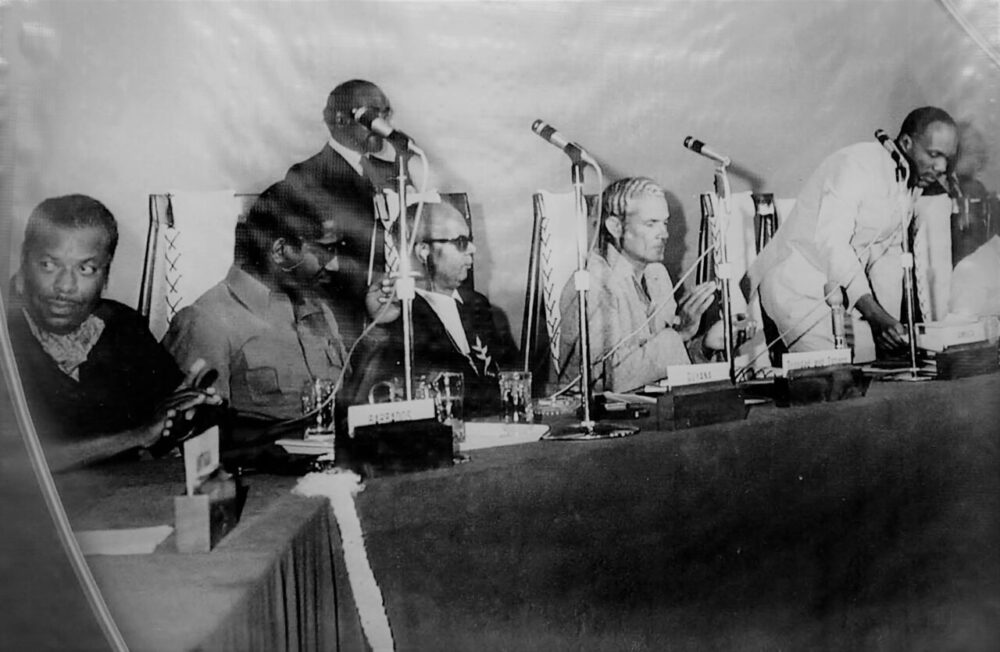
To discuss this concept, the Prime Minister of Trinidad and Tobago convened the first Heads of Government Conference in July 1963, and attended by the leaders of Barbados, British Guiana, Jamaica and Trinidad and Tobago. At this Conference, the participating leaders of the four(4) Caribbean Countries all spoke clearly of the need for close cooperation with Europe, Africa and Latin America.
In July 1965, talks between the Premiers of Barbados and British Guiana and the Chief Minister of Antigua on the possible establishment of a Free Trade Area in the Caribbean resulted in the announcement of definite plans to establish such a Free Trade Area. In December that year, Heads of Government of Antigua, Barbados and British Guiana signed an Agreement at Dickenson Bay, Antigua, to set up the Caribbean Free Trade Association (CARIFTA).
The new CARIFTA agreement came into effect on May 1, 1968, with the participation of Antigua, Barbados, Trinidad and Tobago and Guyana. The original idea to permit all territories in the Region to participate in the Association was achieved later that year with the entry of Dominica, Grenada, St. Kitts/Nevis/Anguilla, Saint Lucia and St. Vincent in July and of Jamaica and Montserrat on August 1, 1968. British Honduras (Belize) became a member in May 1971.
At the Seventh Heads of Government Conference in October 1972, Caribbean Leaders decided to transform CARIFTA into a Common Market and establish the Caribbean Community of which the Common Market would be an integral part.
At the Eighth Heads of Government Conference of CARIFTA held in April 1973 in Georgetown, Guyana the decision to establish the Caribbean Community was brought into fruition with the consideration of Heads of Government of the draft legal instruments and with the signing by 11 members of CARIFTA (the exception being Antigua and Montserrat).
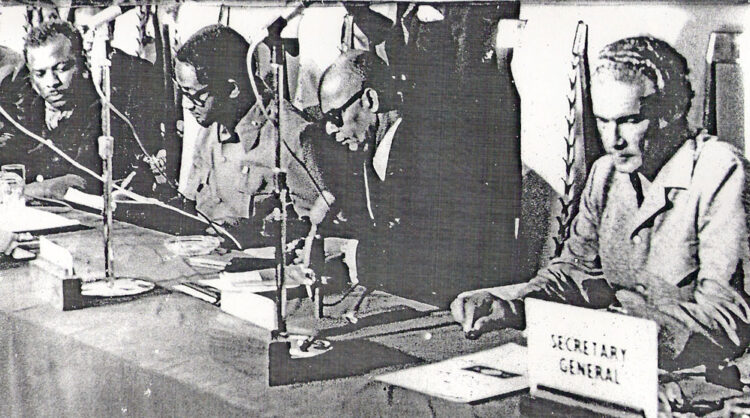
The Accord provided for the signature of the Caribbean Community Treaty on July 4 and its coming into effect in August 1973, among the then four independent countries: Barbados, Guyana, Jamaica and Trinidad & Tobago.
The Georgetown Accord also provided that the other eight territories – Antigua, British Honduras, Dominica, Grenada, Saint Lucia, Montserrat, St. Kitts/Nevis/Anguilla and St. Vincent which signed the Accord would become full members of the Community by May 1, 1974.
The Caribbean Community and Common Market (CARICOM) was established by the Treaty of Chaguaramas, which was signed by Barbados, Jamaica, Guyana and Trinidad & Tobago and came into effect on August 1, 1973. Subsequently the other eight Caribbean territories joint CARICOM. The Bahamas became the 13th Member State of the Community on July 4, 1983, but not a member of the Common Market.
In July 1991, the British Virgin Islands and the Turks and Caicos became Associated Members of CARICOM, followed by Anguilla in July 1999. The Cayman Islands became the fourth Associate Member of the regional grouping on 16 May 2002, and Bermuda the fifth Associate Member on 2 July 2003.
Suriname became the 14th Member State of the Caribbean Community on July 4, 1995.
Haiti secured provisional membership on 4 July 1998 and on 03 July 2002 was the first French-speaking Caribbean State to become a full Member of CARICOM. (CARICOM)
![Haitians deported from the US land in Cap-Haitien, Haiti, on August 27 [Ketlain Difficile/AP Photo]](https://villagevoicenews.com/wp-content/uploads/2026/09/haiti-750x375.webp)