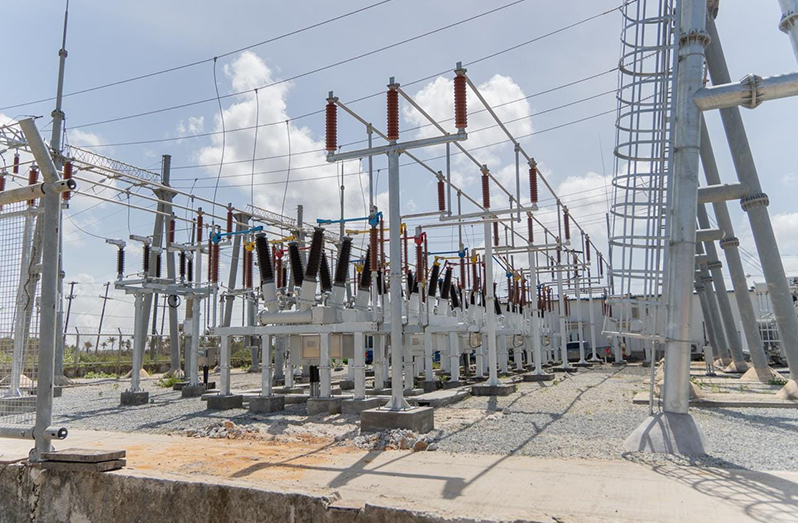
By Mark DaCosta- A some 45-hour blackout in East Berbice-Corentyne has reportedly ended in stages, and it has raised hard questions about how reliable our national electricity system really is. The failure of a single substation at Canefield, a facility Guyana renovated at great public expense, left thousands of Region Six households and businesses without power for nearly two days. The authorities’ thin communication during the crisis made matters worse.
Trouble began around midday on Thursday, 19 November. Technicians at Guyana Power and Light (GPL) were re-energising the Canefield substation when a flash erupted from a switchgear cubicle. GPL later traced the fault to failed insulation in the panel housing the grounding transformer. That device allows protective systems to detect and isolate faults, so the station could not safely be returned to service. Several defective components had to be replaced and the equipment retested, experts tell this publication.
Public patience was tested further when GPL’s Saturday deadline of 1 p.m. passed unmet. The utility conceded shortly before that hour that it could not deliver. Into that vacuum came a doctored social media post, made to resemble an official notice, promising power on 22 or 23 November. GPL rejected it as fake, but the episode showed how quickly rumour fills a silence.
By about 6:48 p.m. on Saturday, GPL declared the Canefield repairs finished and began phased restoration. New Amsterdam was repowered first, with Republic Road, Strand, and the corridor from Main Road to Mara following. Sections between Canje and Auchlyne were also reconnected, while lines from Canefield towards Williamsburg and Kortberaadt were to follow. The company offered a rare apology for what it called a prolonged and frustrating interruption.
President Irfaan Ali termed the outage “wholly unacceptable”, apologised to East Berbice consumers, and promised a review once power was back. Yet neither the Government nor GPL held a press conference on what has been described as the longest outage on the Demerara-Berbice system in decades. Updates came through Facebook posts, a thin channel for a crisis affecting an entire region.
The irony is plain. Canefield was upgraded under a Japanese-funded project of about G$1.4 billion, commissioned in 2021 to steady voltage and cut outages across Region Six, and Prime Minister Mark Phillips later commissioned a further upgraded facility at the site. Those investments were meant to buy resilience. Instead, one internal failure showed how much of the region’s supply still hangs on a single node.
The outage also follows the widespread blackout of 30 October, which GPL said it strongly suspected was caused by deliberate interference with a high-voltage line. There is no public evidence linking the Canefield failure to that suspected sabotage, and it would be irresponsible to suggest a connection before investigators speak.
The coming review must therefore be public, and its findings must be made known. Region Six residents are owed a clear account of why the equipment failed, why repairs overran, and what redundancy will stop a repeat. Restoration was still in progress at the latest reports, so some feeders may remain dark. For a nation that is investing heavily in new energy infrastructure, steady power is a basic test of competence and of respect for the people it serves.