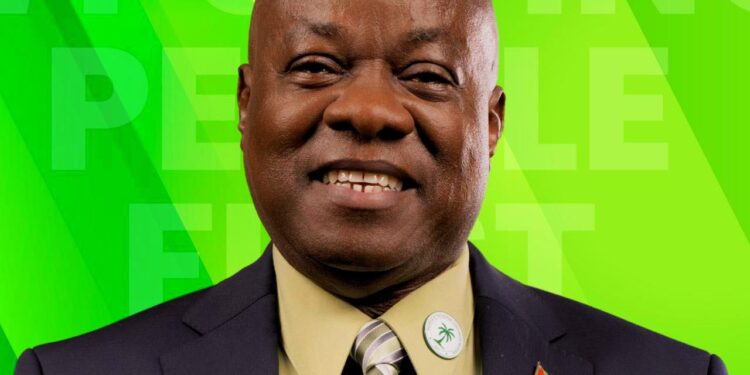
Former Minister and former Member of Parliament Annette Ferguson has challenged Local Government Minister Priya Manickchand to explain the legal and financial basis for the benefits accessed by former President David Granger, questioning whether the Government’s proposed 2026 Former Presidents’ Benefits Bill would remove important safeguards on public spending.
Ferguson’s response followed Manickchand’s defence of the legislation during parliamentary debate, in which the minister said of Granger: “He (an ailing David Granger) is perhaps the former president who has used those services more than anybody else and I say he should.”
But Ferguson, in a pointed statement, argued that the minister’s defence sidesteps a more fundamental question: whether the services and payments provided to Granger were consistent with the law already in force.
She noted that Granger was President when the Former Presidents (Benefits and Other Facilities) Act 2015 was assented to on July 10, 2015, and questioned whether he was expected to respect the limits established under legislation to which he himself gave assent.
Ferguson also demanded disclosure of the authority under which payments were made, who approved them, the amounts spent by the State and whether those expenditures complied with the law.
The 2015 Act established specific limits, including monthly allowances of $25,000 each for water, electricity and telephone services, a maximum of three household staff, no more than two state-owned vehicles and an annual medical limit of $200,000. It also restricted security personnel and provided that certain benefits would cease if a former president entered business, trade or paid employment.
The proposed 2026 Bill, introduced by Finance Minister Dr Ashni Singh, seeks to repeal the 2015 framework and restore the broader arrangements under the 2009 legislation. It provides for lifetime payment of utilities, household and clerical assistance, medical treatment for former presidents and dependent family members, full-time personal security, state-maintained vehicles, toll-free transportation and an annual vacation allowance equivalent to two first-class return airfares.
The legislation has become a point of contention over whether former presidents should receive uncapped publicly funded benefits or whether reasonable financial ceilings should remain in place. Government ministers have defended the Bill as necessary to ensure equal treatment of former heads of state, while opposition parliamentarians have pressed for limits and greater accountability.
Ferguson said her objection was not to providing former presidents with dignity, security or appropriate medical attention, but to the prospect of an open-ended commitment of taxpayers’ money.
In her statement, titled “Let Us Have an Honest Conversation About the 2026 Former Presidents’ Benefits Bill!”, she said:
“Minister, let us not confuse the legitimate recognition of a former President’s service with an argument for unlimited benefits at taxpayers’ expense.
Nobody is suggesting that former Presidents should be abandoned, denied reasonable security or deprived of appropriate medical attention.
But why should holding the office of President automatically translate into an entitlement to an unlimited package of publicly funded privileges for the remainder of one’s life?”
She questioned why taxpayers should be required to finance uncapped utilities, medical expenses, household staff, security, vehicles and other facilities while ordinary Guyanese struggle to meet basic needs.
Ferguson also challenged the Government’s argument about equal treatment, insisting that equality does not require the removal of every financial safeguard.
“Equality does not necessarily mean removing every safeguard and financial ceiling. We can establish equal entitlements while maintaining reasonable limits, accountability and transparency.”
Her intervention adds to the pressure on the Government to explain why the restrictions introduced in 2015 should be discarded and what controls, if any, would govern expenditure under the proposed law.
The Bill was not passed during the parliamentary debate that continued into Thursday morning. The National Assembly adjourned, with debate scheduled to resume on Monday, November 23.
Ferguson said public funds belong to the people of Guyana and should not be treated as the entitlement of former presidents, sitting presidents or political administrations.
She concluded:
“The question is not whether David Granger deserves dignity. Every former President deserves dignity.
The question is whether the proposed 2026 legislation strikes a reasonable balance between the dignity of former Presidents, accountability for public expenditure and the welfare of the Guyanese people.
The dignity of the Presidency must never become an excuse for unlimited expenditure from the national treasury.”