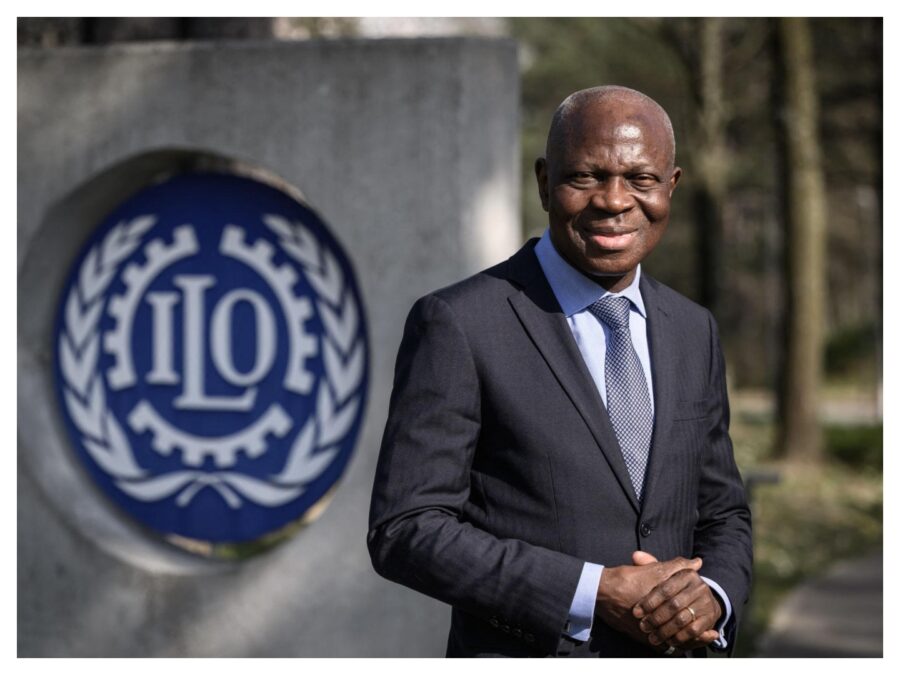
Togolese national Gilbert F. Houngbo has been re-elected Director-General of the International Labour Organization (ILO), securing a second five-year term at a time when the United Nations agency faces mounting financial pressures, concerns over workers’ rights and the growing impact of artificial intelligence on employment.
Houngbo received 51 of 56 votes in a secret ballot on November 16, 2026, during the ILO Governing Body’s 358th session in Geneva. Five members abstained.
His new mandate will begin on October 1, 2027, and run until September 30, 2032. He first assumed office in October 2022, becoming the first African to lead the organisation.
His re-election followed the withdrawal of both challengers. Spain’s Labour Minister and Deputy Prime Minister Yolanda Díaz withdrew on the morning of the vote, while Peru’s former Foreign Minister Javier González-Olaechea had pulled out earlier in November.
Díaz said she did not want to divide the international trade union movement, but also criticised the organisation’s leadership, describing its financial situation as a serious crisis.
With both challengers out of the race, Houngbo secured another term with no opposing candidate on the ballot.
Financial pressures confront ILO
The re-election comes as the ILO confronts significant financial challenges, including the withholding of United States contributions, which have traditionally represented an important source of its funding.
The shortfall has forced the organisation to consider operational changes and workforce reductions, prompting concerns among employees and trade union representatives.
The financial difficulties have also raised questions about the agency’s ability to maintain its programmes and international labour initiatives at a time when millions of workers worldwide face economic uncertainty.
The ILO’s responsibilities include promoting decent work, protecting workers’ rights, combating forced and child labour, advancing social protection and encouraging fair employment practices.
Artificial intelligence poses new employment challenges
One of the central issues facing Houngbo’s second term will be the impact of artificial intelligence and technological advances on the global workforce.
The rapid expansion of automation and AI is transforming industries, changing the nature of employment and raising concerns about job displacement, wage inequality and the skills workers will need to remain competitive.
Houngbo has argued that technological development must benefit humanity rather than undermine workers’ livelihoods.
“Our organisation should be at the vanguard of these reflections such that technological progress can remain at the service of human beings,” he said.
His position signals that the ILO intends to play a central role in shaping international discussions about the future of work, including the need for policies that protect workers while allowing technological innovation.
Who is Gilbert Houngbo?
Houngbo, 65, is a former Prime Minister of Togo, having served from 2008 to 2012. Before taking the helm of the ILO in 2022, he held senior positions in international development, including at the United Nations Development Programme and the International Fund for Agricultural Development.
The ILO, established in 1919, became the first specialised agency of the United Nations in 1946. It has 187 member states and operates through a distinctive tripartite structure that brings together governments, employers and workers in its decision-making processes.
For developing countries, including Guyana, the organisation’s work has particular relevance to fair wages, occupational safety, employment security, social protection and the protection of workers’ rights.
Houngbo’s second term will therefore be measured not simply by the organisation’s ability to navigate its financial difficulties, but also by how effectively it responds to changing employment conditions and ensures that economic and technological progress translates into decent work and improved livelihoods for workers.