At the opening of Guyana Festival 2026, President Irfaan Ali urged Guyanese to recommit themselves to national unity and inclusion, declaring that One Guyana must become a lived reality rather than merely a slogan.
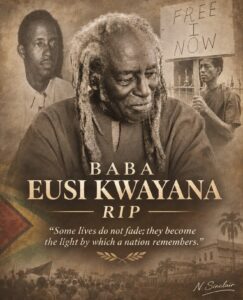
Those words have remained with me, particularly following the passing of Baba Eusi Kwayana on October 10, 2026, at the age of 101.
Unless I have overlooked an official statement, I have yet to see President Ali, Vice President Bharrat Jagdeo, or the leadership of the PPP/C publicly acknowledge his passing with the same courtesy extended to former PNC leader Robert Corbin.
I raise this not to diminish the respect shown to Mr. Corbin.
Such recognition was appropriate.
Rather, I question why a similar gesture appears absent for a man whose contributions to Guyana’s political development transcended party affiliation and whose life was inseparable from the nation’s struggle for independence.
Baba Eusi Kwayana, born Sydney Evanson King in 1925, was not merely a witness to Guyana’s political history.
He was one of its architects.
He entered political activism during the colonial period, became a founding member of the People’s Progressive Party, and served as Minister of Communications and Works in the historic 1953 government elected under universal adult suffrage.
Following the British suspension of the Constitution, he was detained by the colonial authorities.
His political activism was never without personal sacrifice.
Raised in Buxton, a village established by formerly enslaved Africans, Kwayana began teaching at a remarkably young age.
He organized among sugar workers and, according to historical accounts, was barred from eleven plantations because of his activities.
While detained by the British, he undertook a hunger strike in solidarity with Kenyans imprisoned during the Mau Mau uprising.
These were not the actions of someone seeking political convenience.
They reflected a lifelong commitment to resisting injustice, even when doing so carried personal consequences.
His departure from the PPP was also rooted in political conviction.
He disagreed with the party’s positions on West Indian federation and the Soviet suppression of the Hungarian uprising in 1956.
He subsequently became involved with the PNC, serving as its General Secretary and editing its newspaper, New Nation, before breaking with that political environment over concerns surrounding ethnic divisions and political direction.
Through ASRE and ASCRIA, he helped advance African cultural consciousness, dignity and self-determination.
Yet his commitment to African identity did not prevent him from pursuing cooperation across Guyana’s ethnic communities.
He later became a founding figure of the Working People’s Alliance, working alongside Walter Rodney, Andaiye, Rupert Roopnaraine and others in the struggle for democracy and accountability.
One particularly remarkable aspect of his legacy is that he wrote political songs associated with the PPP, PNC and WPA. Three movements central to Guyana’s political history carry elements of his cultural contribution.
How many Guyanese can claim such an extraordinary place in the political and cultural development of their country?
And his intellectual contributions extended far beyond party politics.
He was an educator, writer, community organizer and historian who documented the experiences of ordinary Guyanese, particularly those whose stories might otherwise have been excluded from the national record.
Perhaps most extraordinary is that his commitment to constitutional accountability continued into his final year.
On January 16, 2026, at the age of 100, Kwayana wrote publicly about consulting a constitutional lawyer regarding possible judicial intervention to address what he considered violations affecting Guyana’s parliamentary democracy.
A century old, and still concerned about protecting the Constitution and strengthening the country he helped build.
It is difficult to imagine a more compelling demonstration of lifelong national service.
This is why the apparent absence of official recognition troubles me.
President Ali has spoken repeatedly about national reconciliation, respect for diversity and the importance of overcoming political divisions.
Vice President Jagdeo, in his tribute to Robert Corbin, demonstrated that political opponents can acknowledge one another’s contributions despite their differences.
Why should that same principle not extend to Baba Eusi Kwayana?
Our leaders regularly engage in diplomatic courtesies with representatives of foreign governments, including those with whom Guyana has profound historical or contemporary disagreements.
Surely, extending a few words of national respect to one of our own independence pioneers should not be more difficult.
I am not suggesting that Kwayana was beyond criticism.
His political positions, like those of every historical figure, remain open to examination and debate.
But disagreement should never require the erasure or diminished recognition of a person’s contributions.
Indeed, the measure of genuine national unity is not how warmly we embrace those with whom we agree, but whether we can acknowledge the service and humanity of those with whom we differ.
Guyana’s freedom was shaped by generations of African resistance to enslavement and colonial domination, the labour and sacrifices of indentured workers and their descendants, Indigenous peoples, and countless ordinary citizens who challenged injustice.
Kwayana understood that the nation’s future depended upon recognizing those intertwined histories rather than allowing political divisions to consume them.
He lived to witness Guyana’s first election under universal adult suffrage, the lowering of British colonial authority, the raising of our national flag, and six decades of independence.
He also witnessed the disappointments, political conflicts and unfinished promises of that independence.
Yet he never stopped engaging with his country’s future.
As Guyana bid farewell to this remarkable son, I extend heartfelt condolences to his family, loved ones, comrades and the generations of Guyanese whom he taught, inspired and challenged.
I also ask our national leaders to reflect upon the meaning of the unity they so frequently advocate.
If One Guyana is truly a lived reality, then national recognition must extend beyond political allegiance.
Baba Eusi Kwayana’s contributions belong to Guyana, not merely to the WPA, the PNC, or the early PPP. His legacy is woven into the history of all three.
And to those who may have chosen silence, I offer this reminder: whenever the political history of those organizations is written, whenever their cultural contributions are examined, and whenever Guyana’s independence struggle is remembered, Eusi Kwayana’s name will remain.
A government may choose whether to acknowledge a man, but it cannot erase the history that man helped create.
May Baba Eusi Kwayana rest peacefully with the ancestors, and may Guyana honour his memory by striving toward the unity, dignity and accountability to which he devoted his life.
Yours sincerely,
Nakisha Sinclair (Martian Nella)
Writer & Social Advocate