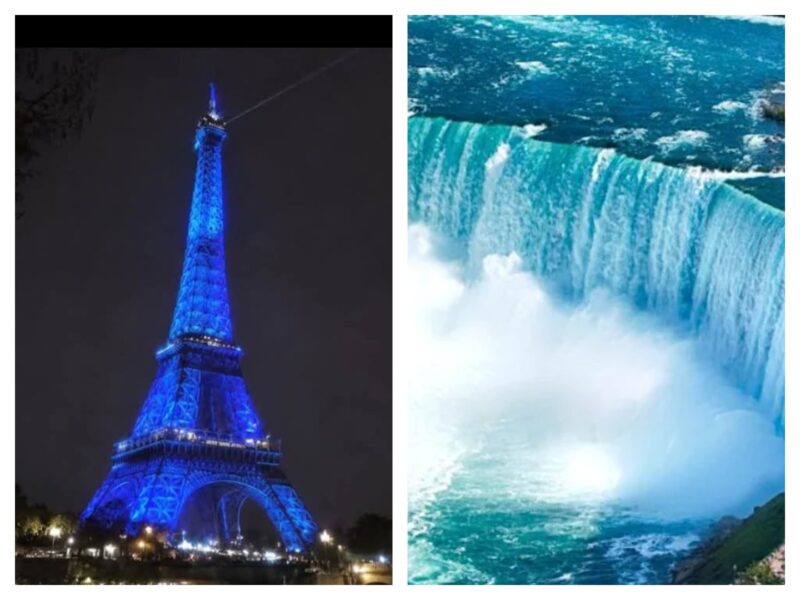
By Mark DaCosta- Reports that Democrats swept the United States midterm elections on 3 November, taking control of both the House of Representatives and the Senate, have prompted political reactions on either side of the Atlantic. Blue — the Democrats’ familiar party colour — also appeared in photographs of the Eiffel Tower and Niagara Falls. But the available information does not show that either landmark was deliberately illuminated to celebrate the reported result.
In France, Economy Minister Roland Lescure was reported to have called the Democrats’ victory decisive and said it could constrain President Donald Trump’s room to manoeuvre on domestic policy. French politician Raphaël Glucksmann was also said to have welcomed the result as a setback for anti-democratic politics. Those reactions, if accurately reported, reflect European interest in a US election that may shape policy well beyond America’s borders. But the election result itself, including the scale of the Democratic gains, should be checked against authoritative returns before being treated as settled fact.
The Eiffel Tower’s blue appearance has added a dramatic image to the story. Yet no reliable evidence in the supplied account establishes that the Paris landmark changed its lighting in response to the US vote. The tower is regularly lit for public campaigns, commemorations and other events; a blue image, without confirmation from its operators or organisers, cannot identify the reason. In other words, the photograph may be real while the political explanation attached to it is not.
The same distinction applies at Niagara Falls. Images shared online showed the water appearing blue during election night, prompting speculation that Canada was sending a message to its southern neighbour. However, the schedule cited in the account listed a teal display from 10pm to 10.15pm. Teal can look bluer in photographs depending on exposure, surrounding light and the screen on which an image is viewed. The schedule points to a planned illumination, not a confirmed election tribute.
Niagara’s nightly displays use powerful lights at several locations and are programmed for a range of causes and occasions. That routine makes it especially risky to infer political intent from colour alone. No confirmation is presented that Canadian officials or the attraction’s operators arranged a special display for the Democrats. The online response appears to have grown from the coincidence of timing, the colour in the images and the strained atmosphere between Washington and Ottawa.
That atmosphere is significant. The account describes a relationship damaged by tariff threats, retaliatory measures and Trump’s provocative talk of Canada becoming America’s 51st state. It also portrays Prime Minister Mark Carney as seeking wider trade options, including closer economic engagement with China, while the two countries confront a difficult review of their trade arrangements. These claims provide context for why some viewers might read a Canadian light display as a pointed gesture. They do not, however, prove that the display was political. Specific details about later negotiations and policy changes should be independently checked before publication, particularly when they are being used to support a strong conclusion about diplomatic intent.
If Democrats did secure both chambers, a divided balance of power in Washington could complicate Trump’s domestic agenda and influence debate ahead of the 2028 presidential election. That possibility is consequential, but control of Congress alone would not settle every policy dispute: the effect would depend on the election margins, party unity, legislative priorities and the president’s use of executive authority. Nor would a US result automatically signal a change in Canadian policy or European relations.
For Guyana, the episode is a reminder to separate political interpretation from verifiable fact. Our country follows decisions in Washington closely because US policy can affect trade, investment, energy and regional diplomacy. In that environment, viral images can quickly acquire meanings that their makers never intended. The responsible conclusion is narrower than the most colourful online claims: blue lights were seen, French figures reportedly welcomed the Democratic gains, and Niagara’s published schedule specified teal. A deliberate transatlantic celebration has not been established. But the whole story is still quite interesting.