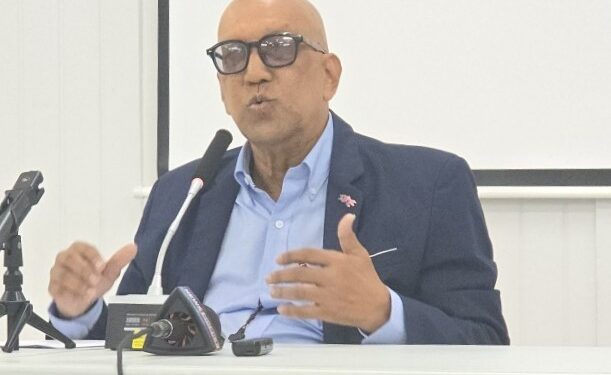
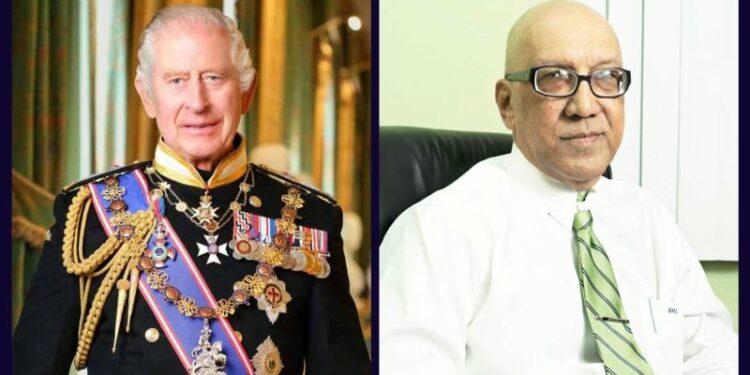
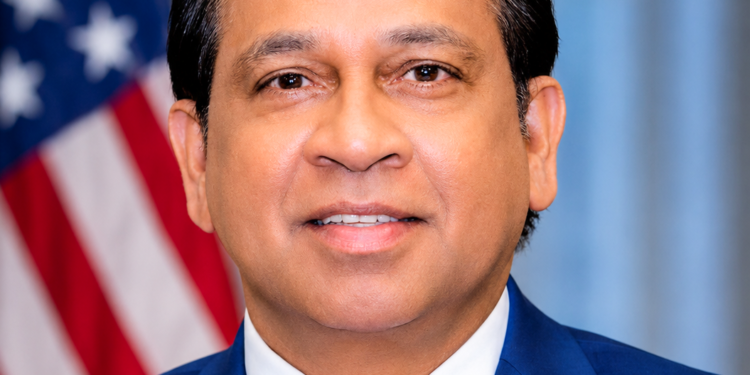
GHK Lall has now treated us to not one, not two, but three separate opinion pieces, all united by a single, tiresome theme: Opposition Leader Azruddin Mohamed is somehow failing at his job because he refuses to kneel before the PPP government’s onslaught. According to Lall’s logic, Mohamed should stop getting arrested, stop getting shot at, stop having his businesses seized, and simply… what? Sit quietly in parliament while the government dismantles everything he has built and every check on its power?
Let us be clear about what Lall is actually arguing. He is arguing that the victim of state harassment should modify his behavior to accommodate his harassers. He is arguing that a man who has had his banks seized, his licenses revoked, his phone confiscated, his freedom of movement restricted, and his person jailed should somehow be more circumspect, as if the PPP’s aggression is a natural phenomenon, like rain, rather than a deliberate strategy of political elimination.
This is the classic blame-the-victim playbook, dressed up in the language of avuncular concern. “I speak many languages,” Lall informs us, “and I cross my religions.” What he does not speak is truth to power. Instead, he speaks power’s preferred language: quiet down, sit still, know your place.
Lall asks, with feigned bewilderment, “Whoever heard of an Opposition Leader who is regularly arrested, regularly handcuffed, regularly jailed?” The answer, Mr. Lall, is anyone who has watched authoritarian governments weaponize the police against their political opponents. The question should not be why Mohamed keeps getting arrested, it should be why the PPP government keeps arresting him. But Lall never asks that question. He accepts the arrests as a given, a fact of nature, and then lectures the arrested man for failing to avoid them.
The remarkable thing about Lall’s three-part lecture series is how thoroughly it ignores cause and effect. The PPP government “took away his business,” Lall writes. “Took away his banks. Took away his phone. Took away his licenses. Took away his freedom of movement. And, last, took away his freedom.” Lall lists these extraordinary acts of state coercion as though they are merely the backdrop against which Mohamed should perform his role more gracefully. He does not pause to ask whether these actions are just. He does not consider whether they are legal. He does not question what precedent they set for future opposition leaders. He simply notes them, then turns to Mohamed and says: adapt.
What exactly is Mohamed supposed to do in the face of these attacks, Mr. Lall? Should he stop investigating government corruption? Should he stop holding press conferences? Should he stop gathering intelligence on the ruling party’s abuses? Lall sneers that Mohamed shouldn’t be engaged in “intelligence gathering” at all, as if opposition leaders in functioning democracies are supposed to sit in a corner and wait for the government to hand them information voluntarily.
Here is the truth that Lall dances around: Mohamed is being targeted precisely *because* he is effective. The government has seen the same research data that Mohamed has seen. They know what the polls say. They know that Mohamed is the only opposition leader in years who poses a genuine electoral threat to the PPP. That is why they are coming after him with everything they have, his businesses, his finances, his liberty, his life.
Lall writes that “the PPP Govt doesn’t even have to lay a trap for him. He walks with his own, then walks right into it.” This is a remarkable admission. It is an acknowledgment that the government is actively laying traps, and Lall’s advice is not that the government should stop, but that Mohamed should somehow learn to avoid them. The PPP is watching, Lall warns. The PPP isn’t letting up. The PPP holds all the cards. And what is Lall’s conclusion? That Mohamed should… grow into his role? Adapt? Become more disciplined?
Disciplined for what, Mr. Lall? Disciplined for the convenience of his persecutors?
Lall invokes Cheddi Jagan, Desmond Hoyte, Robert Corbin, and Bharrat Jagdeo as models of what an Opposition Leader should be. But Jagan was never subjected to the kind of state harassment that Mohamed faces, and even if he had been, would Lall’s advice have been that Jagan should simply have stopped provoking the government? The role of Opposition Leader is to oppose. It is to hold the government accountable. It is to highlight abuses of power. Mohamed is doing exactly that. The fact that the government is retaliating is not evidence of Mohamed’s failure, it is evidence of his effectiveness.
Lall’s Op-Eds are not the work of a neutral commentator. They are the work of someone who has internalized the government’s narrative so thoroughly that he can no longer distinguish between the oppressor and the oppressed. He writes that Mohamed should not be “making himself into a sitting duck”, as if the government’s decision to fire bullets at him is a natural consequence of his own behavior, rather than a deliberate act of political violence. He writes that Mohamed should “learn a few things quickly”, as if the lesson to be learned is that resistance is futile.
Here is a different lesson, Mr. Lall. A precedent is being established. The treatment being meted out to Azruddin Mohamed is the template for how the PPP will treat *any* opposition leader who dares to challenge its power. If Mohamed is broken, if he is jailed, if he is bankrupted, if he is killed, the message will be clear: this is what happens to those who refuse to kneel. And commentators like Lall will be there to explain, in elegant prose, that it was all Mohamed’s fault for not kneeling fast enough.
Lall closes his piece with a flourish: “I could have been dead. It’s time that something sinks in his head.” What should sink in, Mr. Lall, is that you are using your platform to normalize the very abuses that you claim to deplore. You are giving the PPP government a pass, a “past,” as you put it, for conduct that should be condemned in the strongest possible terms. You are telling the victim of political persecution that he should have known better. You are telling the Guyanese people that this is just how politics works, that the strong do what they can, and the weak must adapt.
It is not. It should not be. And those who have the privilege of a platform in this country have a responsibility to say so. Instead of lecturing Mohamed about what he should have done differently, Lall should be demanding answers from the government that seized his businesses, revoked his licenses, and put him in a jail cell. Instead of advising Mohamed to be more like Cheddi Jagan, Lall should be asking why the PPP government is treating a legitimate political opponent like a criminal.
Be careful, Mr. Lall. Be careful what you wish for. Be careful what precedent you help to establish. Because the day may come when the treatment being meted out to Mohamed is meted out to someone you care about, and on that day, you will have no standing to complain. You will have already taught the government that the victim, not the oppressor, is the one who should be judged.
Azruddin Mohamed is not wasting the Opposition Leader portfolio. He is proving, under fire, that he is worthy of it. The waste is the commentary that would tell him otherwise.