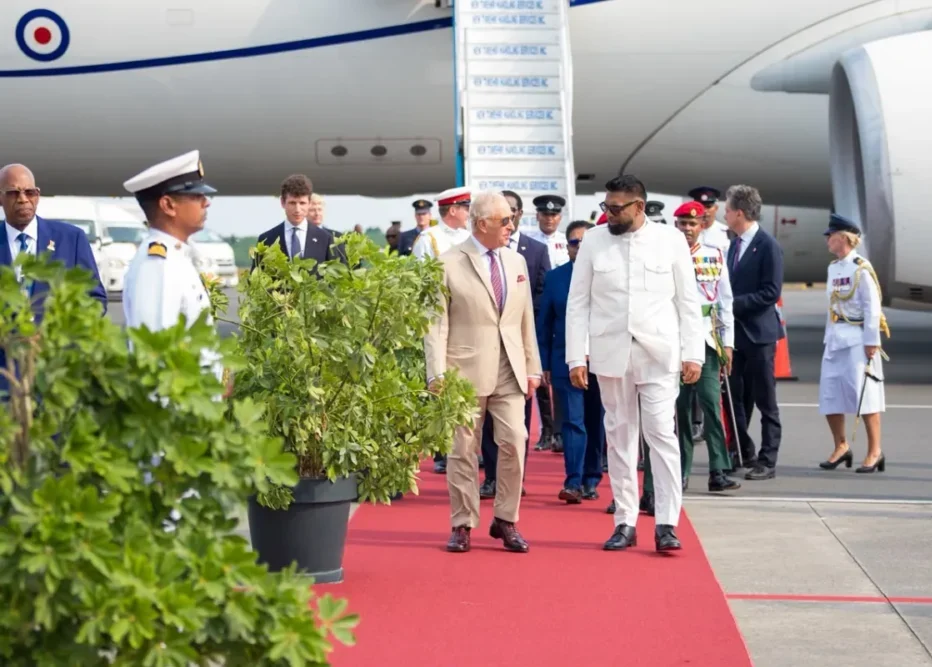
King Charles III arrived in Guyana on Thursday afternoon for a two-day state visit, receiving a ceremonial welcome at the Cheddi Jagan International Airport even as renewed demands for slavery reparations and controversy surrounding the detention of Opposition Leader Azruddin Mohamed cast a political backdrop over the royal engagement.
President Irfaan Ali, Cabinet ministers, senior government officials and representatives of the disciplined services welcomed the British monarch, whose visit is expected to focus on bilateral relations, environmental conservation, biodiversity and investment.
Members of the Guyana Defence Force mounted a ceremonial welcome as the King disembarked and was greeted by President Ali.
According to the Department of Public Information, the monarch’s first official engagement is a meeting with Ali at State House, followed by a reception in the State House gardens attended by representatives of communities across Guyana.
The King is also scheduled to visit the Georgetown Botanical Gardens, where he will examine conservation initiatives and meet young environmental leaders involved in sustainability projects.
On Friday, he is expected to engage British businesses and local stakeholders on investment and commercial partnerships.
His visit coincides with the second Global Biodiversity Alliance Conference at the Arthur Chung Conference Centre, where he will meet scientists, Indigenous representatives and innovators and receive a briefing on the work of the Iwokrama International Centre.
Reparations demands greet royal visit
Beyond the ceremonial welcome, the visit has renewed attention on Britain’s historical responsibility for African enslavement and colonial exploitation.
The International Decade for People of African Descent Assembly–Guyana (IDPADA-G) has urged President Ali to use the royal engagement to press Britain for reparations while committing his own administration to addressing the enduring economic and social consequences of slavery.
In an October 25 letter signed by Chairman Vincent Alexander, the organisation argued that Britain must confront its historical obligations while Guyana must address unresolved inequalities affecting African Guyanese.
“Domestic action is not a substitute for British reparations, and it should not wait for Britain’s response,” the organisation stated.
IDPADA-G has proposed national consultations, an independent assessment of historical disadvantages, land justice measures, economic empowerment programmes and greater investment in African-Guyanese heritage.
It wants the first approved and funded measures implemented beginning August 1, 2027, Emancipation Day.
The organisation maintains that Guyana’s expanding petroleum wealth provides an opportunity to address longstanding inequalities rather than allowing the legacy of slavery to persist alongside unprecedented national revenues.
Opposition Leader’s detention fuels controversy
The royal visit also unfolds against a politically charged backdrop following Wednesday’s arrest of Opposition Leader Azruddin Mohamed, leader of the We Invest in Nationhood (WIN) party.
Mohamed was detained in connection with a police investigation into the alleged payment of G$800,000 for government surveillance footage relating to an October 12 confrontation involving Senior Superintendent Prem Narine.
Mohamed has denied paying for the footage, maintaining that it was provided by individuals within the police force.
His sister, Hana Mohamed, Office Manager in the Office of the Leader of the Opposition, was also arrested on Wednesday in a separate matter involving alleged damage to Narine’s vehicle. She was subsequently released on bail, although this publication has since received reports that she was arrested again.
Caribbean Guyana Institute for Democracy, President Rickford Burke expressed the view that the Opposition Leader’s detention is intended to prevent him from participating in protests during the King’s visit. He has called for mass demonstrations over the arrests and what he described as government misuse of the police force.
The King’s visit therefore places several issues before the country: the future of Guyana’s relationship with Britain, demands for historical justice, opportunities for environmental and economic cooperation, and concerns raised over the treatment of political opposition figures.
While the official programme emphasises diplomacy, conservation and investment, the wider national debate concerns whether the visit will produce meaningful commitments on reparations and other matters of public concern.