The Commission of Inquiry into the MV Barima disaster is confronting critical questions about passenger safety, emergency preparedness and the adequacy of the rescue response, with testimony that none of the 26 survivors rescued by one Coast Guard team was wearing a life jacket intensifying scrutiny of the circumstances surrounding the tragedy.
The revelation, delivered by Coast Guard Petty Officer Jeromey Agard on October 19, raises a fundamental question about the disaster: why were so many survivors struggling in the water without life jackets, and were adequate safety measures in place before the vessel went down?
Agard described survivors clinging to objects to stay afloat, including a group of approximately three people holding onto a life jacket.
The testimony does not establish whether life jackets were unavailable, improperly distributed or lost during the sinking. However, those questions go to the heart of the commission’s mandate to determine whether the tragedy could have been prevented and whether anyone failed in their responsibilities.
A vast search, but questions remain
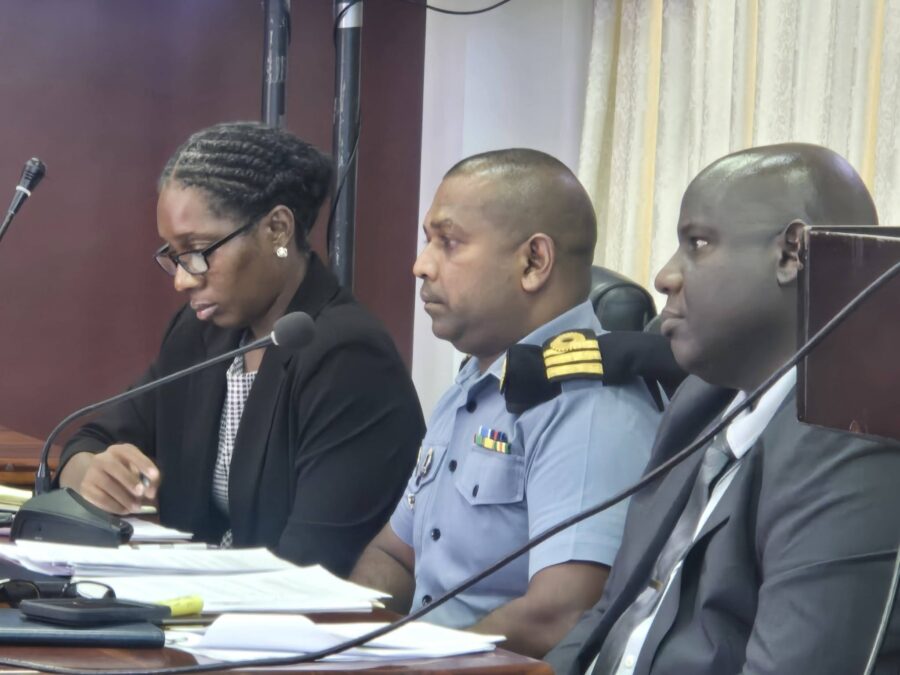
On Wednesday, October 21, Guyana Defence Force Coast Guard Commander David Shamsudeen testified that the search covered approximately 26,000 square nautical miles, with electronic charts, tidal patterns, sea conditions and vessel-monitoring systems guiding the operation.
The Commission was told that the offshore patrol vessels searched a wide area, while smaller vessels concentrated closer to the shoreline.
Shamsudeen said the first distress coordinate received was approximately 12.3 nautical miles from the wreck, while the second was about four nautical miles away. He explained that authorities initially could not establish whether the distress signals originated from the MV Barima.
The Coast Guard’s deployment timeline is also significant. At an earlier hearing on October 16, the commission heard that distress coordinates were received at 11:07 p.m. on July 18 and that a team was deployed within approximately 15 to 20 minutes.
But a rapid deployment does not, by itself, settle questions about the adequacy of the response. Investigators must establish when the vessel encountered difficulty, when assistance was requested, what information authorities received and whether the response was appropriate to the circumstances.
Shamsudeen emphasised that his role concerned search and rescue rather than determining why the vessel sank. That distinction reinforces the need for the commission to examine evidence beyond the rescue operation itself.
Survivors found shivering
Davanand Jaipaul, a seaman attached to the Maritime Administration Department, testified that survivors rescued aboard the pilot vessel Haiama were shivering and required first aid.
He said the vessel collected 50 survivors and one deceased person. Jaipaul also described encountering debris and an empty life raft during the search.
His testimony provides a grim account of the ordeal endured by survivors while raising further questions about the ferry’s safety equipment, emergency procedures and compliance with applicable maritime requirements.
The commission must establish whether the vessel was seaworthy, whether passengers had access to functioning life-saving equipment and whether any shortcomings contributed to the loss of life.
Will the accused testify?
Another unresolved issue is whether the commission will summon Captain Kevin Price, Chief Mate Rondell Dwayne Roberts and Goods Superintendent Delon Granderson, who face murder charges arising from the disaster.
Commission Chairman, retired Justice Godfrey Smith, said the inquiry had not decided whether to call the three men, although he acknowledged that their testimony could be useful.
“We have not decided on summoning them.”
Smith also recognised their right to refuse to answer questions that could incriminate them.
The criminal proceedings and the commission’s inquiry serve different purposes. The commission must establish the circumstances surrounding the sinking and identify any failures within its mandate without prejudging the guilt of the accused.
Transparency is essential
With more than 100 witnesses expected to testify, the inquiry must provide credible answers about the vessel’s condition, passenger safety, distress calls and the rescue response.
Restrictions on real-time livestreaming have also drawn criticism from the Guyana Press Association, reinforcing concerns about public access to proceedings of profound national importance.
The families of those who died deserve more than a reconstruction of the final hours of the MV Barima. They deserve a searching examination of whether passengers were adequately protected, whether emergency procedures were sufficient and whether decisions made before and during the disaster cost lives. The commission must identify any failures, establish who was responsible where the evidence supports such findings, and make clear recommendations to prevent another tragedy. Anything less would leave critical questions unanswered and undermine public confidence in the pursuit of accountability.