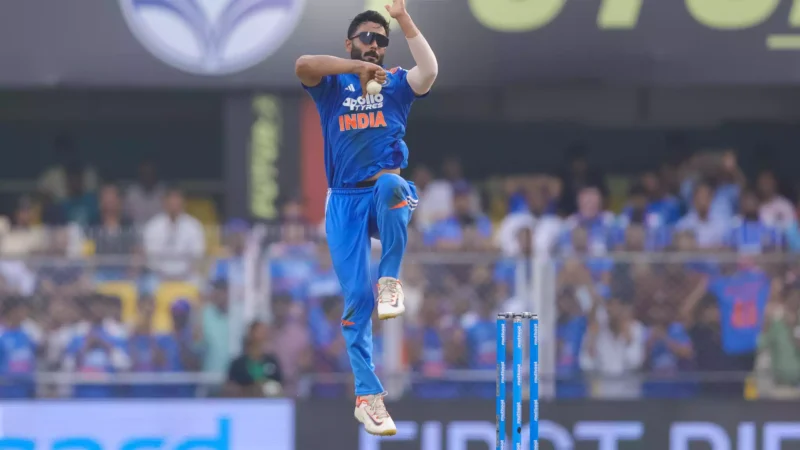
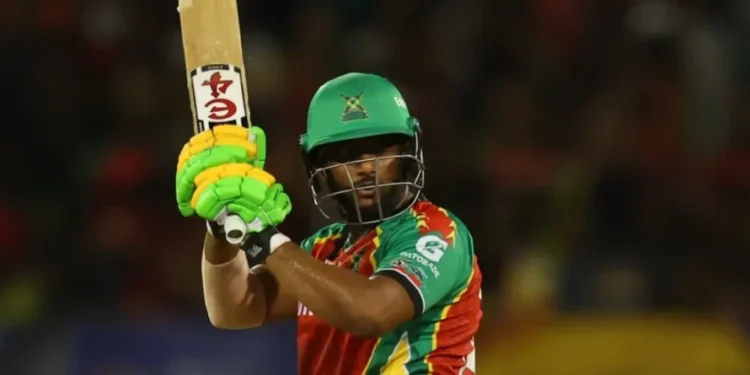
The T20I leg of West Indies’ tour of India was an opportunity for India to test their bench strength. Mayank Yadav and Prince Yadav made their case with the ball, but Naman Dhir emerged as the tour’s most interesting find across formats. In Bengaluru, a six-ball cameo offered a glimpse of his batting potential. Until then, it had been his off spin, a work in progress, that had made the stronger impression.
Steady rain had kept the Bengaluru pitch under covers, and during India’s 46-ball innings, the West Indies seamers found that anything fuller got hit, while anything back of a length and straighter did damage. Abhishek Sharma lofted Keemo Paul’s first full ball over mid-wicket, then picked out the fielder when Paul dragged his length back. Shamar Joseph’s off-pace ball into the pitch had Ishan Kishan mistiming to mid-on, Shamar Springer seamed one back to bowl Sanju Samson, and Shreyas Iyer miscued a pull.
India were 88/4 in the nine-overs a side contest with 17 balls remaining when Dhir walked out ahead of the more established Shivam Dube. Despite having had little opportunity to bat on the tour, he showed no rustiness. Paul’s off-pace delivery, though it was misdirected towards leg, sailed over deep mid-wicket. When the bowler overcompensated by going wide of off stump, Dhir used his height and high bat grip to muscle the ball over long-off for a boundary. That was 10 off two balls.
Paul followed up with a delivery clocked at 140 kph that was called wide. Dhir moved slightly across to the next ball, at 137 kph, and connected cleanly to clear long-off using his height and high grip. With 16 runs off three balls, he had injected momentum back into India’s innings. West Indies were protecting the boundaries in front of the square on a slower surface, but Springer – the best bowler of the night – erred in line and length, delivering a fuller delivery outside off with mid-off inside the circle. Dhir dispatched it for his third six off just five balls, finishing with 24 off six. As his Mumbai Indians teammate Tilak Varma noted after the game, Dhir offered value through such cameos down the order.
If Bengaluru showcased his hitting, the rest of the T20I series was more revealing about his bowling. In the preceding ODI leg, where spinners conceded at 6.55 runs per over, Dhir’s 16.3 overs went at 6.30, the third-best economy rate across teams, behind Kuldeep Yadav (5.56) and Matthew Forde (5.90).
On pitches that offered little assistance to spinners, Dhir’s response to being hit stood out. He conceded 12 sixes, the second-most in the T20I series, but on five occasions, he followed a six with a wicket off the very next ball. The ability to reset rather than let a boundary dictate his next delivery earned rich praise for his mindset from West Indies coach Daren Sammy.
Sammy also praised the approach of Dhir and Roston Chase in a difficult series for spinners. “Not bowling too many boundary balls. I think that’s the key here on good wickets. Not going for too many runs by the boundary routes. And they bowled much more dots,” he said. Dhir finished with a dot-ball percentage of 35, second only to Mayank Yadav’s 43.3%. Chase had the best economy rate at 9.06 and a boundary percentage of 19.1, against the tournament average of 27.7%.
Dhir was brought into the T20I side at the last minute in place of Washington Sundar, another player with similar skill set. With the ball, however, Dhir showed a wider range of pace than Sundar, whose deliveries generally sit in the mid-90s to 100-plus kph range. Dhir varied his speed from the early 80s to the late 90s, a range that proved particularly useful on his T20I debut in Lucknow.
He was introduced in the ninth over after Shai Hope and Sherfane Rutherford had rebuilt following an early collapse. His first over cost just six runs, while Kuldeep and Axar Patel conceded 15 and 18 respectively on either side of it.
After Hope hit a 94 kph length ball over deep mid-wicket, Dhir went slightly wider and took five kph off his pace, allowing the ball to turn into the right-hander. The change reduced his leverage, resulting in a catch in the same area where he had hit a six off the previous ball. Against Romario Shepherd, he brought his speed down to 85 kph and generated 2.93 degrees of drift away from the right-hander, to induce a miscue to long off having been hit over the square-leg boundary off the previous ball down the leg side. His final wicket that night, Springer, came through a change of angle from around the wicket to over it, denying the batter the chance to get underneath the ball for elevation.
In Indore, Kamil Pooran hit Dhir over the ropes three times. Dhir held his nerve, pulled his length back slightly and cramped the right-hander, who miscued his fourth attempt at a six to deep square leg. Four of Dhir’s five wickets in the series came off deliveries in the 80–90 kph range. That was where he found success, unlike the more senior Axar, who went quicker when he was hit for runs and did not bowl from over the wicket at any point in the series.
Four of Dhir’s five victims were right-handers. Tilak highlighted Dhir’s willingness to bowl under pressure as an off-spinner to West Indies’ big-hitting right-handers as one of India’s positives from the series.
Dhir’s bowling returns were not an overnight discovery. While the IPL has made his bowling skills largely redundant, he has bowled regularly in other tournaments. Before joining the Indian team ahead of the ODIs, he put in the hard yards with the Mumbai Indians squad at Reliance Corporate Park in Navi Mumbai, bowling hundreds of overs.
His off spin remains a work in progress, but the series showed that it can offer India a useful second skill. Shreyas Iyer was impressed by Dhir’s willingness to bowl in crucial moments. “Special player, I must say. Like showing that attitude and approach, wanting to bowl in those crucial moments, he realized that the ball was turning, and then he capitalized on it,” India’s captain said after Lucknow.
Dhir’s primary value, though, remains his batting. His ability to hit pace across different length bands, as seen in the IPL, could strengthen India’s lower middle order, particularly with Shivam Dube and Axar Patel struggling as finishers against pace and Hardik Pandya’s numbers declining. His six-ball burst in Bengaluru was a reminder of both the power he generates to hit pace off balls and smash high pace.
Dhir has been clear about his ambition. “No, I definitely want to be a genuine all-rounder, but at the time I prefer that I should score more with the bat,” he said during the Hyderabad T20I.
The West Indies series offered evidence of his variations, temperament and capacity to take wickets even after being attacked. Bengaluru, meanwhile, showed how quickly he can change an innings with the bat. Investing in both skills could turn him into a valuable long-term asset for India.