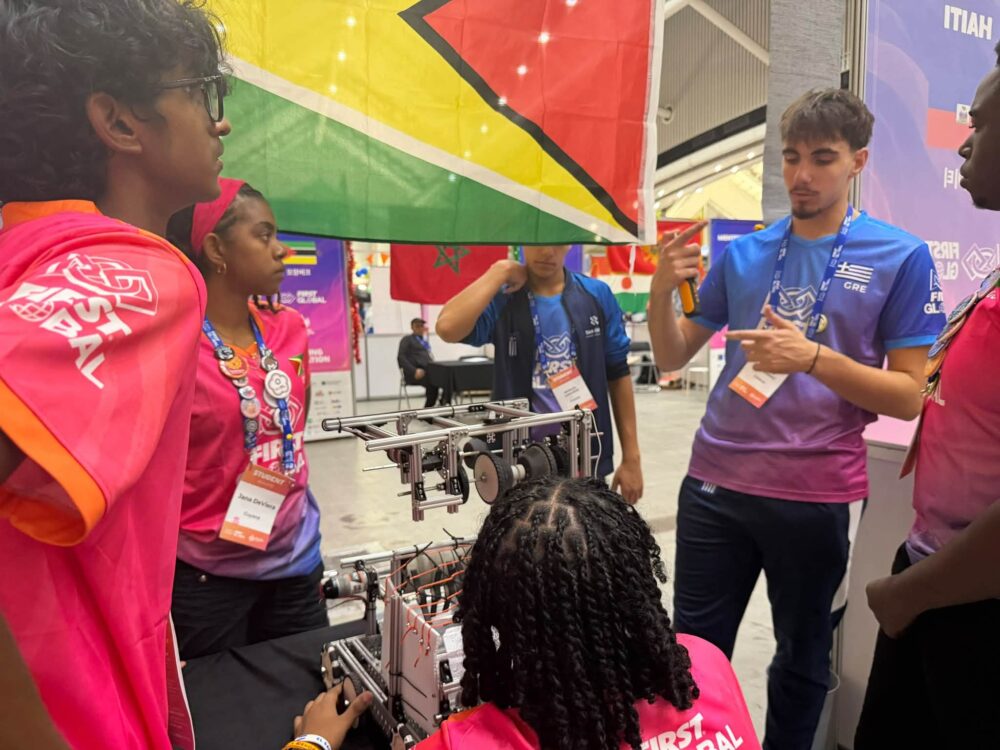
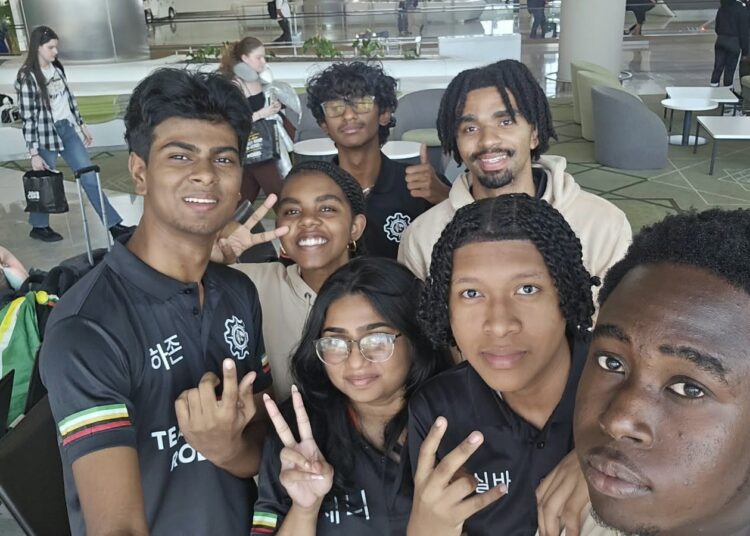
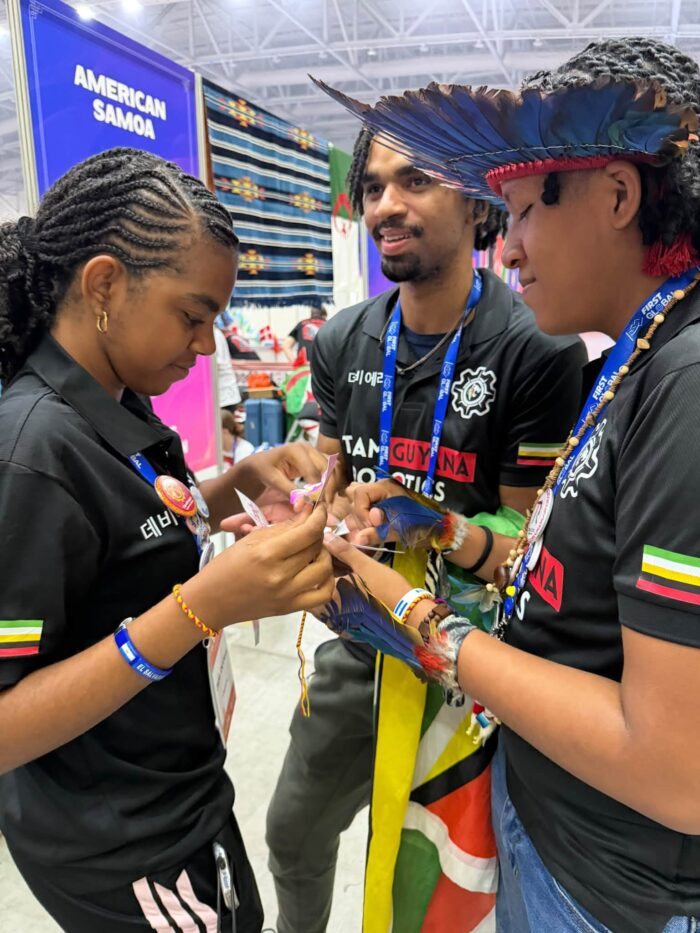
Team Guyana Robotics returns from South Korea with valuable international experience and the pride of having represented the country at the 2026 FIRST Global Challenge. The five-member team made an impressive early impact, climbing to 22nd place after its opening matches and breaking into the top 25 among more than 190 competing nations.
Guyana’s 84th-place finish placed the team within the top half of the field—an achievement in itself for the five young innovators. Beyond the ranking, the students gained invaluable international exposure, sharpened their technical skills and demonstrated that young Guyanese can compete on the global stage when given the opportunity.
The competition ran from October 7 to 10 in Incheon, South Korea, bringing together teams from more than 190 countries under the theme “Igniting Innovation”.
Guyana’s robot, named Panthera Harpia, was developed for a wildfire-themed challenge that tested students’ ability to design, programme and operate a machine to collect and place game pieces before completing a climbing task.
According to the official FIRST Global results, Guyana finished 84th with a ranking score of 154.8.
Uzbekistan-led alliance wins
Uzbekistan, China and Mexico finished first, second and third respectively in the final national-team rankings.
The winning alliance comprised Uzbekistan, Moldova, Venezuela and El Salvador, which collectively scored 1,060 points in the finals. The runner-up alliance scored 1,016, while the third-place alliance scored 1,009.
Alliance results are separate from individual national-team rankings, as teams from different countries combine their robots and performance to compete for the tournament title.
Jamaica earns gold and bronze
Jamaica also secured recognition, winning the Ustad Ahmad Lahori Award for Innovation in Engineering and sharing bronze with Nigeria in Engineering Documentation.
Jamaica finished 100th in the overall national-team rankings, demonstrating that technical awards can recognise innovation and engineering work beyond a team’s final position on the leaderboard.
The Jamaican delegation included students from several schools across the island. Its awards highlight the competition’s broader focus on creativity, technical documentation and problem-solving alongside match results.
More than a leaderboard
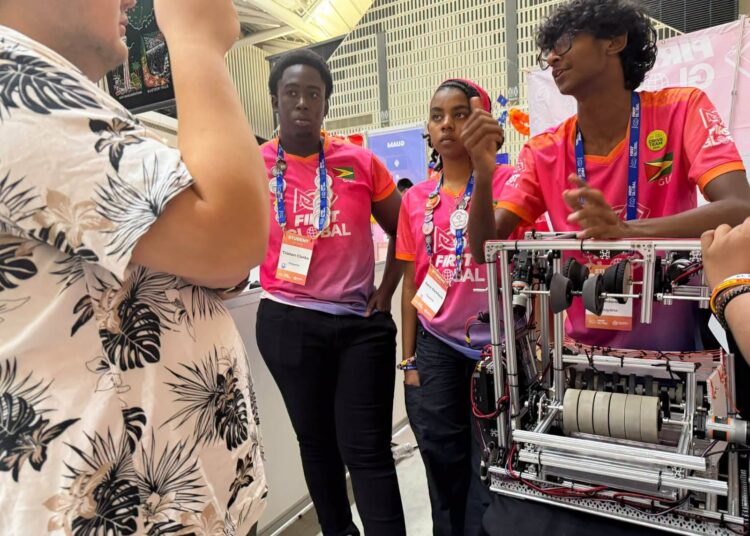
For Guyana’s students, the experience extended beyond points and rankings. Competing internationally exposed them to different engineering approaches, encouraged collaboration and gave them a demanding environment in which to apply their knowledge.
Before travelling, team members spoke about the months spent developing and rebuilding their robot, the challenges of synchronising mechanical systems with programming, and the importance of teamwork.
David Da Silva, 16, the team’s driver and lead engineer, described the challenge of getting the robot’s hardware to work effectively with its code. Eashan Harjohn, 18, identified teamwork as one of the biggest lessons of robotics.
The students also worked around limited preparation resources, including the absence of a full competition field for practice. Their efforts to test and improve the robot with the equipment available reflected the practical problem-solving that STEM education is designed to encourage.
Jana Deviera, the team’s only female student travelling to the competition, highlighted the importance of representing girls in robotics.
“I think it’s really great that I can be able to be an example to other girls, other young girls so they can see me and be empowered and they can know that they can also do this,” she said before the competition.
Her participation underscores the importance of encouraging more girls to explore engineering and technology.
STEMGuyana’s contribution
Team Guyana Robotics operates under STEMGuyana, founded by Dr Karen Abrams to expand access to science, technology, engineering and mathematics education and help young people develop practical skills.
Its programmes include robotics teams, coding activities, after-school clubs and Learning Pods designed to strengthen children’s academic and technical abilities. The organisation’s work across Guyana helps young people explore technology and learn through hands-on projects.
International competitions such as FIRST Global allow selected students to apply those skills in a challenging environment. Participants can also bring lessons home and inspire younger students to pursue robotics and other technology-driven fields.
The team’s participation has benefited from corporate and community support. MODEC has supported STEMGuyana’s robotics activities and Learning Pods programme, including expansion in Regions Two and Eight. ENet and APAN Energy Services also supported the team’s participation.
Such backing is essential because international competition requires equipment, mentorship, training, travel and time to test designs.
Commending the team
The five students deserve commendation for their determination, ingenuity and commitment to representing Guyana on the international stage at a time when technological innovation is becoming increasingly competitive. Despite working with limited resources, they rose to the challenge, tested their abilities against the world’s young innovators and gained experience that cannot be measured by a final ranking alone. Their 84th-place finish does not define their potential; the skills they developed, obstacles they overcame and international exposure they gained are achievements in their own right.
STEMGuyana also deserves recognition for helping turn young people’s curiosity into practical skills, creating opportunities for them to experiment, collaborate and discover what they are capable of achieving. But talent alone is not enough. These young innovators need sustained investment, modern equipment, mentorship and support from businesses, educators, communities and the wider society to compete on an increasingly demanding global stage.
Guyana’s early rise to 22nd place demonstrated that its young people can make their mark internationally. The experience gained in South Korea should now become a foundation for stronger preparation, greater ambition and improved performance in future competitions.
Ultimately, this journey is about more than robotics or rankings. It is about showing young Guyanese that their ideas have value, that limited resources need not extinguish ambition, and that with the right opportunities and support, they can help shape the technological future of their country. Their journey from Guyana to South Korea is not the end of an achievement, but a starting point for what they—and the next generation of Guyanese innovators—can accomplish.