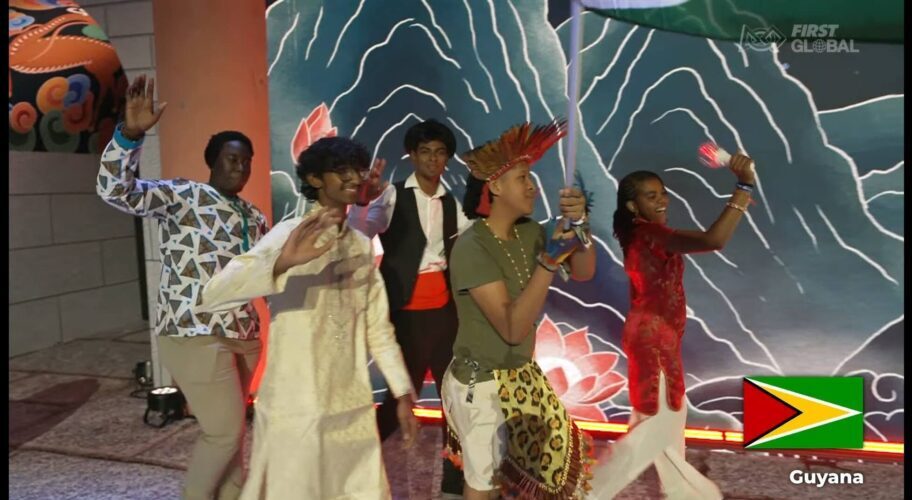
“I’m not only representing myself, but I’m representing the country. I’m representing the whole team that we have… I’m representing the future of tomorrow that Guyana has.”
Those words from a Jana Deviera member of Team Guyana Robotics capture the pride, responsibility and ambition driving Guyana’s young competitors at the 2026 FIRST Global Challenge in Incheon, South Korea.
For the students, the international competition is about far more than building robots or climbing a leaderboard. It is an opportunity to discover their abilities, challenge themselves to think differently, learn from young people across the world and demonstrate what Guyanese children can achieve when given the opportunity.
Team Guyana Robotics secured 22nd place on the opening day, breaking into the top 25 among more than 190 participating countries and giving the country an encouraging start to the competition, which runs from October 7 to 10 at Songdo Convensia.
In interviews conducted by fellow members of the team, the young participants spoke about the experiences that have shaped their journey, the skills they are developing and the possibilities robotics has opened up for their futures.
For David DaSilva, the competition has transformed how he approaches challenges and searches for solutions.
“This competition has encouraged me to be more innovative with my scope of thinking, allow me to analyse problems better, and give me a more effective way of solving it,” he said.
The ability to analyse, experiment and improve is central to robotics. Participants must move beyond learning scientific and technical concepts to applying them, testing their ideas, identifying weaknesses and finding practical solutions.
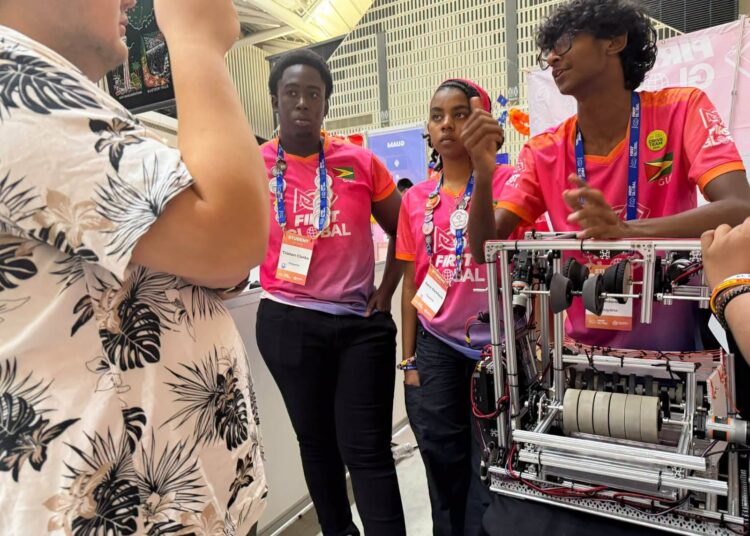
This year’s challenge focuses on wildfires and the use of technology to address the threats they pose. The theme resonated with Eashan Harjohn because of Guyana’s extensive forest cover.
“Well, this year is wildfires. Wildfires is a very big problem that’s causing in the forest right now, and this affects us mostly because our country, Guyana, is 85% forest. If every wildfire was caught here, it could really affect us,” he explained.
His comments show how the competition is encouraging young people to connect technology with real-world problems, including environmental threats that could affect their own country.
Eashan, reflected on the value of collaboration, describing how people with different perspectives can work towards a shared goal.
“It’s very aesthetic, actually, that people like me are focusing on one goal. It can show how different minds can turn around over one goal, how they think differently. It shows we’re all unique in some different way.”
That spirit of cooperation is central to the FIRST Global Challenge, which brings together young people from different countries and backgrounds to exchange ideas, learn from one another and work through complex problems.
For the girls on the team, the experience also provides an opportunity to encourage greater female participation in science, technology, engineering and mathematics (STEM).
“STEM is important to me because it helps to fuel my curiosity in terms of learning new things and learning about the way things work in our environment. And I’m glad to be a part of the females and the community to contribute to the increasing numbers,” Africo said.
She also challenged negative perceptions often associated with robotics and artificial intelligence, emphasising the potential for technological advancements to improve lives and serve positive purposes.
Jana said the opportunity to represent Guyana internationally for the first time has been particularly meaningful.
“It’s a super big deal for me, being able to go and represent Guyana on a global stage, basically, with so many other countries and learn from them, and you can also share your culture as well.”
The participant made clear that representing the country carried a responsibility extending beyond personal achievement.
“I’m not only representing myself, but I’m representing the country. I’m representing the whole team that we have, you know. I’m representing the future of tomorrow that Guyana has, and I’m really proud to be able to do that and show them that the youth of Guyana, they’re able to do great things.”
Jaden Daveira, a second-year mechanical engineering student at the University of Guyana, who has participated in previous FIRST Global competitions, also reflected on the lessons gained through the experience.
He highlighted the competition’s fast pace, the importance of initiative and the need to keep looking for ways to improve. Participants develop practical skills in coding, assembling components and problem-solving while learning to work with people whose ideas and approaches may differ from their own.
The international exposure can also create opportunities for personal connections and future academic and professional development.
The students’ experiences reflect the wider work of STEMGuyana, which provides young people with opportunities to explore robotics, coding and other STEM disciplines. Under the leadership of Dr Karen Abrams, the initiative has helped create pathways for Guyanese students to develop their abilities and compete internationally.
But beyond the organisation’s work and the team’s early position on the leaderboard, the students’ own accounts reveal the deeper value of the opportunity: growing confidence, greater curiosity, stronger problem-solving skills and an expanded sense of what they can accomplish.
Their journey is a reminder that education is about more than examination results. When children are encouraged to experiment, collaborate and tackle difficult challenges, they begin to see themselves not simply as learners but as potential innovators capable of developing solutions and contributing to society.
Whatever position Team Guyana ultimately secures, these young competitors have already given the country reason to be proud. Their early top-25 showing is an achievement worth celebrating, but so too are the determination, curiosity and ambition they have demonstrated.
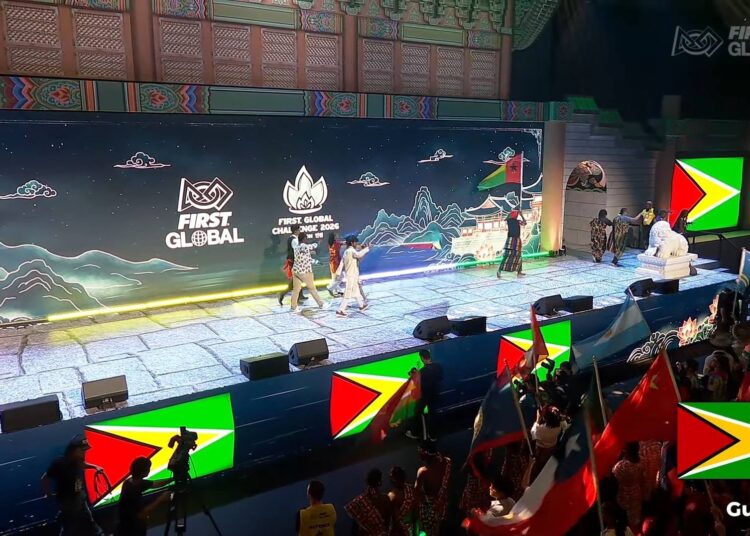
They have travelled to compete with the world, learn from their peers and share their culture. They will return with more than competition experience: they will bring home new knowledge, stronger confidence and a powerful example for other Guyanese children who may now see robotics and STEM as opportunities within their reach.
For these students, the competition is a milestone. For Guyana, their voices offer a glimpse of what the next generation can become.