The rate is set by the Community, not by any one country. Heading 96.19 of the Revised Common External Tariff of the Caribbean Community covers “Sanitary towels (pads) and tampons, napkins and napkin liners for babies and similar articles, of any materials”, and every subheading beneath it carries 20 per cent. Guyana’s own First Schedule reproduces the figure exactly.
That is why Vice President Bharrat Jagdeo said on 14 August 2025 that “the tariff is a Common External Tariff so to remove you have to notify CARICOM”. He was describing the instrument accurately.
What does the tariff actually say?
A tariff rate is a choice, and the choices on either side of this one show it. The two headings printed immediately above and below sanitary products in the Community’s schedule carry different rates.
| Heading | Goods | CET rate |
|---|---|---|
| 9618.00 | Tailors’ dummies; animated displays for shop window dressing | 0-5% |
| 96.19 | Sanitary towels (pads) and tampons, napkins and napkin liners | 20% |
| 9620.00 | Monopods, bipods and tripods | 10% |
Source: Revised Common External Tariff of the Caribbean Community, HS 2017, revised 11 April 2018.
The Community reserves its high rates for goods it makes. Its own schedule states the principle: the list of items ineligible for duty exemption “includes those items produced in the Caribbean Community in quantities which are considered adequate to justify the application of tariff protection”.
The same document goes further for this heading than a rate alone. It creates three separate subheadings under 56.01 whose description is the manufacture of these goods, and gives each of them 0-5 per cent.
| Subheading | Description as it appears in the tariff | Rate |
|---|---|---|
| 5601.21 10 | Wadding for use in the manufacture of sanitary towels and tampons, of cotton | 0-5% |
| 5601.22 10 | Wadding for use in the manufacture of sanitary towels and tampons, of man-made fibres | 0-5% |
| 5601.29 10 | Wadding for use in the manufacture of sanitary towels and tampons, other | 0-5% |
| 5601.21 30 | Articles of wadding, of cotton | 20% |
Ordinary articles of wadding in the same subheadings pay 20 per cent. The reduced rate is specific to wadding destined for sanitary manufacture.
The raw material enters at 0 to 5 per cent and the finished pad at 20 per cent. Somebody designed that gap, and they designed it for a factory.
Who does the 20 per cent protect?
United Nations Comtrade records what each state actually ships. In 2023 the eight CARICOM members reporting trade in heading 9619 imported US$84.7 million of it and exported US$1.06 million.
| Member state | Imports US$ | Exports US$ |
|---|---|---|
| Trinidad and Tobago | 27,894,468 | 348,473 |
| Jamaica | 20,959,929 | 569,729 |
| Guyana | 12,614,104 | 67 |
| Bahamas | 8,927,623 | 341 |
| Antigua and Barbuda | 7,120,154 | 144,166 |
| Belize | 4,052,235 | none recorded |
| Grenada | 1,916,479 | none recorded |
| Dominica | 1,246,414 | none recorded |
| Total | 84,731,406 | 1,062,776 |
United Nations Comtrade, 2023, partner world. Saint Lucia, St Vincent and the Grenadines, St Kitts and Nevis and Suriname returned no record for the year and are not in the total, so regional imports are higher than the figure shown.
Exports are 1.25 per cent of imports. Guyana’s figure for 2023 is sixty-seven United States dollars, against US$12.6 million of imports, and the five-year series holds the same shape: US$95,187 exported in 2020, US$191 in 2021, US$21,022 in 2022, US$2,333 in 2024.
An export figure is not a production figure, and the caution runs one way only. Some of the Antiguan and Trinidadian tonnage is likely re-export rather than manufacture, which would make regional production smaller than these numbers rather than larger.
One regional manufacturer is named in the trade literature. A feminine hygiene manufacturers directory lists Agostini Industries Ltd of Port of Spain producing “Fancy Free” maxi pads and “Secure” feminine napkins. On the public record this newspaper can find, that entry is the single source for current Caribbean production of these goods, and it carries no date.
The company’s own account does not support it. Agostini Limited lists its subsidiaries across pharmaceuticals and healthcare, consumer products, energy and industrial services, and restaurants and retail. Neither brand appears, and no subsidiary is described as making sanitary towels, tampons or any feminine hygiene product. Two of the eighteen are described as manufacturers: Carlisle Laboratories, which has made medicines and vitamins since 1961, and Intersol Limited, a manufacturer of personal care products under the DIQUEZ range. On the public record this newspaper can find, neither is said to produce goods under heading 96.19.
The input tells the same story as the output. The tariff admits sanitary wadding at 0 to 5 per cent precisely so that it can be converted into pads here, so the volume of wadding coming in is a measure of whether anyone is converting. In 2023 the twelve CARICOM members reporting the trade imported US$2,175,202 of wadding under headings 5601.21, 5601.22 and 5601.29, some 661 tonnes. Against US$84.7 million of finished imports, the input is 2.6 per cent of the finished bill.
The largest importer was Trinidad and Tobago, at US$821,604 and 203 tonnes, followed by Jamaica at US$447,713 and Suriname at US$326,225. Guyana took US$57,891. Two cautions belong with those figures. United Nations Comtrade reports at six digits, and at that level the headings cover wadding of cotton, of man-made fibres and of other textiles, which is also cotton wool, medical swabs and cosmetic pads; only the national subheadings ending 10 are the sanitary-grade lines, and they are in the tariff rather than in the trade data. And Trinidad, the largest importer of the input, is where the one company ever named as a producer is based. The figures are consistent with conversion on a small scale and equally consistent with none.
A Chinese producer is meanwhile registering to sell here. The Official Gazette of 3 October 2026 published a trademark application by Quanzhou Era Sanitary Products Co. Ltd of Jinjiang City, Fujian Province, filed on 2 January 2026, covering “Sanitary towels, sanitary pads, babies’ napkins [diapers]” and related goods in International Class 5.
That matters for what the tariff is doing. A 20 per cent rate on every subheading of 96.19 is the rate the Common External Tariff reserves for goods the region makes. The region’s own trade figures show exports at 1.25 per cent of imports, and the single company ever named as a producer does not list the products today.
La Caribena News put six questions to the Caribbean Private Sector Organisation on 28 September 2026, asking whether its record identifies any current manufacturer under heading 96.19 in CARICOM, what regional production volume is and what share of the import bill existing capacity could meet, whether any assessment of regional demand and supply has ever been carried out for the heading, whether it considers the 20 per cent rate still necessary, and whether it would support a member state seeking suspension of the rate under Article 83 of the Revised Treaty of Chaguaramas. A response was requested by 5 October. The organisation had not responded by the time of publication.
At 20 per cent, the duty on the imports in the table above comes to roughly US$16.9 million a year before exemptions. Guyana’s own share, on 2024 imports of US$10.8 million, is about US$2.17 million.
What did Guyana promise, and what has been gazetted?
President Irfaan Ali told a rally at Bath, Region Five, on 10 August 2025: “we have decided in our Manifesto that we are going to remove all taxes on sanitary supply”. News Room reported the measure was expected to take effect in the next budget.
On the instruments, it has not. A census of Guyana’s E-Gazette between 1 September 2025 and 7 October 2026 returns no Customs Duties (Amendment of First Schedule) Order and no VAT (Amendment of Schedules) Order. The eleven publications issued between 16 September and 7 October 2026 were downloaded and searched for this report; none contains either order. The Budget 2026 speech, delivered by Dr Ashni Singh on 27 January 2026, returns no mention of menstrual, hygiene, feminine, napkin, tampon or diaper across 109 pages and 38,596 words. Act No. 3 of 2026, the only tax statute of the period, amends the Customs First Schedule for security equipment, double-cab vehicles and outboard motors.
The commitment has been reported internationally as completed. Health Policy Watch published a piece by Leslie Ramsammy on 23 November 2025 stating that “In August 2025, Guyana’s President Irfaan Ali removed all taxes and customs duties on feminine hygiene products”. Contemporaneous Guyanese reporting of the same remarks uses the future tense, recording that the President announced the government would remove the remaining taxes.
Two taxes sit on these goods and they behave differently. Value-added tax on sanitary napkins and panty liners is zero under Schedule I, paragraph 14(c) of the VAT Act, and the Guyana Revenue Authority’s published list of zero-rated supplies still reads that way. Tampons are named in neither schedule, so on the instruments a tampon is standard-rated at 14 per cent. The customs duty is 20 per cent on all of it.
How does the Caribbean compare on removing the tax?
Better than the Americas average, on the measure that is normally used. Calderón-Villarreal, writing in The Lancet Regional Health Americas in 2024, reviewed 57 countries and territories and found that ten had eliminated taxation on menstrual products since 2012: Jamaica first in 2012, then Canada, Saint Kitts and Nevis in 2015, Trinidad and Tobago in 2016, Guyana in 2017, Colombia, Puerto Rico, Mexico, Ecuador, and Barbados in 2022. Taxes still applied in 63.2 per cent of locations in 2022 at an average rate of 11.2 per cent.
The Caribbean sits worse than that headline suggests. More than half of locations in the sub-region still taxed the products: 68.8 per cent of countries and 50 per cent of territories, a list that includes Antigua and Barbuda, Dominica, Grenada, Saint Lucia and St Vincent and the Grenadines, all of them CARICOM members paying the same 20 per cent at the border.
The measure itself has a limit worth stating. A full-text search of that study returns no occurrence of “tariff”, “duty”, “import duty” or “import tax”. The two appearances of “customs” are inside citation web addresses. The literature that ranks countries on the tampon tax counts consumption taxes and does not count the border duty, which is how Guyana appears on a list of countries that eliminated the tax while charging 20 per cent on every consignment that lands.
Guyana has moved on supply rather than on price. The Menstrual Hygiene Initiative, launched in 2021 and championed by First Lady Arya Ali with support from the United Nations Population Fund, has given more than 32,000 school-age girls free sanitary pads, and has extended to Region Eight. The Ministry of Education found that one third of female secondary school students struggle to afford or access them.
What would removing it take?
A route that exists and has been used. Suspension of the Common External Tariff runs under Article 83 of the Revised Treaty of Chaguaramas, granted to member states and subject to review by the Council for Trade and Economic Development. The tariff carries standing lists of such suspensions, List A for indefinite grants and List D for additional grants to Belize, St Kitts and Nevis and other OECS states.
Heading 96.19 appears in none of them. It is not in List A, not in List C, not in List D, and not in the list of commodities ineligible for conditional duty exemption, which is where the Community records the goods it has judged to be regionally produced in adequate quantities. The 20 per cent stands unqualified.
Guyana has worked the mechanism before. A single objection from Guyana reopened a Community tariff decision on paint, recorded in How One Objection From Guyana Reopened a CARICOM Tariff Decision. The procedural routes available to a member state that wants a rate changed were set out in CARICOM Gives a Business Three Ways to Raise a Trade Barrier.
Regional financing and procurement for women’s enterprise were examined in The Mothers Built the Lane. Resource It..
What the title card shows
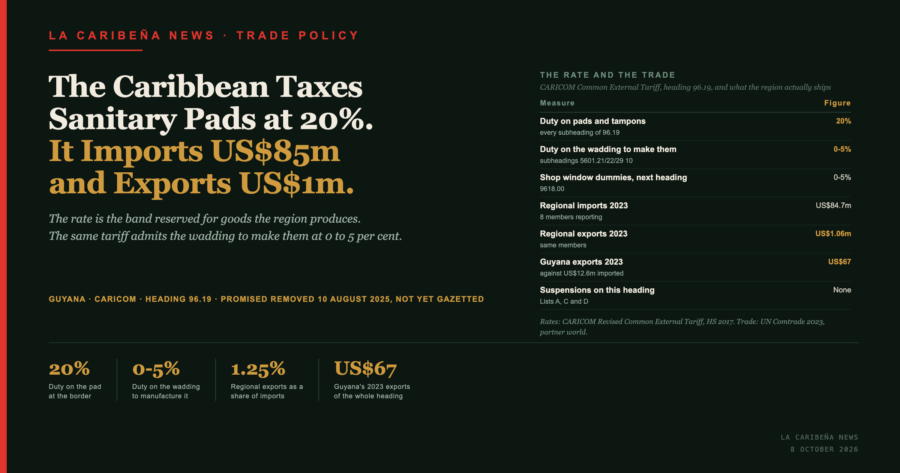
20 per cent: the Common External Tariff rate on every subheading of heading 96.19, sanitary towels, tampons, napkins and napkin liners, in the Revised Common External Tariff of the Caribbean Community, HS 2017, revised 11 April 2018. 0-5 per cent: the rate the same tariff gives to wadding under subheadings 5601.21 10, 5601.22 10 and 5601.29 10, described in the instrument as being for use in the manufacture of sanitary towels and tampons. US$84.7 million: imports of heading 9619 by the eight CARICOM states reporting to United Nations Comtrade in 2023. US$1.06 million: their exports in the same year, 1.25 per cent of imports. US$67: Guyana’s recorded exports of the heading in 2023, against US$12.6 million of imports. 10 August 2025: the date President Irfaan Ali said at Bath, Region Five, that all taxes on sanitary supply would be removed. 329: publications in Guyana’s E-Gazette between 1 September 2025 and 16 September 2026, none of them an Order amending the duty. 32,000: school-age girls given free pads under the Menstrual Hygiene Initiative.
Frequently Asked Questions
What duty do sanitary pads and tampons pay entering Guyana?
Twenty per cent. The rate is set by heading 96.19 of the CARICOM Common External Tariff and reproduced in Guyana’s Customs Act First Schedule, which names sanitary towels and tampons expressly at subheadings 9619.00 11 and 9619.00 21. Value-added tax on sanitary napkins and panty liners is separately zero-rated.
Are tampons treated the same as sanitary pads in Guyana?
Not for VAT. Schedule I, paragraph 14(c) of the VAT Act zero-rates “sanitary napkins or panty liners” and does not name tampons, so on the instruments a tampon is standard-rated at 14 per cent. For customs duty they are treated identically, both at 20 per cent, because the tariff names them together.
Did Guyana remove the tax on menstrual products in August 2025?
President Ali committed to removing it on 10 August 2025. No implementing instrument has been published. A census of Guyana’s E-Gazette publications between 1 September 2025 and 7 October 2026 found no amending Order, and Budget 2026 contained no such measure. At least one international publication has reported the removal as completed.
Why does CARICOM tax these goods at 20 per cent?
Twenty per cent is the band the Common External Tariff applies to goods produced within the Community in quantities considered adequate to justify tariff protection. The tariff also admits the raw wadding for making them at 0-5 per cent, a structure that assumes regional manufacture.
How would the duty be removed?
Through Article 83 of the Revised Treaty of Chaguaramas, which allows a member state to seek suspension of the Common External Tariff subject to review by the Council for Trade and Economic Development. Heading 96.19 does not currently appear in any of the tariff’s standing suspension lists.
Disclosure
Theon Alleyne, the proprietor of La Caribeña News, is an investor in Women’s Haven Guyana, a woman-owned company and the Guyanese arm of a Caribbean brand founded in the Cayman Islands and The Bahamas. Its product range includes sanitary pads, tampons and liners falling under heading 96.19. A reduction in the duty described here would affect that business. He is also a director of the Guyana Manufacturing and Services Association, whose membership includes manufacturers that benefit from Common External Tariff protection on other headings.