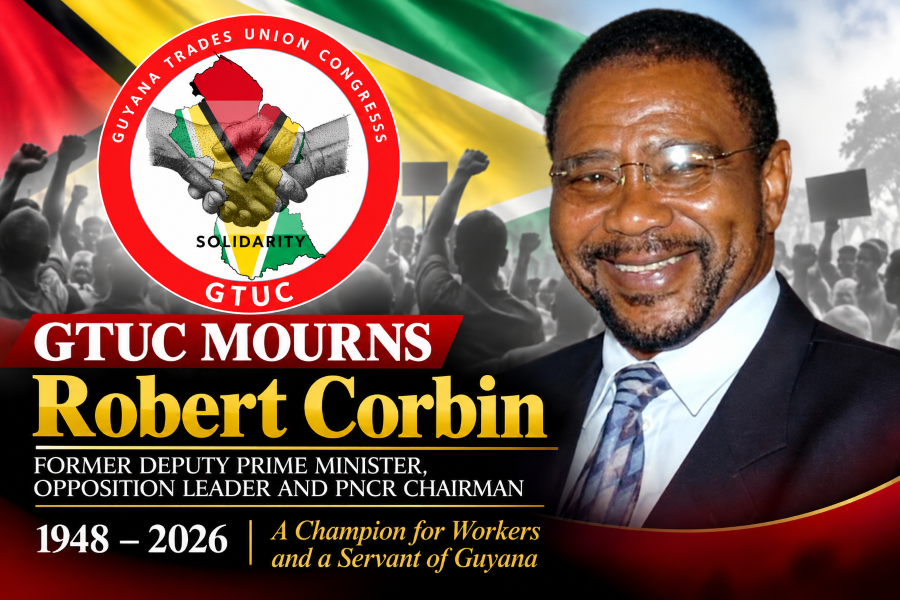
The Guyana Trades Union Congress (GTUC) is mourning the passing of former Deputy Prime Minister, Opposition Leader and People’s National Congress Reform (PNCR) Chairman and Leader Robert Herman Orlando Corbin, who died on October 4, 2026, at the age of 78.
The GTUC’s tribute highlighted Corbin’s support for workers, particularly during the bitter industrial dispute involving the Guyana Bauxite and General Workers Union (GB&GWU) and Bauxite Company of Guyana Inc. (BCGI), a subsidiary of RUSAL.
According to the GTUC, at a time when dismissed bauxite workers and their union were seeking protection of their rights, Corbin went beyond statements in Parliament. He physically stood with the workers and union and pressed the Government to fulfil its responsibilities under Guyana’s labour laws.
The federated body recalled Corbin’s confrontation with then Labour Minister Manzoor Nadir over the Government’s handling of the dispute.
The matter eventually reached the National Assembly, where a no-confidence motion was brought against Nadir over his handling of the dispute and alleged failure to carry out his legal responsibilities in relation to trade disputes. The motion was defeated by the Government majority.
The GTUC said it remembers the episode because it reflected an important aspect of Corbin’s public service—his willingness to stand with workers when he believed their rights were being denied.
“The GTUC recalls these moments because they speak to an important aspect of Mr. Corbin’s public service: his willingness to stand with workers when he believed their rights were being denied.”
Beyond his support for the labour movement, the GTUC also recalled Corbin’s advocacy for political inclusion during his years as Opposition Leader. It said he worked to advance the principle that political inclusion should extend beyond elected representatives to the citizens and supporters they represented.
The organisation pointed to the May 6, 2003 Joint Communiqué between Corbin and then President Bharrat Jagdeo, which emerged from a process of engagement between the Government and Opposition and addressed issues including parliamentary cooperation and equitable access to state-owned media.
The GTUC said it regretted that important commitments arising from the process were not honoured by the Jagdeo administration, describing their failure to be fully realised as part of the unfinished business of Guyana’s political development.
Corbin’s public career spanned decades. He served as a parliamentarian, lawyer and senior political organiser, as well as General Secretary and Chairman of the PNCR, before becoming its Leader and Leader of the Opposition. He also served as Deputy Prime Minister.
The GTUC noted that Corbin’s journey from checker to Deputy Prime Minister, Opposition Leader and party leader demonstrated the possibilities that could emerge through work, education, discipline, political engagement and national service.
The union called on Guyanese, particularly younger citizens, to study Corbin’s life and contributions and to respect the service of those who helped shape the country, even where political differences remain.
“Nation-building demands that we recognise that no single political party, movement or generation owns Guyana or its history.”
The GTUC extended condolences to Corbin’s wife, Carol, his children, relatives, friends and all others mourning his passing.
“May his soul rest in eternal peace.”
GTUC Mourns the Passing of Robert Corbin
The Guyana Trades Union Congress (GTUC) extends heartfelt condolences to the family, friends, colleagues and associates of former Deputy Prime Minister, Opposition Leader and Chairman and Leader of the People’s National Congress Reform (PNCR), Mr. Robert Herman Orlando Corbin, on his passing on October 4, 2026.
Mr. Corbin’s life represented an extraordinary journey in public service. He rose from the ranks of a checker to Deputy Prime Minister of Guyana, demonstrating through his own experience the possibilities that can emerge from work, education, discipline, political engagement and a commitment to national service. Parliament’s record of his career notes his long service as a Member of the National Assembly and his various ministerial responsibilities, including serving as Deputy Prime Minister.
His public life spanned decades of Guyana’s political development. He served as a parliamentarian, lawyer, senior political organiser, General Secretary and Chairman of the PNCR, and ultimately as its Leader and Leader of the Opposition.
The GTUC particularly remembers Mr. Corbin’s efforts as Opposition Leader to advance the principle that political inclusion must extend beyond elected representatives to the citizens and supporters they represent. He worked towards ensuring that opposition supporters were recognised as equally deserving members of Guyanese society, entitled to participate in and benefit from the nation’s patrimony, irrespective of their political affiliation.
One significant example was the May 6, 2003 Joint Communiqué between Mr. Corbin and then President Bharrat Jagdeo, which emerged from the process of constructive engagement between Government and Opposition. The agreement addressed important issues including parliamentary cooperation and equitable access to state-owned media. The existence and content of the communiqué are documented in parliamentary and regional records.
The GTUC regrets that important commitments arising from that process were not honoured by the Jagdeo administration. The failure to fully realise those commitments remains part of the unfinished business of Guyana’s political development.
The labour movement also remembers Mr. Corbin for his solidarity with workers during the bitter industrial dispute involving the Guyana Bauxite and General Workers Union (GB&GWU) and the Bauxite Company of Guyana Inc. (BCGI), a subsidiary of RUSAL.
At a time when dismissed bauxite workers and their union were seeking protection of their rights, Mr. Corbin did not confine his support to statements from Parliament. He engaged, physically stood with the workers and union, and pressed the Government to fulfil its responsibilities under Guyana’s labour laws. Contemporary reporting records his intervention with then Labour Minister Manzoor Nadir and his criticism of the Ministry’s handling of the dispute.
The matter subsequently reached the National Assembly, where a no-confidence motion was brought against Minister Nadir over his handling of the dispute and failure to carry out his legal responsibilities in relation to trade disputes. The motion was defeated by the Government majority.
The GTUC recalls these moments because they speak to an important aspect of Mr. Corbin’s public service: his willingness to stand with workers when he believed their rights were being denied.
His passing should therefore be more than an occasion for political mourning. It should be an opportunity for Guyanese to learn about the man, the era in which he served, the positions he took and the contributions he made to the development of the country.
The GTUC calls on Guyanese, especially the younger generation, to take the time to study our national history and to respect the contributions of those who served, even where political differences remain profound. Nation-building demands that we recognise that no single political party, movement or generation owns Guyana or its history.
Mr. Corbin’s journey—from checker to Deputy Prime Minister, Opposition Leader and party leader—is part of that history. His service, including his advocacy for political inclusion and his support for workers, deserves to be remembered and examined honestly.
As Guyana continues the unfinished work of building a just, democratic and inclusive nation, we must learn to disagree without denying the humanity, dignity and contributions of those with whom we differ.
The GTUC extends its deepest sympathy to Mr. Corbin’s wife, Carol, his children, relatives, friends and all who mourn his passing.
May his soul rest in eternal peace.
October 5, 2026