By Dr. David Hinds- Today the APNU is a household name. We take it for granted. But it was not always so. It is difficult to accurately predict political behavior. What is true for 50 years could change in a day. Guyana’s recent elections have proven the validity of that formulation. All of us got it wrong, even if we got some parts right.
The narrow victory by the APNU+AFC Coalition at the 2015 election went against the traditional grain in Guyanese politics. The conventional wisdom has been that, given our entrenched ethnic voting patterns, it was near impossible for the party or parties whose base lies outside the Indian Guyanese constituency to win a majority of the votes.
That changed in 2011 when the combined APNU and AFC votes surpassed those of the PPP. As commentators and politicians began to contemplate the possibility that a joint APNU+AFC slate could actually win, there were some questions that were raised. The big one was whether the majority votes accumulated in 2011 as separate contestants could be replicated if they joined together in a coalition. Some, including this writer, were skeptical.
Those who felt it was possible to win premised their calculations on the ethnic identity of the Presidential candidate. They argued that since you could not win the PPP without pulling away a significant section of the Indian Guyanese electorate, it was better to have an Indian Guyanese presidential candidate.
In the end all of us were wrong to some extent. First, the Coalition did defeat the PPP. And it did so inspite of the ethnic voting remaining constant. Second, the PPP got 49% of the votes. Those who predicted a Coalition victory did not bargain for such a good showing by the PPP. Third, the Coalition won without an Indian Guyanese Presidential candidate.
More in-depth analysis is needed to determine the real causes of this. But the one thing we know for certain is that the presence of the Coalition made a difference. It had a great psychological effect on the Opposition constituency; it gave them a sense of confidence that their votes could make a difference.
The dynamics of Partnership politics are complex. I am sure that some members of the PNC feel that the party gave up too much to the APNU and to the Coalition. Such thinking, while understandable, loses sight of the big picture. The PNC was now back in power. But as part of a broader partnership, it had to share power. In so doing it was potentially insulated against party hegemony, one of the scourges of Caribbean governance.
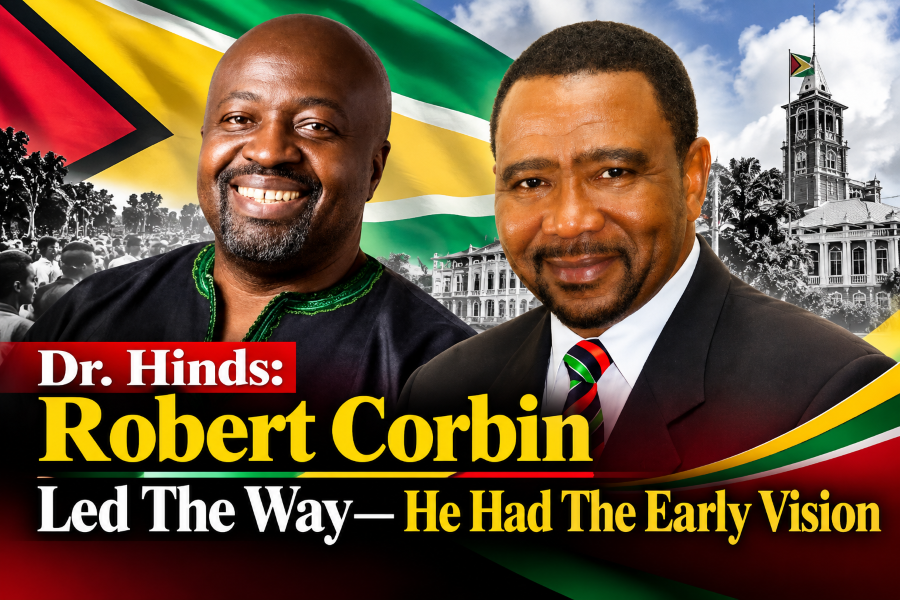
Many people and groups can lay claim to be the architects of the end product, but I would single out two of those for special mention—WPA’s Professor Clive Thomas and Dr Rupert Roopnarine and PNC’s Robert Corbin.
I did not know Robert Corbin outside of politics. My political contact with him occurred during the run-up to the 2011 elections when I was part of the WPA’s delegation and he led the PNC’s delegation at APNU leadership meetings.
From as far back as the run-up to the 2006 election Corbin signaled his intention to decisively break with the One-PNC tradition. He was bold enough to court or was open to be courted by the WPA. This took courage.
The PNC-WPA rivalry was perhaps the most intense in Guyana’s political history. Corbin was ready for the plunge even if most in the PNC were not. The WPA was not ready in 2006. Emotions still flared. The AFC came on the scene and took away part of the PNC’s constituency. The PNC had recorded its worst showing in an election up to that point
But by 2011 they were ready to take the plunge. Corbin was still there. I got the sense that unlike most of his colleagues, he had freed himself from the myth that the PNC could win an election on its own. But more than that, I think he reasoned that the vote that went to the AFC could be won back by a Coalition. He had become a soldier for Coalition politics, even if he was not the top candidate.
He worked for it. He had to navigate the WPA’s demands and that party’s militant political culture. But he stuck with the project, even as some of his colleagues thought the WPA brought nothing to the table and the PNC should go it alone. The AFC was not ready for the Coalition, but Corbin was never daunted.
In the end he delivered the APNU to a skeptical PNC. The 2011 election proved him right. The APNU brought back the traditional PNC constituency together. By 2015, the AFC could join the Partnership. The AFC had great difficulty joining the PNC. They joined the APNU. The rest is history. Robert Corbin led the way. He had the early vision.