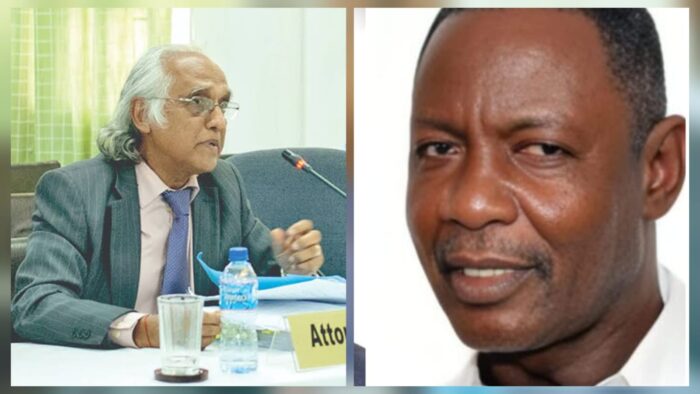
The National Insurance Scheme (NIS) is facing the threat of legal action over alleged underpayments of the statutory minimum old-age pension dating back to 2021, with attorney and commentator Christopher Ram and 10 trade unions demanding that outstanding sums be calculated and paid.
A formal letter dated October 1, 2026, from Christopher Ram and Associates gives the NIS Board seven days to state its position on the alleged underpayments and account for the amounts owed to minimum-rate pensioners.
The letter was sent to the Secretary of the NIS Board and copied to the Board’s Chairman, the NIS General Manager and Senior Minister in the Office of the President with responsibility for Finance.
At the centre of the dispute is Regulation 4(b) of the National Insurance and Social Security (Benefit) Regulations. The NIS itself currently states that an old-age pension “must not be less than 50% of the existing Public Service Minimum Wage.”
Ram and the unions contend that this statutory minimum has not been consistently reflected in payments since 2021.
According to their letter, the last year in which the minimum pension matched the 50 per cent formula was 2020, when the Public Service minimum wage was $70,000 and the NIS minimum pension was $35,000.
The dispute centres on what the Board was legally required to do as the Public Service minimum wage subsequently increased.
The 2026 National Estimates, cited in the letter, put the Public Service minimum wage at $102,346. Half of that is $51,173, while the published NIS minimum pension is $43,075.
That represents a claimed monthly shortfall of $8,098 for each pensioner receiving the minimum rate.
The NIS confirms that the minimum old-age and invalidity pension was increased from $35,000 to $43,075 effective January 1, 2025.
Ram and the unions argue, however, that a later adjustment cannot extinguish any arrears that had already accrued if pensioners were legally entitled to a higher minimum during earlier periods.
“Nor is the default cured by a later increase. The subsequent adjustment of the minimum pension does not extinguish arrears which had already accrued.”
The letter further challenges the treatment of any Public Service minimum-wage increases that were applied retroactively, arguing that the Board would need to identify the legal basis for not applying the corresponding pension adjustment from the same effective date.
The group is also relying on Section 34(2) of the National Insurance and Social Security Act, which expressly provides that any temporary insufficiency in the Fund’s assets to meet its liabilities may be met with money advanced by Parliament.
That provision is significant to the legal argument because, according to the letter, an inability of the NIS Fund to meet a statutory liability would not by itself establish that the liability could simply go unpaid.
Ram and the unions are therefore demanding that the Board identify every pensioner affected, calculate the alleged arrears from 2021 onward and make payment.
If the Board disputes liability, they want it to state within seven days the precise legal basis on which it considers payments below the alleged statutory minimum to have been lawful.
Failure to provide a satisfactory response, the letter warns, will result in legal proceedings “without further notice.”
The proposed action could seek court declarations on the pension entitlement, an accounting of sums allegedly owed, payment of arrears with interest, mandatory orders requiring continuing compliance with the regulations and legal costs.
The unions supporting the action include the federated Guyana Trades Union Congress (GTUC), National Union of Public Service Employees, General Workers Union, Guyana Local Government Officers Union, Union of Agricultural and Allied Workers, United Minibus Union, Guyana Market Vendors Union, Guyana Postal and Telecommunications Workers Union, GTC/GTT Pensioners Association and Guyana Bauxite and General Workers Union.
Ram said the dispute is particularly serious because it involves elderly and vulnerable citizens.
“We have been drawn into this action because a statutory right designed to protect the elderly and vulnerable has been curtailed by an administration that has failed to do what the law requires. In a country whose extraordinary growth has been repeatedly celebrated, minimum pensioners should not have to fight for a few thousand dollars already theirs by law.”
He also criticised what he described as the failure to address the NIS’s wider financial and actuarial problems, while questioning the Government’s reported $10 billion intervention in the Scheme.
“For years, the Board and Government have failed to confront the actuarial warnings and repair the Scheme, while finding $10 billion for an ad hoc NIS intervention.”
The NIS Board now has seven days from receipt of the letter to respond before the threatened proceedings are initiated. The underlying question of whether the alleged arrears are legally due would ultimately be for the appropriate legal process to determine.