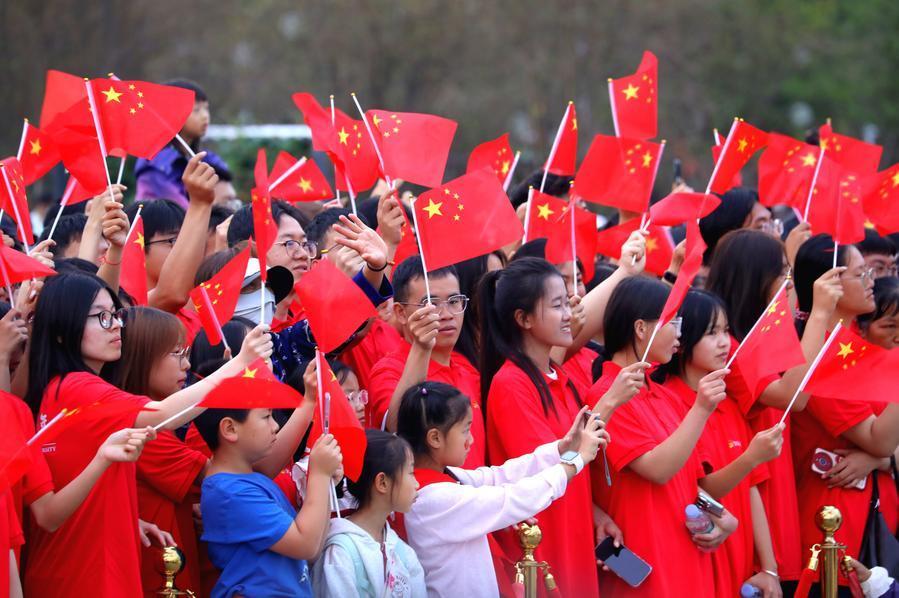
BEIJING, Oct. 1 (Xinhua) — Hours before dawn on Thursday, Tian’anmen Square was already alive with anticipation. More than 100,000 people from across China gathered at the heart of Beijing to watch the national flag-raising ceremony as the People’s Republic of China (PRC) marked its 77th founding anniversary.
At around 6:10 a.m., the national anthem echoed across the square. People sang in unison, their eyes following the five-starred red flag as it rose into the sky. For many, the moment brought tears.
When a large flock of white doves soared into the air, cheers and applause erupted from the crowd, filling the square with jubilation.
Children waved national flags as they ran about, young people chatted and laughed with national flag stickers on their cheeks, and older visitors in bright, festive clothes smiled for group photos in front of an 18-meter-high flower basket at the center of the square.
The festive mood extended far beyond the capital. Across the country, many streets were lined with national flags and floral displays, while residential communities were adorned with lanterns and traditional Chinese knots.
“Every time I pass these flower displays, I feel inspired,” said Gao Feng, a food delivery rider who crossed Chang’an Avenue, a major thoroughfare through central Beijing.
“I truly believe that if everyone does their job well and takes things one step at a time, we can build a better future,” Gao said.
On Wednesday, Chinese President Xi Jinping and other senior leaders paid tribute to fallen heroes at a Martyrs’ Day ceremony, honoring those who sacrificed their lives for the liberation of the Chinese people and the development of the PRC.
China also presented the 2026 Chinese Government Friendship Award to 50 foreign experts in recognition of their contributions to China’s development and to friendship and cooperation between China and other countries.
REMARKABLE PROGRESS
On this very day 77 years ago, the late Chinese leader Mao Zedong stood on Tian’anmen Rostrum and declared the birth of the PRC, marking a watershed moment in Chinese history.
In the decades since, China has risen from a poor country to the world’s second-largest economy and a major country striding toward the center of the world stage.
By 2025, China’s GDP had surpassed 140 trillion yuan (about 19.6 trillion U.S. dollars), accounting for about one-sixth of global GDP, while the country continued to contribute roughly 30 percent of global economic growth.
Economic growth has translated into higher incomes and longer lives. Per capita disposable income rose from just 49.7 yuan in 1949 to 43,377 yuan in 2025, while average life expectancy more than doubled, from 35 years to 79.25 years.
The country has eliminated absolute poverty and established the world’s largest systems for education, social security and healthcare. Over the past decades, China has undergone one of the world’s largest and fastest urbanization processes. Once largely agrarian, China is now home to about twice as many urban residents as rural residents.
China has become a global manufacturing powerhouse, producing everything from new-energy vehicles to industrial robots and advanced chips. In 2025, output of new-energy vehicles exceeded 16 million units, while production of industrial robots and integrated circuits rose by 28 percent and 10.9 percent, respectively.
It has emerged as one of the world’s fastest-rising forces in innovation, making major advances in cutting-edge fields such as artificial intelligence, biomedicine and quantum technology. It has achieved breakthroughs in both land-based and sea-based rocket recovery technologies.
These changes have also shaped the way China engages with the wider world. More people around the world are gaining a deeper appreciation of an increasingly innovative and culturally vibrant China through firsthand encounters. At the same time, its experience has broadened the paths for developing countries to achieve modernization.
“We take immense pride in the extraordinary achievements of New China and have full confidence in the bright prospects of Chinese modernization,” Xi, also general secretary of the Communist Party of China (CPC) Central Committee and chairman of the Central Military Commission, said at a reception on the eve of the National Day.
JOURNEY AHEAD
For visitors, the giant flower basket at the heart of Tian’anmen Square is a backdrop for holiday photos. And far more than that, it tells a story about where China is heading.
This year marks the beginning of the 15th Five-Year Plan period, which runs from 2026 to 2030. The basket features 15 types of floral designs and five types of fruit, symbolizing hopes for abundant blossoms and fruitful results over the next five years.
Beyond the flower basket, 10 three-dimensional flower installations line Chang’an Avenue, bringing themes such as new quality productive forces, harmony between people and nature, urban renewal and beautiful rural areas to life. Together, they highlight some of China’s development priorities for the next five years.
Those priorities are backed by concrete goals. The plan aims to lay the groundwork for doubling per capita GDP from its 2020 level by 2035, while accelerating breakthroughs in core technologies in key fields. It also calls for raising average years of schooling among the working-age population to 11.7 years and life expectancy to 80 years, while further strengthening China’s soft power.
The 15th Five-Year Plan period represents a crucial window for laying a solid foundation toward China’s 2035 goal of basically achieving socialist modernization and making decisive progress in that direction.
The plan has dedicated sections on Hong Kong and Macao, outlining measures to support the two regions in better integrating into and contributing to the country’s overall development. In September, Hong Kong unveiled its first Five-Year Plan, while Macao released its third in August, both aligned with the national development strategy.
Since the beginning of this year, the Chinese economy has maintained progress despite pressure and achieved innovation-driven and high-quality development while demonstrating strong resilience and vitality, Xi said at Wednesday’s reception.
“As long as we remain confident, stay focused on our goals and move forward steadily, step by step, success will ultimately belong to the great CPC, the great Chinese people and the great PRC,” Xi added.