The Caribbean’s transition to renewable energy faces a familiar obstacle — money — and the CARICOM Secretariat is turning its attention to the financing mechanisms needed to move projects from plans to investment.
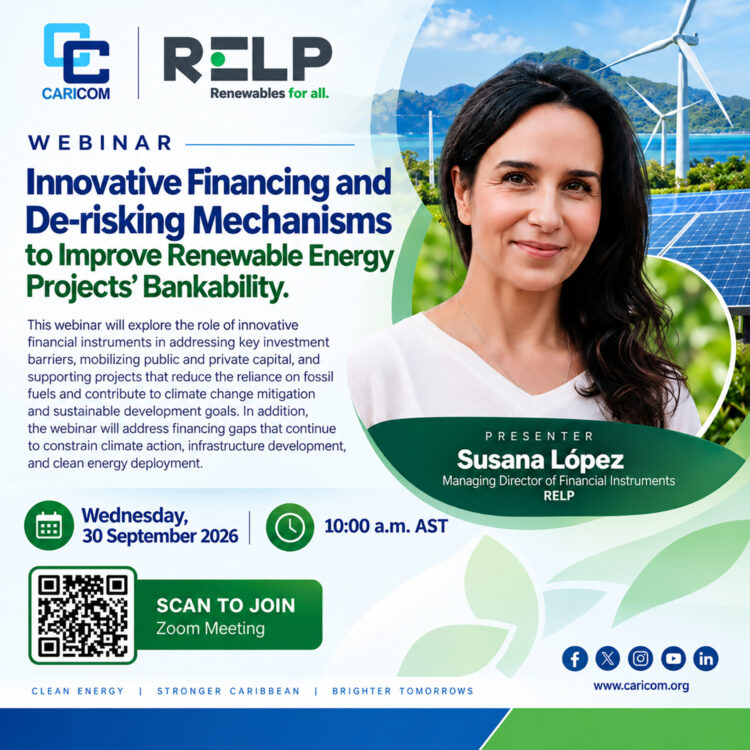
The Secretariat will host a regional webinar on September 30 examining how innovative financing and de-risking tools can make renewable energy projects more attractive to investors and lenders, while helping Caribbean countries mobilise the capital needed to diversify their energy systems.
Titled “Innovative Financing and De-risking Mechanisms to Improve Renewable Energy Projects’ Bankability,” the one-hour session will explore approaches aimed at overcoming investment barriers, bringing public and private capital together and accelerating renewable energy deployment across CARICOM Member States.
The Financing Challenge
The region’s energy transition is being constrained by several structural challenges.
CARICOM identifies small market sizes, high perceived investment risks, limited access to concessional financing and restrictions on public funding among the factors making renewable energy projects difficult to finance.
Global geopolitical developments and fluctuations in fossil-fuel prices have added another layer of uncertainty, reinforcing the need for Caribbean countries to diversify their energy sources and strengthen energy security.
The issue is not simply whether renewable energy projects can be developed. It is whether those projects can be structured in ways that give investors sufficient confidence to commit capital.
That is where “bankability” becomes critical.
A technically viable solar, wind, geothermal or other renewable energy project may still struggle to secure financing if investors consider the market, regulatory environment, revenue streams or other risks too uncertain.
De-risking Investment
Sasana Lopez, Managing Director of Financial Instruments at RELP, will lead the session, focusing on tools including blended finance, guarantees and risk-sharing instruments.
The webinar will also examine practical case studies showing how these mechanisms can be used to attract investment and address financing gaps.
Blended finance can combine public or development resources with commercial capital, while guarantees and risk-sharing arrangements can help reduce particular risks that might otherwise discourage private investors.
The underlying objective is to find ways of using limited public and development resources to unlock larger pools of private investment.
That could be particularly important in Caribbean markets where relatively small project sizes and limited domestic capital can make it difficult to achieve the scale investors typically seek.
Energy Security at the Centre
The financing question also has implications beyond renewable energy.
Caribbean economies remain exposed to international fossil-fuel prices. Sudden price increases can place pressure on electricity costs, businesses, consumers and national finances.
Greater use of renewable energy can help reduce that exposure while supporting longer-term energy security.
CARICOM has already been pursuing a wider sustainable-energy agenda, including work on electric mobility and the harmonisation of electric-vehicle charging infrastructure across Member States. A June regional webinar examined safety measures, installation requirements and inspection procedures needed to support interoperable charging systems.
The latest initiative shifts attention to another critical component of the transition — how to pay for it.
Regional Stakeholders to Participate
The September 30 session will bring together stakeholders from the energy, finance, investment, policy and project-development sectors, including government policymakers, financial institutions, development finance institutions, renewable energy developers and international development partners.
Event: Innovative Financing and De-risking Mechanisms to Improve Renewable Energy Projects’ Bankability
Date: September 30, 2026
Time: 10:00 a.m.–11:00 a.m. AST
Speaker: Sasana Lopez, Managing Director of Financial Instruments, RELP
Host: CARICOM Secretariat
The discussion comes at a critical point in the Caribbean’s energy transition. Renewable energy ambitions are growing, but turning those ambitions into functioning projects will depend increasingly on whether governments, development institutions and private investors can build financing structures capable of sharing risk and unlocking capital.
In the Caribbean’s energy transition, the question is no longer simply what can be built. It is how the region can make it financeable.
The webinar is open to the public. Persons can join via the following link or by scanning the QR code in the graphic.