President Irfaan Ali’s projection that at least three million people could pass through Guyana’s economy by 2030 has placed migration at the centre of the country’s development debate—but the Government’s proposed policy must answer a question that cannot be separated from the labour shortage: what happens to wages, working conditions and the economic security of Guyanese and migrant workers alike?
Ali said on September 26 that Guyana is already dependent on foreign labour, particularly in construction, and that the Government is developing a migration policy to meet the demands of an economy being transformed by oil, gas and new industries.
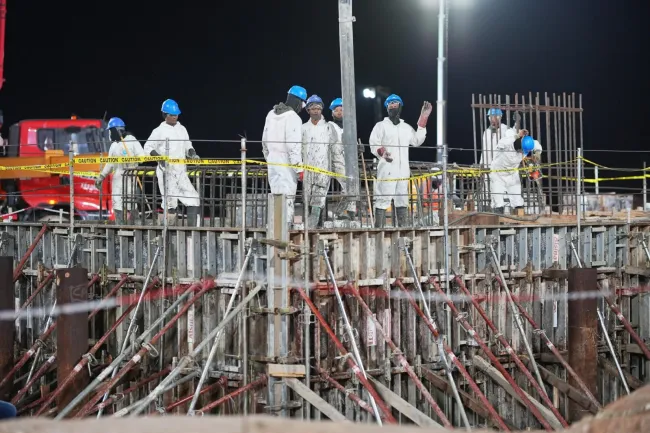
“Can you imagine a construction sector without the foreign workers now?” Ali asked.
He projected that by 2030:
“At least three million people will be passing through this economy…And that by itself creates its own demand.”
The projection is enormous when measured against Guyana’s population. The World Bank estimates the country’s population at fewer than one million, meaning three million people passing through the economy would represent several times the resident population—although the President was referring to movement through the economy, not three million new residents.
That distinction matters because migration, tourism, temporary labour and permanent settlement require different policies.
A labour shortage—but what kind of jobs?
Government’s own 2026 Mid-Year Report says Guyana’s labour-market problem has shifted from creating jobs to finding enough people with the skills required to fill them.
The national unemployment rate fell to 6.2 per cent in the fourth quarter of 2025, while labour-force participation reached 59.2 per cent. Government says shortages of technical and professional skills are threatening to delay projects and are putting upward pressure on labour costs.
That creates an important policy test.
If Guyana requires foreign workers because particular skills are unavailable locally, migration can help fill genuine gaps. But importing labour cannot become a substitute for training Guyanese workers, improving wages and creating conditions that retain skilled people.
Union Demand Decent, Livable Wages
Guyana’s economic expansion is also sharpening a question that cannot be answered by job numbers alone: what can workers actually afford to live on?
Since first oil in December 2019, Guyana has accumulated roughly US$10.5 billion in petroleum revenues deposited into the Natural Resource Fund (NRF), through June 2026. The figure includes the government’s share of profit oil and royalties.
Yet the country’s trade-union movement continues to press for wages that reflect the cost of living, safer working conditions and a greater share of economic gains reaching workers.
The Opposition, A Partnership for National Unity (APNU) has called for the minimum wage for public servants to be raised to G$200,000 per month, arguing that workers must be able to keep pace with the cost of living.
A living wage goes beyond simply meeting the legal minimum. It is intended to provide workers and their families with a decent standard of living, covering essential costs such as food, housing, healthcare, education, transportation and other basic needs.
The Guyana Public Service Union (GPSU) has similarly called for a living wage based on the actual cost of living and argued that economic growth must translate into stronger purchasing power for workers.
The Guyana Agricultural and General Workers Union (GAWU), meanwhile, has highlighted its three-year wage agreement with GuySuCo, which established an industry minimum wage of G$100,000 per month for sugar workers.
The contrast raises a fundamental question about Guyana’s oil-fuelled economic transformation: if billions of US dollars are flowing from the country’s natural resources, how much of that wealth is translating into better pay and living standards for the people who keep the economy moving?
A booming economy cannot be measured simply by the number of jobs created. It must also be measured by whether those jobs pay enough for workers to live with dignity.
That principle should apply equally to Guyanese and foreign workers, particularly as employers compete for scarce labour.
Protecting migrant workers is part of the policy
There is already evidence of why stronger labour oversight will be necessary if migration expands dramatically.
Earlier this year, the Ministry of Labour investigated complaints involving foreign workers, including allegations concerning working conditions and the handling of passports. The Ministry said the investigation remained ongoing and stressed that both the workers’ allegations and the company’s response had to be examined before conclusions were reached.
In another case involving 37 foreign workers at a quarry, the Labour Ministry examined complaints involving wages, passports, contractual arrangements and occupational safety. The Ministry subsequently said outstanding salaries had been paid and that safety concerns had been investigated.
These cases do not establish a general pattern of abuse. They do, however, demonstrate why a migration policy must include effective enforcement, transparent contracts, wage protections, occupational safety standards and access to labour rights.
Three million people require more than a work-permit policy
Ali says Guyana must prepare for natural gas, a proposed urea plant, an alumina plant and hyperscale data centres.
“We have to have a flexible, dynamic, modern migration policy to deal with what would be our needs and requirements in the future,” he said.
But flexibility without clear safeguards could leave critical questions unanswered.
Who determines how many foreign workers Guyana needs? Which sectors receive priority? What training commitments must employers make to Guyanese workers? What minimum wages and conditions apply? How will housing, healthcare, transportation, water and electricity keep pace? What happens when major projects end?
And critically, will economic growth lift wages and living standards for ordinary Guyanese, or will labour shortages simply be filled while the benefits of growth remain concentrated elsewhere?
Guyana already has a Decent Work Country Programme for 2025–2030, developed with the International Labour Organisation and national stakeholders.
The migration policy should therefore be integrated into that wider labour framework rather than treated as a standalone mechanism for importing workers.
Guyana may indeed need foreign labour to sustain its unprecedented economic expansion.
But if the country is preparing for three million people to move through its economy, the measure of success cannot simply be whether the jobs are filled.
It must also be whether the workers—Guyanese and foreign—are paid decently, protected by law, treated fairly and able to share meaningfully in the prosperity their labour helps create.