What began with a mother’s curiosity following a workshop she attended has grown into a small agro-processing business with ambitions of becoming a household name.
For Xuxa Lowe, Managing Director of Sand Flower Products, the journey is one rooted in family, tradition, and a desire to give consumers more opportunities to choose locally produced goods.
Sand Flower Products, named after the beautiful wildflowers, grown at Siriki Sand, Upper Pomeroon, was started by Lowe’s mother in 2015. At the time, she was working as a midwife while also involved in forestry through a concession on which there were many palm trees bearing a small dark purple fruit called Acai berries. After attending a workshop, the older woman learnt that the acai berry, locally known as manicol, could be used to make drinks.
“She came home, she experimented and that is how the business was birthed in 2015 with acai berry wines,” Lowe recalled.
The name chosen for the business, she then explained, has its roots in the community.
“In our community there are these little flowers, commonly called sand flower. They just spring up all over the place, and that is how we got the name of the business,” Lowe explained.
Her mother retired in 2020, and the business subsequently expanded its product range to include cassava bread. Today, Sand Flower Products produces several locally made items, including plain cassava bread, garlic cassava bread, garlic and parsley cassava bread, as well as acai berry and cherry wines.
For Lowe, the decision to focus on traditional products was driven by a simple observation: consumers want access to local alternatives.
“I think that persons want more of a local something. Not everybody is foreign-minded or wants to try things that are being imported…Sometimes they just don’t know how to get local products or even how to make it, so I thought that it was a great opportunity for us to give people more traditional products,” she said.
That focus on local production aligns with the broader objective of the GNBS Made in Guyana Certification Mark Programme, which provides a recognised mark for certified Guyanese-made products. It also gives consumers a way to identify locally produced goods.
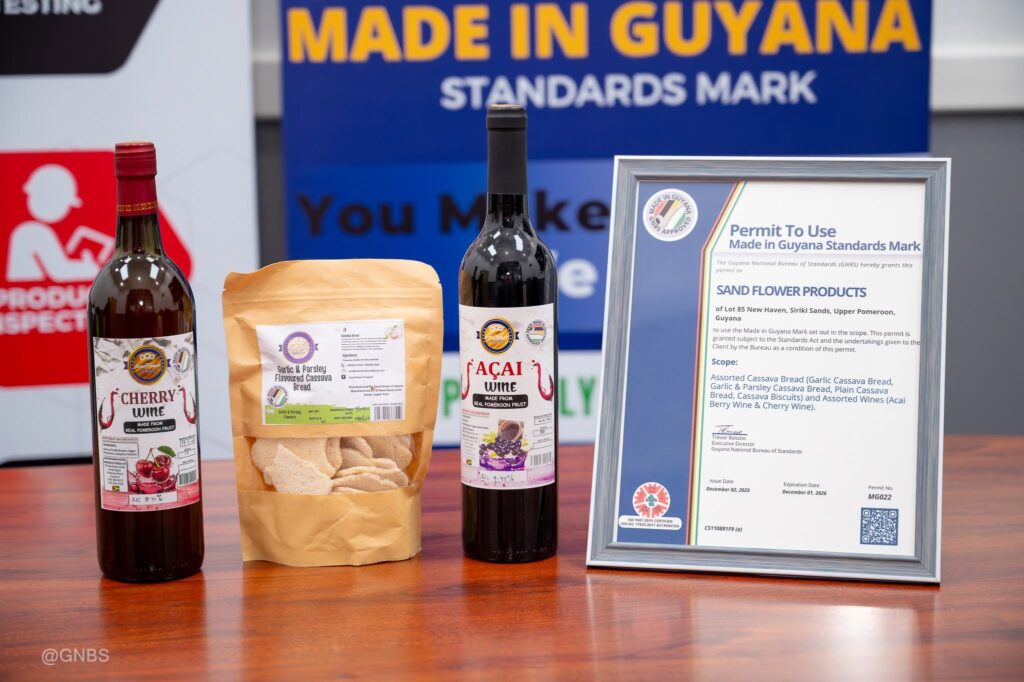
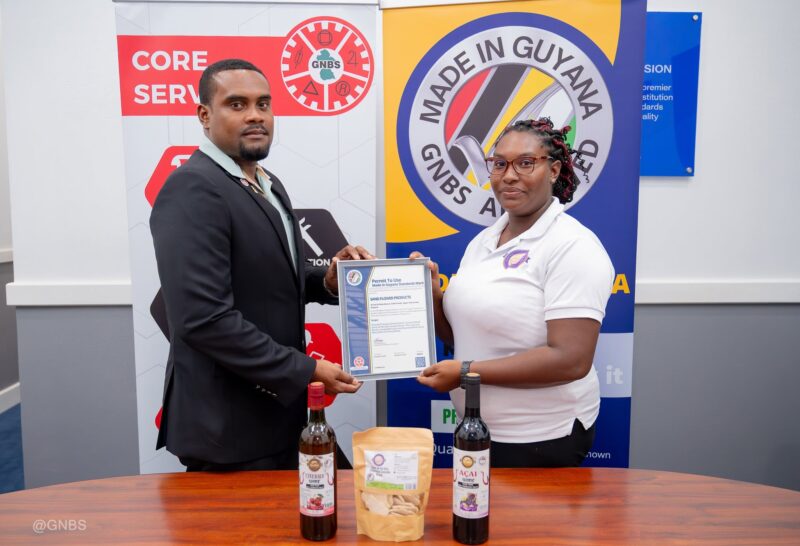
In 2024, Sand Flower Products joined the GNBS Made in Guyana Certification Mark Programme after a colleague shared her experience with the process, prompting Lowe to look at the application.
For the business, the process proved manageable, partly because systems were already in place. The certification helped in formalising the business processes.
“It wasn’t really hard. The guys (GNBS) worked along with us, and we were already keeping records of our products, including batch numbers, so it was easy for us to get everything together,” Lowe explained.
To produce quality products which also taste delicious, Lowe said, “when we are finished, if we are making cassava bread, we make sure that we taste it; that it is of quality before we do packaging; same thing with the wines,” she said.
Asked what makes her products stand out, the Managing Director said, “it is made with love.”
She explained that even when people follow the same recipe, the end product is not the same.
Since achieving the rights to use the GNBS-approved Made in Guyana Mark on its products, more opportunities were created in the marketplace for the business.
“The market opportunities have been great because when people look at your product and they see that it has been certified by GNBS, it is something that they look at like, oh, this is a good product,” Lowe said.
She pointed to the company’s process flow charts and Key Performance Indicators (KPIs) as part of the systems used to keep the business on track. GNBS also conducts audits, during which records and other requirements are reviewed.
Having gone through the process herself, Lowe encouraged other small manufacturers to consider the Made in Guyana Certification Mark Programme. “I would definitely tell them to go after it,” she said.
She acknowledged that some businesses may not have all the required systems or records when they initially apply. However, based on her experience, GNBS works with manufacturers to help them meet the requirements.
“Even if, when you apply for it, you don’t have the necessary requirements that GNBS needs from you, they’re going to work along with you and make sure that everything is okay. They follow up and do all of that,” Lowe highlighted.
The Made in Guyana Certification Mark helps local businesses to boost their brands by authenticating their products’ origin, giving them a competitive advantage over other producers.
For Lowe and her business, the journey is far from over. With new markets ahead and the Made in Guyana mark helping to strengthen the brand’s presence, Sand Flower Products is continuing to build on the family venture that began more than a decade ago—with the ambition of putting its name in households across Guyana and beyond.
For more information on the GNBS Certification Mark programme, contact GNBS on telephone numbers: 219-0064-66 or WhatsApp: 692-4627 or visit the GNBS website: www.gnbsgy.org