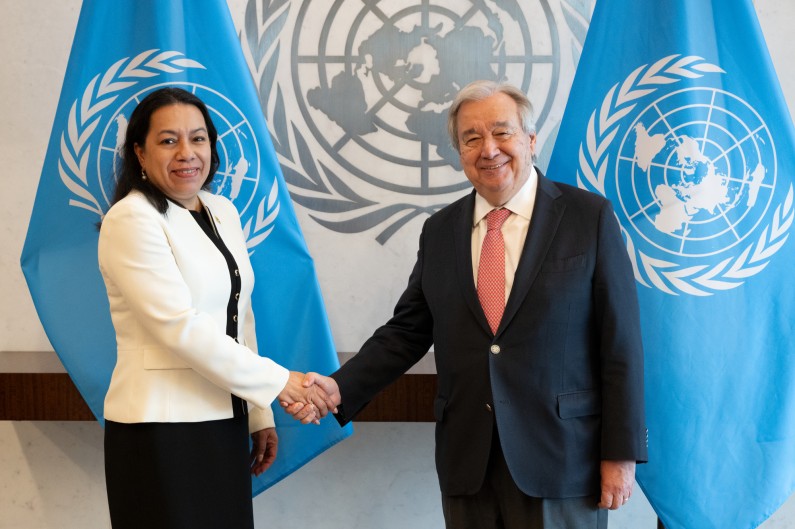
President Irfaan Ali used his United Nations (UN) address Thursday to make his most forceful public appeal yet for Ambassador Carolyn Rodrigues-Birkett to become the next UN Secretary-General, even as her candidacy faces a potentially significant hurdle in the form of reported U.S. opposition.
Ali devoted some of the strongest and most personal language of his roughly 25-minute address to Rodrigues-Birkett, presenting her as a leader capable of restoring confidence in a troubled United Nations and urging member states to judge her beyond Guyana’s size.
“This is an individual of extreme quality. Not because she’s a Guyanese. Not because she comes from Guyana. But because I know her personally…”
He followed with an emphatic endorsement:
“I know that this world will be a better place with Carolyn Rodrigues as the Secretary-General of the United Nations.”
Ali then appealed directly to the international community:
“Look beyond the small country that nominated her.”
The appeal comes as the selection process enters a more consequential phase and reported questions remain over Washington’s position on the Guyanese candidate.
The New York Times has reported that the United States opposes Rodrigues-Birkett’s candidacy over her characterization of Israel’s conduct in Gaza as genocide. That reported position has potentially serious implications because the Secretary-General must first secure a recommendation from the 15-member Security Council before the 193-member General Assembly can make the appointment.
Under Article 27 of the UN Charter, a substantive Security Council decision requires at least nine votes and the concurring votes of the permanent members. A negative vote from any of the five permanent members — the United States, China, Russia, Britain or France — can therefore block the recommendation.
A reported U.S. objection, however, is not the same as an actual veto. Washington has not formally cast a veto because the process has not reached that stage.
Straw Poll Shows Tight Race
The latest informal Security Council straw poll on September 18 placed Costa Rica’s Rebeca Grynspan ahead of Rodrigues-Birkett. Grynspan received nine “encourage” votes, five “discourage” votes and one “no opinion,” while Rodrigues-Birkett received eight “encourage,” six “discourage” and one “no opinion.”
The result marked a reversal from the previous round on August 21, when Rodrigues-Birkett led with eight “encourage” votes.
The latest poll does not determine the eventual outcome. The ballots are informal and confidential, and no candidate has yet secured a consensus among the Council’s permanent and elected members.
Rodrigues-Birkett nevertheless remains among the leading contenders. CARICOM has endorsed her candidacy, while her campaign has also carried the significance of potentially making her the first Caribbean national and first woman to serve as UN Secretary-General.
But regional backing cannot substitute for the Security Council’s formal recommendation.
Rodrigues-Birkett’s record on Gaza and Israel has become an important part of the political debate surrounding her candidacy. In 2024, she described the situation in Gaza as involving “a veritable genocide,” a position that has drawn criticism in U.S. political circles.
Ali nevertheless presented her as precisely the type of leader he believes the United Nations requires.
“We need a Secretary-General who will defend the Charter, not only when it is politically convenient, but precisely when its principles are under pressure.”
That appeal now intersects with the hard realities of Security Council diplomacy.
For Guyana, the campaign is no longer simply about accumulating support in the wider UN membership. The more difficult question is whether Rodrigues-Birkett can secure the backing — or at least avoid the opposition — of the permanent members when the process moves from informal straw polls to the formal Security Council stage.
Ali’s public endorsement has put Guyana’s diplomatic weight firmly behind its candidate. The outcome, however, will ultimately depend on negotiations behind closed doors and the positions taken by the Council’s five veto-holding powers.