President Irfaan Ali used a high-level United Nations dialogue to call for a coordinated, multi-sectoral approach to pandemic preparedness, but his message also throws a spotlight on Guyana’s own challenges in building the kind of integrated system he advocated internationally.
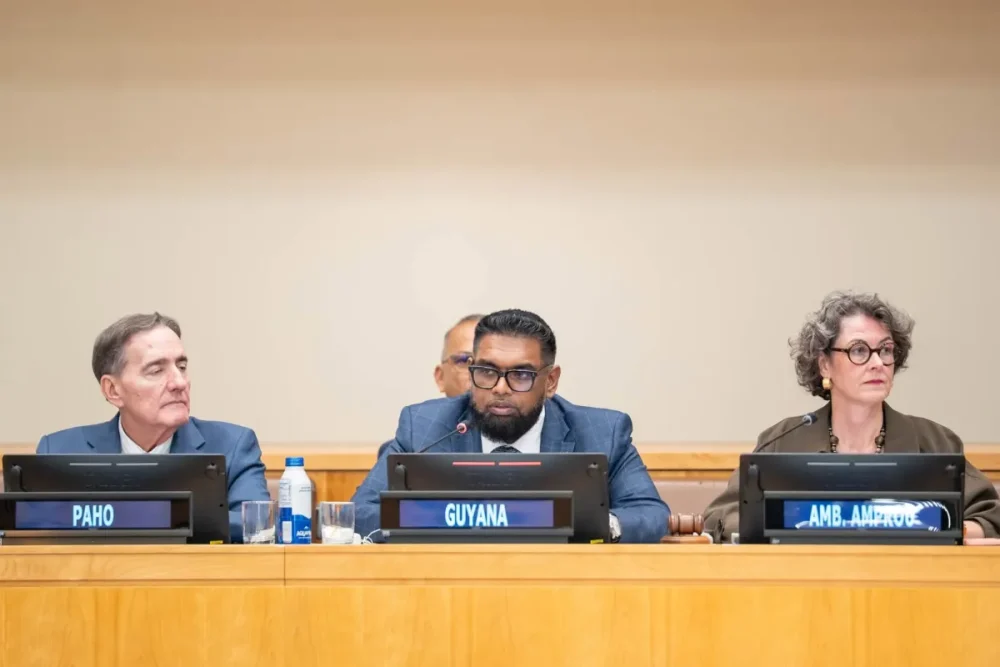
Speaking Tuesday on the sidelines of the 81st UN General Assembly, Ali said pandemic prevention, preparedness and response must be treated as a sustained economic, development and security priority, rather than a responsibility left to the health sector alone.
“While we cannot prevent every outbreak, we can prevent an outbreak from becoming a catastrophe,” Ali said.
He called for stronger laboratories and hospitals, trained personnel, technology, scientific capacity, cross-border cooperation and domestic production of essential medicines.
The challenge for Guyana is that many of those capacities are still being developed, while the country faces a combination of infectious diseases, flooding, changing rainfall patterns, water insecurity and weaknesses in emergency and health infrastructure.
The scale of the dengue problem illustrates the vulnerability.
According to the Global Dengue Observatory, Guyana recorded 56,293 dengue cases during 2026 through August, approximately 6.7 times the expected level. The country recorded 9,711 cases in July and another 7,194 in August.
The figures come despite government measures including nationwide fogging, larviciding, surveillance and training of health workers. The Ministry of Health has said it tracks dengue cases weekly and has equipped Neighbourhood Democratic Councils with fogging machines.
Dengue, however, is only one component of the country’s broader vulnerability.
Flooding is a health emergency too
Guyana’s exposure to flooding creates a second layer of public-health risk.
The country experienced significant flooding in March 2026 following several days of sustained rainfall. The Civil Defence Commission reported flooding in coastal communities and significant water accumulation on agricultural lands in Mahaica, Mahaicony and Canal Polder. Government agencies had to activate an Emergency Operations Centre, conduct aerial assessments and distribute sanitation and cleaning supplies to affected communities.
Flooding does not end when the water recedes. Contaminated water, stagnant pools, damaged sanitation systems and displaced populations can create conditions for dengue, malaria, leptospirosis, gastrointestinal and other water- and vector-borne illnesses.
Guyana’s own climate-health assessments acknowledge these risks. PAHO reported that stakeholders have identified increases in vector-, water- and food-borne diseases, respiratory illnesses and heat-related conditions as climate patterns change.
The country’s health infrastructure is particularly exposed because many facilities are concentrated along the vulnerable coastal belt. A national climate assessment noted that the 2005 floods affected more than 25 health centres in Georgetown, the East Coast and West Bank Demerara, with health-sector losses and costs estimated at US$0.9 million.
Guyana’s drainage infrastructure is itself undergoing a major rethink. Agriculture Minister Zulfikar Mustapha acknowledged that traditional approaches are no longer sufficient, noting that rainfall that once occurred over months can now occur within hours. The government launched its first National Drainage and Irrigation Strategy 2030 in June, including plans for improved mapping, pumping, sluice rehabilitation and real-time monitoring.
A system still being built
There are signs that the government recognises the gaps.
The US$22 million Guyana One Health Project, backed by the World Bank and Pandemic Fund, is intended to strengthen laboratories, disease surveillance, emergency response, workforce capacity and coordination among human, animal and environmental health agencies. The World Bank has also identified weaknesses including shortages of health workers in hinterland regions and a largely paper-based health information system.
Guyana’s WHO preparedness assessment has likewise identified low-scoring areas involving national coordination, health-emergency staffing, surge capacity and infection prevention and control.
Those realities complicate the President’s message at the UN.
Ali is correct that pandemics cannot be managed by hospitals alone. But neither can Guyana’s health threats. Effective preparedness requires drainage and flood management, safe water, sanitation, environmental monitoring, reliable disease data, functioning laboratories, emergency transportation, trained personnel and coordinated action among health, agriculture, environment, local government and disaster-response agencies.
Guyana is now investing in many of those areas. The question is whether the country can move from responding to outbreaks and floods as they emerge to maintaining a genuinely integrated system capable of anticipating and mitigating their health consequences before they become crises.