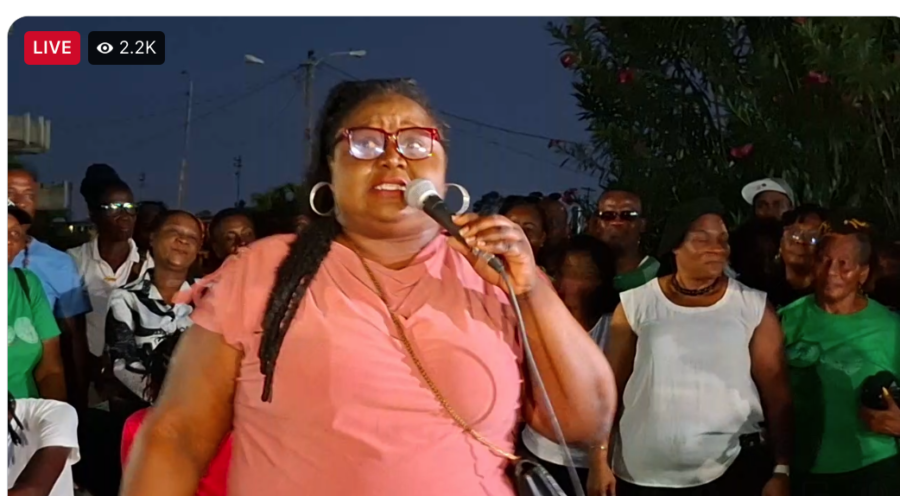
Opposition Member of Parliament and We Invest in Nationhood (WIN) General Secretary Odessa Primus is questioning what she describes as the Government’s “selective urgency,” contrasting its swift response to political opponents with the situation facing an Indigenous community defending its titled lands against renewed mining activity.
Primus launched the criticism in a social media post as residents of Chinese Landing reported that miners and heavy machinery had again entered their territory, forcing villagers into a continuing standoff to protect their community.
“The Government of Guyana has demonstrated that it knows how to respond quickly when it wants to.”
Primus contrasted the Government’s response to Opposition Leader Azruddin Mohamed with what she described as its silence over the Chinese Landing dispute.
“As soon as the Honourable Leader of the Opposition Azruddin Mohamed coughs, sneezes, walks, wakes up, says a word the government sends out all its ammunition. They find the time, the microphones and the urgency to address him and the political opposition.”
Then came her central question:
“So where is that same urgency for the people of Chinese Landing?”
Miners, Heavy Equipment and a Government Response Under Question
Kaieteur News reported on September 21 that Chinese Landing residents had been maintaining a round-the-clock blockade after four excavators and a bulldozer linked to mining interests entered the area. The report said residents were attempting to prevent heavy equipment from reaching mining areas and accused state authorities of failing to intervene.
The report also said GGMC Commissioner Newell Dennison informed Toshao Nikita Miller in a September 7 letter that the Commission was withdrawing as mediator in the dispute, saying the initiative for a mediated solution had been overtaken by developments and circumstances affecting both sides.
Primus directly challenged the authorities:
“Where is the Minister of Amerindian Affairs?
Where is the Ministry of Natural Resources?
Where is the decisive intervention from the GGMC?”
She demanded that the Government explain what it is doing to protect Chinese Landing residents and their land rights.
The dispute is not new. Chinese Landing holds titled community lands, and the conflict over mining has previously drawn international human-rights scrutiny.
IACHR Already Warned of Serious Risk
In July 2023, the Inter-American Commission on Human Rights (IACHR) granted precautionary measures to members of the Indigenous Carib Community of Chinese Landing after finding that the information before it indicated a serious and urgent risk to their rights to life and personal integrity.
The Commission cited reported threats, harassment and violence connected to opposition to mining activities on the community’s lands. It called on Guyana to take measures to protect residents, consult with the community and investigate the incidents that led to the precautionary measures.
The IACHR also noted concerns that previous reported incidents had not resulted in identified suspects, criminal trials or perpetrators being held responsible.
Against that history, Primus questioned why residents in 2026 are again being left to protect their own territory.
“Yet, in 2026, villagers are still being forced to stand guard over the lands they call home.”
From Chinese Landing to MV Barima and Mahdia
Primus broadened her criticism by pointing to previous tragedies involving Indigenous Guyanese.
She cited the 2008 Waramadong dormitory fire, the 2023 Mahdia dormitory fire that killed 20 children and one adult, and the July 2026 MV Barima disaster.
“How many tragedies, how many cries for help and how much suffering must our Indigenous people endure before they receive the same urgency, visibility and attention that this Government so readily finds for its political battles?”
Her broader argument is that government responsiveness should not depend on whether an issue involves political opponents.
“So the question is no longer whether the Government can act. We know it can.”
“The question is: who does it consider important enough to act for?”
The renewed confrontation at Chinese Landing now places pressure on the Government and the agencies responsible for Indigenous affairs and mining regulation to publicly clarify the status of the disputed mining activity and what enforcement measures, if any, are being taken.