Political and economic commentator GHK Lall has used the reported U.S. visa review involving Guyanese High Court Justice Gino Persaud to launch a broader critique of what he describes as shifting standards of accountability, political influence and justice in Guyana and Washington.
In an opinion published today in Village Voice News, Lall argued that the controversy surrounding Persaud exposes what he sees as contradictions in how powerful individuals are treated when political and strategic interests change.
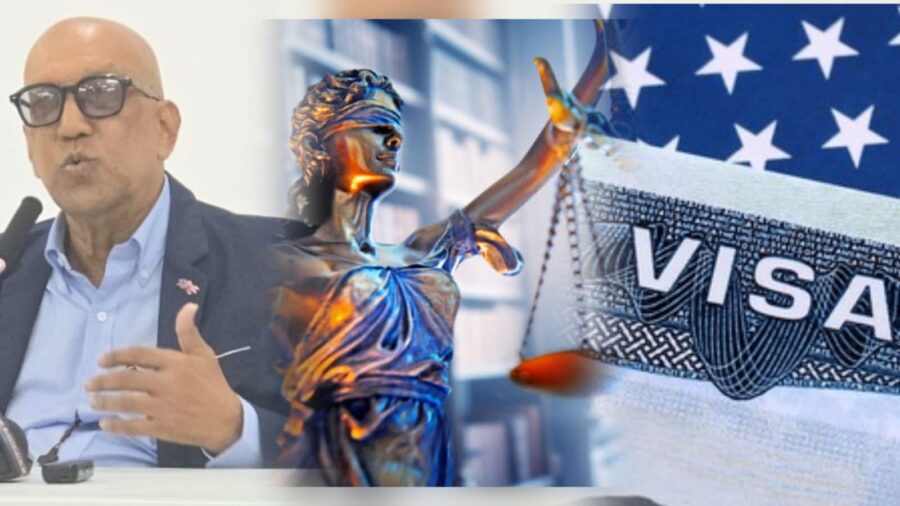
The reported visa development surfaced on September 19, when Persaud was reportedly unable to proceed with travel to Jamaica for a Commonwealth judicial conference after being informed that his U.S. visa was “under review.” The precise reason for the review has not been publicly disclosed. Importantly, a reported visa review is not the same as a confirmed revocation, and there is no established evidence connecting the development to Persaud’s judicial decisions.
Lall nevertheless questioned whether the incident reflects a wider pattern in which international relationships and political interests can influence how individuals are treated.
“Visa review. I am all for it. But when all are included, when no one is excluded. Not even presidents and prime ministers.”
He argued that scrutiny should not be selectively applied to individuals who challenge powerful interests while senior political figures escape equivalent examination.
Lall’s concerns are particularly pointed because Persaud has recently presided over several cases involving the Guyana Revenue Authority and members of the Mohamed family. In November 2025, Persaud ruled in favour of Opposition Leader Azruddin Mohamed in a judicial review involving approximately G$421 million in vehicle assessments.
The GRA appealed. Persaud later issued rulings involving other members of the Mohamed family, including decisions quashing assessments totalling almost G$800 million. Those decisions have also been challenged by the GRA. There is currently no publicly established evidence that those rulings prompted the U.S. visa review.
Lall questioned the broader consequences of what he regards as selective international scrutiny.
“Today, those who stand against the rampages of the twisted and deformed in Guyana’s power architecture are the ones targeted.”
He also broadened his argument beyond Guyana, pointing to changes in U.S. policy toward Venezuela. In April, the U.S. Treasury removed Delcy Rodríguez from its sanctions list after she had previously been sanctioned in 2018.
The shift has itself attracted criticism in Washington. U.S. Senators Jeanne Shaheen and Elizabeth Warren subsequently requested an explanation from the Trump administration for lifting sanctions against Rodríguez, citing her previous designation and questioning the policy basis for the change.
Lall used the Venezuelan developments to question whether geopolitical interests can produce dramatic changes in the treatment of individuals previously subjected to U.S. sanctions or scrutiny.
“The pendulum has swung, and it is not toward justice, nor the American Way.”
He argued that the same principle should apply in Guyana, insisting that any U.S. accountability mechanism should extend beyond Opposition figures, judges or individuals who have fallen out of favour.
“If they, then ministers and senior public servants, must be part of the American Dragnets.”
Lall also questioned what he described as the growing influence of international interests over Guyana as the country manages unprecedented oil wealth.
“I am touched and troubled by how this national patrimony has become a Pandora’s Box for Guyanese. A world of ills. An arena of disreputable men and women in Guyana and abroad.”
His criticism ultimately extends to both Guyanese political leadership and Washington’s role in the country’s evolving oil-driven geopolitical landscape.
“And the curse bigger than even them, once oil is around: The Great White Fathers in Washington.”
The circumstances surrounding Justice Persaud’s reported visa review remain unresolved. No public explanation has established why the review occurred, who initiated it or whether it has any connection to his judicial work.
Lall argues that the unanswered questions lie at the heart of the controversy, raising broader concerns about whether accountability is being applied consistently where political power, judicial independence and international interests intersect.