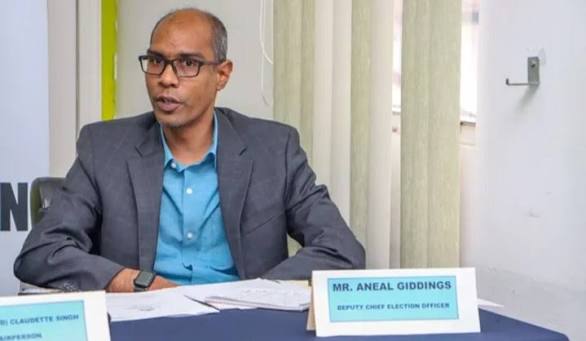
The testimony of former Guyana Elections Commission (GECOM) IT Manager Aneal Giddings in the trial arising from Guyana’s disputed 2020 General and Regional Elections has raised questions about who had authority over critical election technology, how the server was secured during a bomb scare, and what independent safeguards existed to verify the integrity of election data.
Giddings testified that he removed the server from the Ashmin’s Building on March 5, 2020, believing it was his duty to protect GECOM’s information. He acknowledged, however, that he did so without authorisation and contrary to instructions from then Deputy Chief Elections Officer Roxanne Myers, placing the server in his personal vehicle before later returning it.
The evidence does not establish that Giddings manipulated election information. He denied stealing the server or information from it. But the circumstances raise questions about authority, chain of custody, physical security and independent verification.
1. His position was important—but was it autonomous?
Giddings was GECOM’s IT Manager and said his responsibility for protecting the Commission’s information resources prompted him to remove the server.
Under cross-examination, however, he acknowledged that neither Myers nor then Chief Elections Officer Keith Lowenfield authorised the removal and that he had no statutory mandate to take custody of the equipment in that manner.
The central question is therefore:
Where did Giddings’ technical responsibility end and GECOM’s chain of command begin?
Technical access and responsibility do not necessarily confer authority to override a superior’s instruction.
2. The contradiction at the heart of the server issue
The testimony establishes that during the reported bomb threat, Myers asked whether the election data could be backed up. Giddings said it could, and a backup was made and delivered to Myers on a flash drive.
Giddings nevertheless removed the physical server, despite Myers instructing him not to proceed. He placed it in his vehicle and later received instructions to return it. The server remained in the vehicle for approximately two and a half hours.
That raises a key procedural question:
If the election data had already been backed up, what additional authority did Giddings have to remove the physical server against an explicit instruction?
His stated reason was protection of GECOM’s information. Whether that justification gave him lawful authority to act as he did is a separate issue.
3. The chain-of-custody issue
There has been no finding that Giddings altered election data, and he denied doing so.
The issue is what happened to the server once it left GECOM’s controlled environment.
What controls existed to establish independently that the server and its contents remained secure while in a private vehicle?
That is different from asking whether Giddings personally tampered with it. Electoral records must be capable of being independently verified, particularly when their integrity becomes relevant in a contested election.
4. The post-incident audit question
The evidence has raised questions about whether an independent forensic examination was conducted after the server was returned.
Such an examination could potentially have established whether files were accessed or modified, timestamps changed, external devices connected, or the system otherwise altered.
The absence of a documented post-incident examination, if confirmed, would not prove that the data were changed. It would, however, leave a potentially important forensic gap.
The question is:
After the server was removed from GECOM’s controlled environment, what independent mechanism verified its integrity?
5. Why Giddings’ IT role matters
Giddings was responsible for GECOM’s IT systems and testified that he was the only person with credentials to publish documents on GECOM’s website at the time. He said his role was to upload documents as received.
That raises a broader institutional question:
Who independently monitored the person responsible for critical election technology and website publication?
The testimony brings into focus the importance of documented authorisation, separation of duties, access controls, audit trails, controlled custody and independent verification.
6. Why was Giddings still inside with the SOPs?
The server issue also intersects with Giddings’ admission that he remained inside the Ashmin’s Building with Paul Persaud, handling and packaging Statements of Poll after Myers ordered people to leave.
Defence counsel suggested that their continued presence created an opportunity to switch or alter SOPs. Giddings denied tampering.
The distinction is important:
Opportunity is not culpability.
Having access to election documents does not establish that a person interfered with them.
But it raises a governance question:
Why were technical personnel still handling critical election documents after the tabulation process had been halted and personnel had been instructed to leave?
7. Could an employee override the chain of command?
If Giddings believed the server was at risk during the bomb scare, what procedure should have governed his response?
Could he have alerted his superior, recommended removal, obtained authorisation and documented the emergency, or did his position permit him to act independently?
His testimony that he proceeded despite Myers’ instruction puts that issue squarely before the court.
8. The website evidence adds another layer
Former GECOM PRO Yolanda Ward testified about sending election declarations to Giddings for publication. Giddings said he uploaded the documents and was the only person with the necessary website credentials.
The broader question is whether the electronic chain can be reconstructed:
Who created the document, who received it, who authorised it, who uploaded it, when was it uploaded, and was it subsequently changed?
9. Capability, opportunity and culpability must remain separate
The evidence may establish that Giddings had substantial technical access, possessed the physical server for a period, and acted contrary to an instruction.
It does not, by those facts alone, establish that he manipulated election results.
The court must determine the significance of the evidence and whether the prosecution has proved the alleged offences.
10. The bigger question for GECOM
The Giddings testimony ultimately raises questions beyond the witness himself.
How did GECOM control critical election infrastructure during one of the most sensitive periods of the 2020 election?
And after the server was removed:
What independent mechanism existed to demonstrate that the election data remained intact?
That is fundamentally an institutional question about GECOM’s safeguards.
11. The critical distinction
It would be premature to conclude that Giddings’ conduct proves election manipulation.
It would be equally incomplete to dismiss every concern by accepting his explanation that he was simply protecting election data.
His testimony raises questions about authority, compliance, custody, security, verification, access, segregation of duties and documentation.
Those questions should not be confused with findings of guilt.
12. Why this matters to the 2020 election trial
The trial concerns allegations arising from the tabulation and declaration of results following the March 2, 2020 General and Regional Elections. Giddings has testified about differences between documents and vote figures, including differences between material used during the original process and later results.
Against that background, the integrity of the systems used to store, handle, transmit and publish election information becomes an important evidentiary issue.
The central question is not simply what Giddings did, but whether GECOM’s systems were sufficiently controlled to document and independently verify what happened to critical election data during the disruptions of March 2020.
That question goes beyond any single witness or defendant. It goes to the reliability and resilience of the electoral system itself.