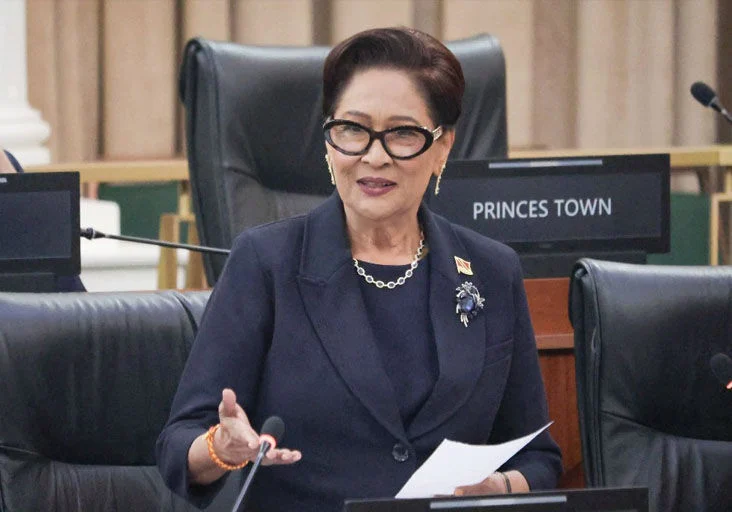
Trinidad and Tobago Prime Minister Kamla Persad-Bissessar has warned that wealthy and politically connected people involved in criminal activity will face the same treatment as other offenders as the country’s state of emergency comes to an end.
In a statement posted on social media, Persad-Bissessar said her government is working with local and foreign law enforcement authorities to target drug trafficking and other organized criminal activity, including in some of the country’s wealthiest communities.
“My Government is working with foreign law enforcement authorities and local law enforcement to ensure that the local drug mafia and those who believe they are untouchable because of their ill-gotten wealth will be prosecuted in the same manner as any other citizen,” she said.
“The filthy, greedy Westmoorings, St Clair and Federation Park gangs who flood our country with illegal drugs and firearms that kill our children will be treated the same as any other gangs from Siparia, Arima or Laventille.”
The warning comes as Persad-Bissessar confirmed that the existing state of emergency “is coming to the end of its authorised period.”
The prime minister accused previous administrations of allowing what she described as a two-tiered justice system to develop over the past three decades, in which ordinary citizens faced harsher treatment than wealthy or politically connected individuals.
“This occurred because of a two-tiered justice system where the average citizen was subjected to the heavy hand of the law, while the eat-a-food fake elite and politically connected received special privileges and treatment,” she said.
Persad-Bissessar said her administration is working “to bring those days to an end,” adding that everyone must now accept personal responsibility for their actions.
She also warned that the end of the SOE would not mean a softer approach to criminal activity.
“Negotiating with or placating criminals only emboldens them to continue their criminal activities,” Persad-Bissessar said. “Despite the end of the SOE, I remind you all that the cells at Teteron and MSP await you if your criminal behaviour continues.”
The prime minister said her administration would continue to take “harsh and brutal measures” against criminals who terrorize law-abiding citizens.
Her comments come as several people detained under Preventive Detention Orders during the SOE are being released ahead of its expiration.
Among them is 69-year-old businesswoman Star Sabga, whose attorney, former Attorney General Faris Al-Rawi, confirmed she was released last week.
Sabga, her niece Genevieve Hadeed and Hadeed’s husband, businessman Dominic Hadeed, managing director of Blue Waters Products Limited, were detained in June in connection with an alleged plot to kill government officials, including Persad-Bissessar.
All three were placed under Preventive Detention Orders at Golden Grove Prison in Arouca on June 27.
The Hadeeds were released July 23 after Homeland Security Minister Roger Alexander revoked their detention orders. Sabga was placed under house arrest from July 27 until her release last Thursday.
Persad-Bissessar also announced that, on the advice of the attorney general, she had decided to declassify and release a report outlining wider operations undertaken by the protective services during the SOE to combat crime.
“These wider actions were carried out simultaneously during the SOE period while the main threat was being addressed,” she said.
She thanked members of the protective services as well as citizens who provided information, supported operations and “endured inconvenience” during the emergency period.
The government is meanwhile preparing to revive controversial legislation establishing zones of special operations, or ZOSOs, as part of its post-SOE crime strategy.
Alexander recently told Parliament that the proposed zones would combine security operations and community development in designated areas, with “special measures to uphold the rule of law, public order, citizens’ security and public safety.”
The move represents the government’s second attempt this year to enact ZOSO legislation.
The Law Reform (Zones of Special Operations) (Special Security and Community Development Measures) Bill, 2026, was defeated in January after failing to secure the required three-fifths majority in the Senate.
The proposed legislation had attracted criticism over human rights protections and the extent of the powers it would grant authorities. Its provisions included warrantless searches, curfews lasting up to 72 hours and detention powers, while also providing for a social committee to coordinate initiatives in housing, health care and infrastructure.
Opposition Leader Pennelope Beckles has criticized the government’s decision to revive the measure, questioning whether ZOSOs would effectively become a permanent expansion of state powers after the SOE ends.
caribbeannationalweekly.com