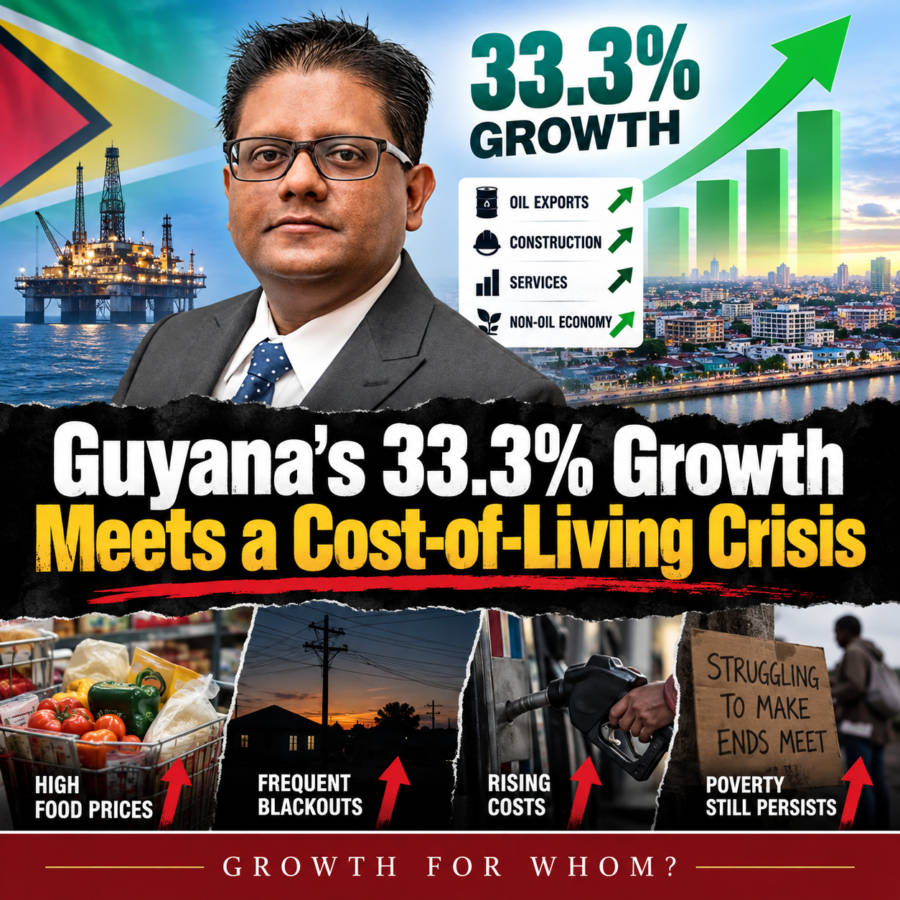
Guyana’s Government is celebrating a 33.3 per cent expansion of the economy in the first half of 2026, but the headline growth figure is likely to raise a more difficult question for ordinary citizens: how much of that extraordinary wealth is actually reaching their daily lives?
The Finance Ministry’s 2026 Mid-Year Report, released Monday, said real GDP grew by an estimated 33.3 per cent during the first six months of the year, while the non-oil economy expanded by 10.1 per cent. The Government has now revised its full-year growth forecast to 20.8 per cent, with non-oil growth projected at 10.2 per cent.
President Irfaan Ali used the figures to declare that Guyana is undergoing a historic transformation.
“This country is on the rise and on the move and my government is going to ensure that Guyana’s position globally and Guyana’s position regionally is not only extraordinary, but one in which all of us will be proud.”
But the Government’s economic success story sits uneasily alongside persistent problems with the basic cost and quality of living.
Growth versus the grocery bill
The Mid-Year Report acknowledges that consumer prices increased 4.4 per cent during the first half of 2026, largely because of higher food prices. Food prices rose 6.7 per cent, according to the Government’s own figures.
The Bureau of Statistics had already recorded food inflation of 5.4 per cent year-on-year in March 2026, while the overall Consumer Price Index was up 2.7 per cent.
That means economic growth and household purchasing power are telling two different stories.
The Government points to a $100,000 grant for adults, higher old-age pensions and public assistance, a higher income-tax threshold and other measures as evidence that it is cushioning households.
Yet cash transfers do not necessarily mean that the underlying cost pressures have disappeared.
Guyana is now an oil-producing economy generating billions of US dollars in export earnings. During the first half of 2026, crude oil exports alone reached US$15.05 billion, an 82.1 per cent increase over the comparable period, according to the Mid-Year Report. Total exports climbed 76.4 per cent to US$16.2 billion.
Oil wealth, unreliable electricity
Perhaps nowhere is the contradiction more visible than electricity.
While the Government promotes its transformation agenda and the Gas-to-Energy project as a pathway to cheaper and more reliable power, Guyanese have continued to endure disruptive outages.
GPL acknowledged last week that peak electricity demand had climbed from 221 megawatts in 2025 to approximately 257 megawatts, placing increased pressure on the distribution network.
The Government says the Gas-to-Energy project is intended to provide a 300-megawatt generation plant and reduce electricity costs.
But for consumers experiencing blackouts today, promised future capacity does not solve the immediate problem.
The irony is particularly stark in a country whose economy is expanding at rates rarely seen anywhere in the world.
The IMF previously described Guyana as having the world’s fastest-growing economy, with real GDP averaging 47 per cent annual growth from 2022 through 2024. It also warned of overheating and inflationary pressures associated with the rapid expansion.
A richer country, but not necessarily a richer household
The Government’s latest figures demonstrate the extraordinary scale of Guyana’s economic transformation. Construction grew 24.7 per cent in the first half, mining and quarrying 40.7 per cent and oil and gas 41.3 per cent.
But GDP growth is not the same thing as household prosperity.
The real test is whether growth translates into affordable food, dependable electricity, functioning infrastructure, quality healthcare, education and secure employment.
The Mid-Year Report itself acknowledges that rising food and energy costs are putting pressure on households.
And Guyana’s development challenge extends beyond the headline numbers. Rapid oil expansion has produced enormous fiscal resources, but it has also intensified questions about whether the country’s transformation is sufficiently inclusive and whether public investment is translating into reliable services.
The Government’s economic figures are undeniably large. But so too are the expectations created by oil wealth.
For a citizen sitting in darkness during another blackout, struggling to keep food affordable or watching household expenses rise, a 33.3 per cent GDP growth rate can seem remarkably distant from economic reality.
Guyana is unquestionably getting richer.
The unresolved question is whether Guyanese households are becoming sufficiently better off to feel it.