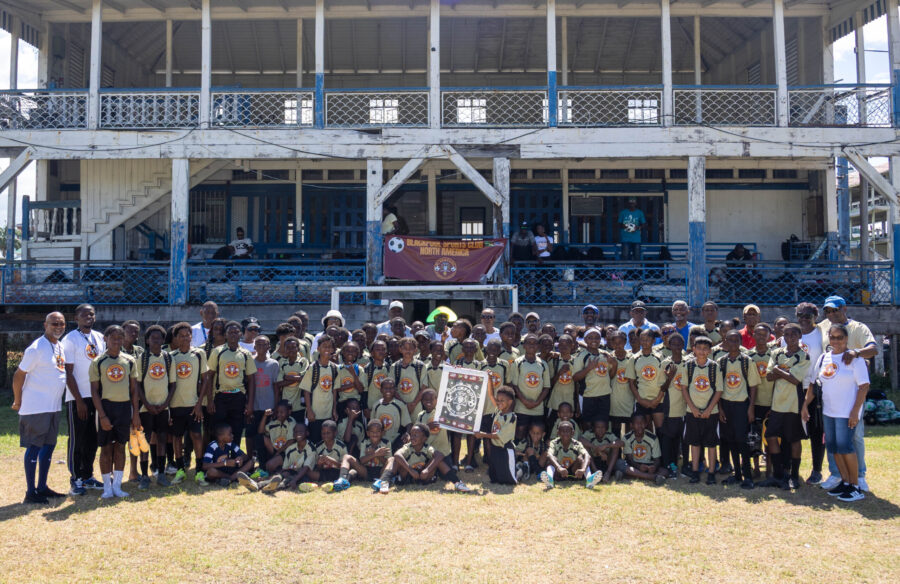
More than half a century after Guyanese footballers in New York came together around their shared love of the game and a commitment to helping one another build new lives abroad, the Blackpool Sports Club of North America (BSCNA) is bringing that same tradition of service home.
In a compelling example of diaspora engagement at the grassroots level, retired Guyanese footballers—several of whom have gone on to become nationally licensed coaches with extensive experience in competitive youth football in the United States returned to Guyana at their own initiative and expense to contribute their knowledge, time and experience to the development of the country’s next generation of players and coaches.
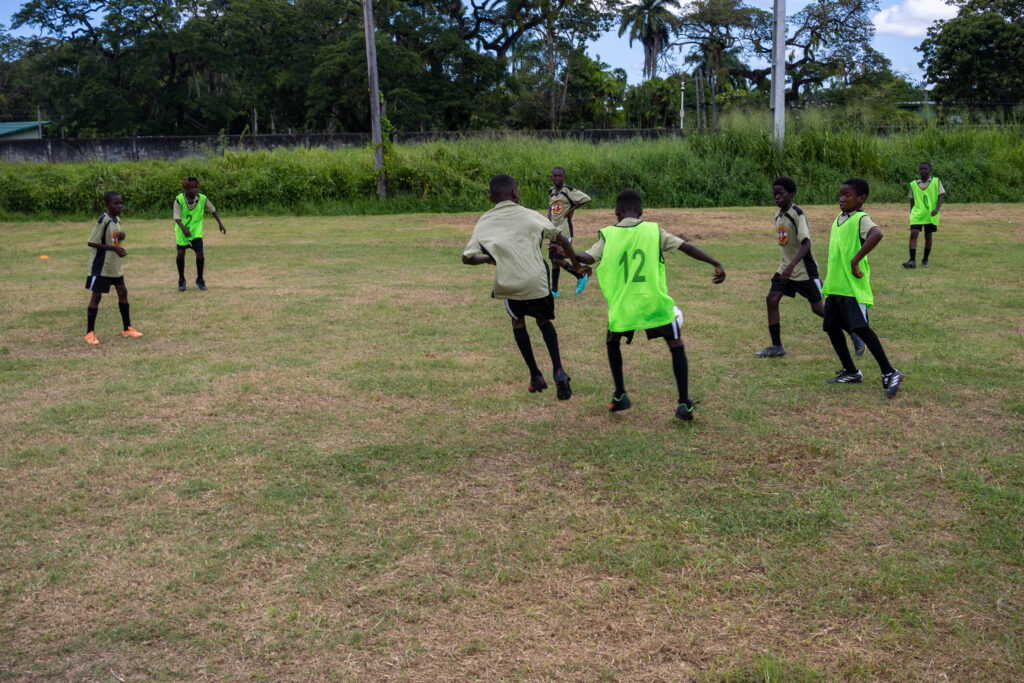
Their vehicle was the BSCNA Youth Football and Life Skills Camp, held for the second consecutive year at the historic Georgetown Football Club (GFC) Ground.
Approximately 70 boys and girls between the ages of seven and 12, drawn from primary-school communities across Georgetown and extending as far as Linden to Buxton on the East Coast, made their way to GFC each day to participate in specialized football training and an accompanying program of life-skills development.
But this was deliberately designed to be much more than a football camp.
The BSCNA initiative rests on a simple philosophy: many of the qualities required to become a better footballer—discipline, preparation, teamwork, resilience, decision-making, respect, confidence and perseverance—are the same qualities that help young people succeed in school, relationships, careers and life.
The result is a program in which football development and life-skills education reinforce each other.
More Than Coaching: Creating a Complete Developmental Environment
BSCNA’s contribution extended considerably beyond bringing experienced coaches to Guyana.
The organization sought to create an environment in which every child could arrive each morning properly equipped, adequately nourished and ready to learn and participate, regardless of individual economic circumstances.
To accomplish this, BSCNA members and supporters undertook the considerable logistical exercise of sourcing and transporting from the United States much of what was required to deliver the program.
Every participating player received a complete football uniform consisting of a jersey, shorts and socks, together with a BSCNA-branded backpack and reusable water bottle.
The visiting coaches also brought from the United States the training equipment necessary to demonstrate and practice the technical fundamentals of football being taught throughout the camp.
This allowed instruction to move beyond explanation into structured, age-appropriate exercises through which young players could repeatedly practice the technical and decision-making principles being introduced.
Equally significant and especially appreciated by the children and those in attendance—was BSCNA’s attention to nutrition and the physical demands placed upon young athletes.
Each day began with a deliberately planned, nutritious breakfast appropriate for active children. Participants were subsequently provided with a morning snack, a similarly thoughtfully planned full lunch, and an afternoon snack.
Considerable attention was paid not only to nutritional value and the need to fuel children participating in repeated periods of physical activity, but also to ensuring that the food was enjoyable and appealing to them. Judging from the response of the young participants, both objectives were achieved.
Nutrition and hydration were themselves part of the educational message. BSCNA wanted participants to begin understanding the relationship between how athletes train, eat, hydrate, rest and prepare and how they ultimately perform.
The meals, snacks, reusable water bottles, uniforms and training equipment were therefore not simply accessories to the football program. They complemented its broader philosophy of developing healthy habits, personal responsibility and good decision-making.
The uniform served another important purpose.
Regardless of school, community, gender, economic circumstances or previous football experience, each child entered the program as an equal participant. Wearing the same kit and carrying the same equipment helped create identity, belonging and the understanding that every participant was valued.
For an organization operating without the resources of a large corporation or international development agency, the scope of this undertaking was significant. Much of what appeared each morning at GFC represented months of preparation, personal expenditure, volunteerism and the physical effort of transporting uniforms, backpacks, bottles, coaching equipment, and other supplies from the United States to Guyana.
Blackpool therefore brought considerably more than coaches to Georgetown.
It brought knowledge for the coaches, instruction for the players, equipment with which to learn, uniforms in which to participate with pride, nutrition with which to perform, and a philosophy that treated each child not simply as a young footballer, but as a young person worthy of investment.
Developing Players—and Developing Those Who Teach Them
An important feature of the BSCNA model is that its impact is not intended to end when the visiting coaches return to the United States.
Local coaches participated alongside their diaspora counterparts and were exposed to structured training methodologies developed and refined by Coach and author Kevin LeDoux, whose work emphasizes age-appropriate player development, purposeful training, decision-making and an understanding of the technical and tactical principles of football.
This coach-mentoring component represents one of the most potentially consequential aspects of the initiative.
Training 70 children can influence 70 young footballers. Helping to develop coaches who will continue working with hundreds of children over successive seasons creates a multiplier effect that can endure long after a single camp has concluded.
BSCNA therefore regards the transfer of coaching knowledge as an essential component of sustainable grassroots development.
Guyana possesses abundant athletic talent. The challenge is to create environments in which that talent can be identified early, taught systematically, and nurtured consistently.
That process begins at the grassroots.
Boys and Girls Belong in Guyana’s Football Future
BSCNA’s vision deliberately encompasses both boys and girls.
The organization believes that the development of football in Guyana cannot reach its full potential unless girls are afforded meaningful opportunities to discover, learn and enjoy the sport alongside boys from an early age.
Grassroots football should therefore serve not simply as a pathway toward elite competition, but as an accessible national platform through which children can become healthier, more confident, and more engaged young citizens.
For some participants, football may ultimately lead to national-team representation, scholarships or professional opportunities. For many others, its lasting value may be the discipline, friendships, physical fitness, confidence, and resilience developed through participation.
Both outcomes represent success.
Diaspora Expertise Answering Guyana’s Call
Across Guyana’s development, there has been increasing recognition of the enormous reservoir of knowledge, professional expertise and experience residing within the Guyanese diaspora.
BSCNA’s initiative represents a practical response to that opportunity.
These former Guyanese footballers did not wait to be recruited. They were not formally commissioned or asked to undertake the project. Consistent with the broader national invitation for Guyanese abroad to contribute their expertise to the country’s development, they identified an area in which decades of accumulated football and professional experience could benefit Guyana—and chose to act.
They returned with coaching knowledge rather than simply nostalgia; with a desire not merely to remember Guyanese football’s past, but to participate in shaping its future.
The second staging of the Youth Football and Life Skills Camp was a resounding success and reinforced BSCNA’s determination to make the initiative sustainable.
The ambition now is to expand the program’s duration, geographic reach, participation of girls and boys, coach-education component, and overall number of beneficiaries, eventually extending opportunities into additional communities throughout Guyana.
That ambition, however, requires partners.
And the story of why BSCNA has assumed this responsibility cannot be fully understood without returning to where Blackpool began more than half a century ago.