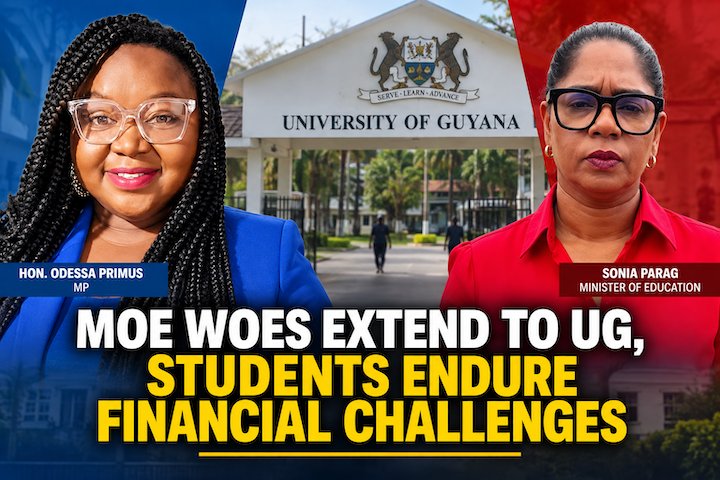
Complaints submitted to Hon. Odessa Primus MP raise questions about examination fees, refunds and old university balances
GEORGETOWN, Guyana: The University of Guyana may now be tuition-free, but complaints submitted to Opposition Member of Parliament Hon. Odessa Primus are raising questions about what students are still required to pay, how those charges are communicated, and what happens when students believe they have been incorrectly charged.
In one of the more troubling complaints, a prospective University of Guyana student says she applied on July 9, 2026, for the Associate of Science in Biology programme and was instructed to pay $30,000 for a Chemistry qualifying examination. According to the complaint, the applicant made the payment at GBTI, obtained a receipt and submitted proof of payment to UG’s Admissions Office, Examination Division and Registry.
What followed, she says, was weeks of uncertainty. Despite emails and repeated visits to the Registry, the applicant alleges that she received no clear information about when the examination would be held and was repeatedly told to wait for an email that never arrived.
The student says she was subsequently informed that she should only have been required to pay $6,000, despite having originally been instructed to pay $30,000.
The complaint therefore raises an obvious question: Why was a prospective student allegedly instructed to pay five times the amount she was later told was required?
The applicant says the matter stretched over approximately two months and ultimately affected her ability to pursue the Biology programme for which she had originally applied. She says she was advised to proceed with another programme and is now being told that recovering the money she paid will require yet another process.
“This entire process lasted approximately two months and caused me a great deal of stress and disappointment,” the applicant wrote in her complaint to Primus. She questioned whether other students may have experienced similar problems involving fees, examinations, communication and refunds.
The allegation should be relatively straightforward for the University to investigate. There should be a record of the qualifying examination fee, the student’s payment and any refund due. It should also be possible to establish whether other applicants were instructed to pay the same amount.
Students also question old balances
A separate complaint submitted to Primus raises another financial issue at UG, this time involving students who accumulated balances before the Government introduced free university education.
A student at the University’s Tain Campus reported being informed that outstanding balances from before the introduction of free UG would have to be cleared before affected students could graduate or receive their certificates.
That complaint raises a different question from the Biology applicant’s experience. There may be a legitimate distinction between tuition becoming free going forward and debts accumulated before the policy took effect. What students appear to need, however, is a clear explanation of precisely what the Government’s free-university policy covers and what financial obligations remain.
If historical balances were not written off, students should know this. UG should also explain whether outstanding balances can prevent students from graduating, receiving certificates or accessing other university services.
The complaints are particularly significant because free university education has been presented as a major expansion of access to tertiary education in Guyana. Removing tuition represents a substantial benefit to Guyanese families, but students should still be able to understand what they owe, why they owe it and what mechanisms exist to challenge an incorrect charge or recover an overpayment.
The issue is therefore larger than whether UG is technically “free.” It concerns the financial administration surrounding the policy.
UG should answer
The University of Guyana should clarify how much applicants to the Associate of Science in Biology programme were required to pay for the Chemistry qualifying examination in 2026 and whether any applicants were instructed to pay $30,000. If the correct charge was $6,000, UG should explain how the higher figure was communicated, whether other students were affected and whether refunds have been issued.
The University should also explain its policy on balances accumulated before tuition became free, including whether those debts remain payable and whether students owing such balances can be prevented from graduating or receiving their certificates.
There is no need for speculation when these matters should be capable of documentary verification.
The complaints submitted to Primus are allegations from students and do not, by themselves, establish wrongdoing by the University. But the details are specific enough to warrant answers.
Free university education is a major public investment. With that investment should come transparent rules, accurate financial information and an administrative system through which a student who pays the wrong amount can have the matter corrected without spending months moving between offices.
For students, “free university” should be a policy they can understand in practice, not one that leaves them wondering which bills disappeared, which remained, what they are still required to pay and how long they must wait to get their own money back.